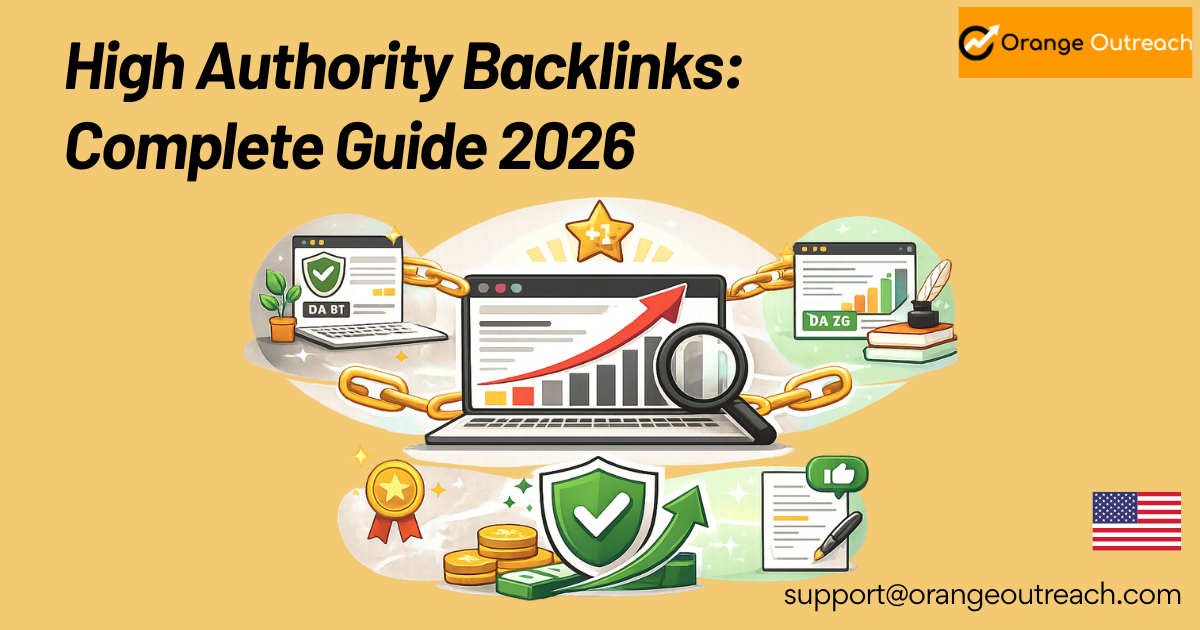
High authority backlinks are links from trusted, reputable websites with strong domain credibility and organic traffic. These links signal trust and relevance to search engines like Google, improving rankings, domain authority, and organic visibility. In 2026, quality outweighs quantity, earning backlinks from authoritative, niche-relevant sites can significantly boost SEO performance, brand trust, and long-term search stability.
Key Takeaways
- High authority backlinks are reputable links that have a domain rating of above 70.
- Content being natural, reputable, and relevant are the three core elements of high authority backlinks.
- The anchor text used for the link gives you an idea about what the linked page is about.
- For high-competition keywords, 100+ high authority backlinks are required.
Guest posting is an effective way to approach high authority backlinks.
Introduction
Do you know, at present, there are around 1.2 billion websites, with over 250,000 new sites created every day?
In this digital crowd, if you want to stand out, securing backlinks organically is one of the most challenging, yet impactful, ways of doing it.
Earning high authority backlinks is the core of search engine optimization (SEO). A topic-relevant link to your website brings value to your business, both in the form of direct referral traffic and in improving your search rankings.
After reading this article you’ll learn
- What are high authority backlinks?
- Types of high authority backlinks
- Safest ways to acquire those links
What are High Authority Backlinks?
A high authority backlink is a link from a reputable website that has a high domain authority (DA) or high domain rating (DR) score of above 70, meaning they’ve been around in this field for a long time and are trustworthy. Authority, here, means the trust and reputation a website has earned in the eyes of Google.
These links can enhance your chances of climbing higher in search rankings.
Also, these links are considered as “votes of confidence.” More number of votes means more spotlight (Google Rankings) for your website.
High authority backlinks look good because they themselves have a lot of quality backlinks from other trusted sources. On top of that, they consistently publish informative, well-researched content.
Some examples of high authority backlink sites include government (.gov) domains, educational (.edu) domains, and major publications like Forbes and The New York Times.
Here, you also need to know that there are three levels of backlinks.
- Low authority backlinks
- Medium authority backlinks
- High authority backlinks
Google strictly classifies low quality backlinks as spam. These are backlinks that have been created in a fake way to manipulate the system. Also, they don’t go with Google’s guidelines. These can be links from new blogs with no established readership.
Medium authority backlinks offer value and are easier to attain than high authority backlinks. These links come from established websites with decent domain authority.
As you know, high authority backlinks provide the most value but are harder to achieve. Because they’re the gold standard. A single high authority backlinks can significantly boost your rankings and drive real referral traffic.
Three Core Elements of High Authority Backlinks
The answer to what makes a high authority backlinks is subjective. How search engines measure them remains vague. But most SEO experts agree that these three elements form a high authority backlink. The backlinks
-
Should Be Natural
Backlinks should always be natural. Because this provides value to their readers. They’re essential for your SEO success.
This differs from unnatural backlinks, where the intent is usually to manipulate the search engines.
If Google detects a backlink as unnatural, it may punish the site, and at times it may even ban the website.
-
Should Be Reputable
What’s more, to be natural, backlinks should be reputable.
Modern search engines follow certain norms to see how credible webpages are. For this, Google has its own PageRank algorithm. This measures the importance and reputation of webpages.
It’s simple: the higher the quality of backlinks a site gets, the higher its chances of ranking at the top.
-
Should Be Relevant
The final core element is that the backlinks should be relevant.
But what does that mean?
This means that while a search engine pays attention to reputation, they also pay attention to relevancy. They review the relevancy of both the page and domain of a backlink.
Understanding What DA and DR Are
Domain Authority (DA) and Domain Rating (DR) remain as two important metrics for link building.
These two are typically used to help identify the right websites for outreach.
Domain Authority (DA) is a search engine ranking metric that gives information about how well a website will rank on search engine result pages (SERPs). DA score ranges from 1 to 100. The higher the score, the more the chances for ranking.
Whereas Domain Rating (DR) shows the strength of a website’s backlink profile. This also scales from 1 to 100. DR has no direct influence on ranking a page on Google. But still, it’s a useful measure to find a site’s link popularity.
How Google Considers a Link as a High Authority Backlink
There are multiple factors in which Google evaluates backlinks and determines whether they carry high authority.
Editorial Placement and Context
The context that surrounds the link matters a lot. Google prefers high authority editorial links that are linked naturally with high-quality content rather than links placed in footers and author bios.
Google’s algorithm then analyzes the surrounding text to make sure the links make sense and add value to the readers.
Anchor Text Optimization
The anchor text one uses for the link gives an idea about what the linked page is about. Here, if you try overly optimized anchor text, it might seem very manipulative. Google favors only natural anchor text that includes branded terms and generic phrases like “click here” that naturally flow within the content.
Content Freshness
The freshness and editorial standards of the linking site matter. Google keeps an eye on this too. A website that is regularly updated with strict guidelines and professional writing gets higher quality than poorly maintained ones.
Remember, sites that follow E-A-T in their content receive better preferences.
The PageRank Algorithm
Google decides which backlinks are high authority by using systems like PageRank. These systems measure how much trust and value a website has based on the quality and number of links pointing to it.
Google looks at a mix of things like the site’s strength, relevancy, and how naturally links are earned. When all of these signals are strong, the links become more valuable for ranking.
User Engagement Metrics
Google is good at evaluating user engagement metrics that are associated with the linking page, such as
- Organic traffic
- Time on page
- Bounce rates
- Click-through rates.
This indicates whether real people find the content valuable.
How Many High Authority Backlinks Are Enough?
I think it’s clear why backlinks matter a lot. Now comes the real question: How many backlinks do we need to make our website authentic?
It is not simple to answer. But it mostly depends on your competition.
- For low keyword competition, 10-30 high authority backlinks are enough.
- For medium 40-80 and
- For high keyword competition, 100+ are required.
Note: If you’ve just started, then build at least 10 good backlinks from trusted sources.
Ways to Get High Authority Backlinks
Now you have reached the important part of the article. How to get high authority backlinks. Here’s how to get it.
Creating Highly Valuable Content
Before anything else, you need to focus on crafting high-value content. No matter how fantastic your pitch is, if your content is trash, no one will link to it.
First, your site should have pillar blog posts that offer significant value to your audience.
Then, create a highly linkable piece of content to use for your outreach. To do that,
- Choose a trending topic that visitors would like to read.
- In the content, include stats, infographics, and authentic sources to boost the trust.
- Add attractive headers and short sentences.
- To make it a shareable one, you can add highlighted quotes and interesting facts.
Note: The more sharable the content is, the easier it will be to get links from high authority sites.
Replace Broken Links with Your Own
This is one of the best and easiest ways to get a high authority backlink.
Make a list of top sites in your industry, and go through their website.
You’ll easily find outdated or broken links that you could replace with your own link. Reach out to the editor or owner of the website and show them which article has a broken link and why they should replace it with your content.
This strategy takes time, and you should be prepared, as it gives slow responses.
For better results, you’ll need to find a link in a more recent article and replace it.
Create Pillar Page
A pillar page is a webpage that covers all aspects of a broad topic on a single page. It serves as the central hub for that subject on your website. It’s also the foundation of a topic cluster.
For example, think of a pillar page as the main chapter in a book. It is designed to give visitors a complete overview of an important topic while organizing all your related content in one place.
The key difference between a pillar page and a regular blog is the structure and purpose.
It is highly recommended for your website to have a pillar page for each content category you write, and each should be highly valuable to readers.
Chances of getting links from such sites are high, so keep putting in your efforts.
Guest Posting
If you prefer a self-build approach, then guest posting is the only way. Find websites that accept guest posting and pitch them your idea. To do it more efficiently, here are a few tips.
- Websites always prefer unique content, so don’t post repetitive content again and again.
- Look for websites in your niche with a high DR.
- Write an intriguing email pitch that goes with the website’s specific guest post guidelines.
- Make sure you choose websites that include a backlink.
Note: Guest posting can be hard work; if done right, you could get your article featured.
Create Skyscraper Content
If you dig in for a trending topic in your niche, you’ll notice that the top results are always long-form articles that cover a lot of information. Also, if you check the site’s DR, you’ll notice that they have a high DR.
To drag those websites out of the top spot, you obviously need to write longer content. This is known as a skyscraper post. This is a great way to get links from websites that have high DA.
You can start with some research on the topic you’re going to write about and figure out what others have written about it.
Next, try to add more stats, more value, and better info graphs to it.
The truth is, it’s hard to create skyscraper posts, but when you have the best content on the topic, websites have no choice other than linking to you.
Acquire Contextual Links
Many sites have an additional resource called the “Read More” section. These sections contain helpful contextual links that provide detailed discussions of specific topics.
For example, a web page about digital marketing will link to additional resources about link building.
Outreach to Bloggers
Another way to get high authority backlinks is through publisher outreach. It involves connecting with bloggers and sending outreach emails to ask them to link to your site.
Here’s how to write an effective outreach email:
First, focus on creating a straightforward one.
- Write an engaging introduction that praises the site’s work.
- Include information about why it’s beneficial for the site owner to link to your site.
- Keep the pitch simple and clear.
- End the email with an encouraging message.
Don’t be discouraged when you don’t get any response. Because your email could’ve been buried somewhere, or the site owner may be busy.
To tackle this, you can send a follow-up email within two to three business days.
Conclusion
SEO constantly evolves; improving your search engine ranking can do a lot for your website. It starts with creating quality content and getting high authority backlinks. Acquiring high authority backlinks is less about quick wins and more about consistent actions.
Consider them as the life support of your digital marketing efforts. They have the potential to promote your content and put your site on top of SERPs. Ignoring the importance of high authority backlinks is a huge blunder.
Remember that high authority link building is a marathon, not a sprint. Results won’t appear overnight. The links that you earn might benefit your site for years to come. They create a solid foundation that complies with algorithm updates and establishes your site as a legitimate one.
Orange Outreach is helping you to deploying the above-mentioned strategies, you can enhance your website’s authority and brand visibility and drive remarkable growth in the competitive digital landscape.
Success comes from patience and the right approach. So, start obtaining a high authority backlink now!!!
Frequently Asked Questions
1. What is a high authority backlink?
A backlink from a website with strong domain authority, trust signals, and consistent organic traffic.
2. Why are high authority backlinks important for SEO?
They improve rankings, increase trust signals, and pass strong link equity.
3. How do you get high authority backlinks?
Through strategic outreach, guest posting, digital PR, and publishing valuable content.
4. Do high authority backlinks guarantee rankings?
No, but they significantly improve your chances when combined with strong on-page SEO.
5. Are high authority backlinks better than multiple low-quality links?
Yes. One relevant high-authority backlink is often more powerful than dozens of spammy links.
6. How long does it take to see results?
Usually 4–12 weeks depending on competition and niche.
Also Read: What are Paid Backlinks in SEO