How Many Backlinks Do You Really Need to Rank in Google in 2026?

How Many Backlinks Do you Need to Rank in Google 2026

How many backlinks do you actually need to rank on Google in 2026? The answer depends on your niche competition, keyword difficulty, and backlink quality and not just quantity. While some low-competition keywords may rank with 10–20 high-quality links, competitive industries often require 100+ authoritative backlinks combined with strong on-page SEO and content depth. In this guide, we break down real-world data, ranking patterns, and practical strategies to help you estimate the right number of backlinks needed to reach page one in 2026.

Key Takeaways

  • There is no fixed rule for how many backlinks to rank on Google.
  • Competitive keywords need stronger backlinks, not just more links.
  • Analysing ranking competitors helps estimate how many backlinks to rank.
  • Better content means fewer backlinks are needed.
  • Quality and relevance decide how many backlinks to rank, not numbers.

Introduction

How many backlinks are needed to rank on Google in 2026 isn’t just a question; it’s one of the biggest SEO puzzles every website owner faces. But here’s the kicker: there’s no magic number that guarantees a top spot. Some sites soar with just a few high quality links, while others struggle despite hundreds. Understanding how many backlinks to rank is not about chasing a number, but about analyzing competition, content strength, and link quality with high authority backlinks.
Get this right, and you won’t just rank, you’ll dominate.

First of all, the number of links you need to rank depends on:

  • Keyword you are trying to rank
  • Strength of the competitors (ranking competitors)
  • Quality of your content
  • Balance of backlink quantity and quality

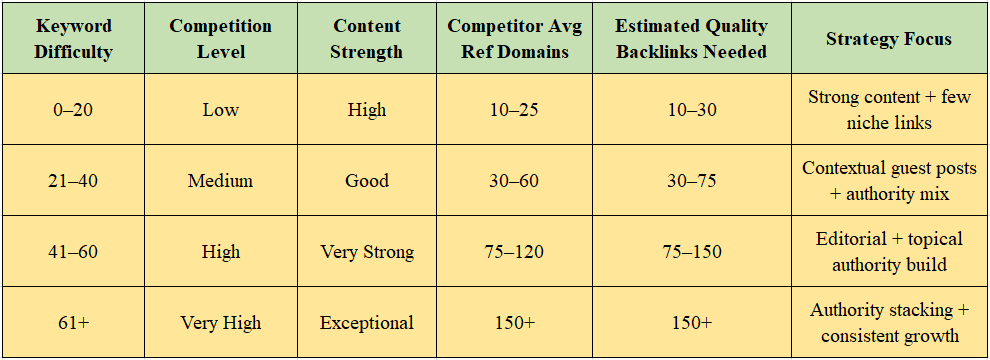
How Many backlinks Do you Need to Rank in Google in 2026 – Table Format

How many backlinks need to rank in google in 2026

Keyword You Are Trying to Rank

  • Higher the keyword difficulty or search volume = More backlinks you need to rank.
  • Lower difficulty or lower volume keywords = Fewer backlinks.

Simply put, if a keyword has high search volume, it means a lot of people are searching for it, and naturally, many websites will compete to capture that traffic. On the other hand, if a keyword has high difficulty, it means the keyword is very competitive, and many websites already have strong content and authority on the topic.

In both cases, the competition is tougher, and simply having great content may not be enough to rank.
Here comes our tie-breaker, “ backlinks”.

When content quality is equal, backlinks are what tip the scales and push your page to the top. This isn’t just a statement; it’s backed by Google’s PageRank Algorithm. When two webpages have equally strong content, Google ranks the page with more high-quality backlinks higher. So, if the keyword you are trying to rank is highly competitive, building more backlinks becomes vital to outperform YOUR COMPETITORS.

So, the keyword you are trying to rank directly helps determine how many backlinks to rank in Google. Understanding this is the first step to building an effective backlink strategy.

Strength of the Competitors (Ranking Competitors)

When it comes to backlinks, Quality matters
Quantity matters
Context also matters

And the right balance between all three is what actually helps you rank. From this, we can understand one more thing:

Backlink count ≠ Backlink strength

This is exactly why understanding how many backlinks to rank requires studying competitor authority, not just their backlink volume.

For example, if your competitor ranks with 40 solid backlinks, you don’t need 200; you just need 40–50 better ones. But here’s the catch: if your competitor suddenly increases their backlink count to 100, should you immediately jump to 150?

No,

Chasing competitors blindly rarely works in the long term. That’s why analyzing the strength of your competitors is vital, but strategically, not reactively.

One important difference you need to understand here is that ranking competitors are different from brand competitors.

Brand competitors:

  • Businesses you compete with in the real world
  • Similar products or services
  • Similar pricing, target audience, or market
  • Important for marketing and positioning, but not always relevant for SEO

Ranking competitors:

  • Pages that appear on page 1 of Google for your target keyword
  • Can include blogs, directories, forums, or new sites
  • Aggregator pages (like Clutch)
  • Sometimes, brands you don’t directly compete with

Why ranking competitors matter more for SEO:

 Google doesn’t care about your real-world competitors. What matters is:

“Which pages best satisfy this search query?”

So, your SEO link building strategy should focus on:

  • Who ranks for your target keyword
  • Their content depth and intent match
  • Their backlink profile
  • Their domain authority and topical relevance

By understanding the strength of your ranking competitors, you can create a smart backlink strategy that focuses on outperforming the right pages rather than blindly chasing numbers, helping you accurately judge how many backlinks to rank for your target keyword and where to invest your efforts for maximum impact.

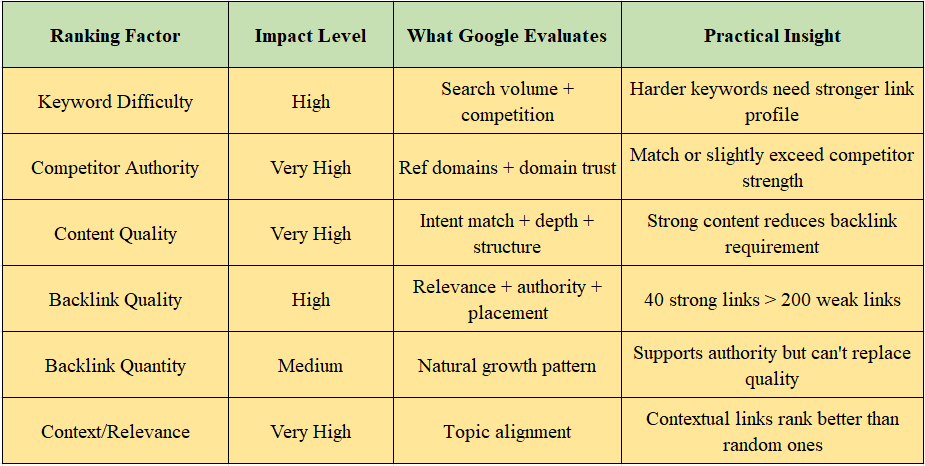
What Actually Decides Rankings (Beyond Just Numbers)

What Actually Decides rankings in google 2026

Quality of Your Content

Content is the backbone of backlinks. No matter how strong the domain linking to you is, the impact of that backlink depends heavily on what it is pointing to. Google doesn’t just evaluate the authority of the linking site; it also evaluates the quality, relevance, and usefulness of the content receiving the link.

High-quality content does three important things at once:

  1. It satisfies search intent
  2. It earns links naturally
  3. It strengthens the value of every backlink you build

If your content is thin, outdated, or less related to the topic, even backlinks from high-authority websites will have limited ranking impact. On the other hand, when your content is in-depth, well-structured, and clearly aligned with the search intent, backlinks act as multipliers, not just signals.

Why content relevance matters for backlinks

Not all backlinks carry the same weight, even if they come from strong websites. Relevance plays a huge role here.

For example:

  • A backlink from a high-authority marketing blog linking to an SEO guide makes sense.
  • A backlink from the same blog linking to an unrelated legal or medical article weakens contextual relevance.

Google looks at:

  • The topic of the linking page
  • The topic of the linked page
  • How naturally the link fits within the content

When backlinks are contextually relevant, Google understands that your page is a trusted resource within that topic cluster. This strengthens topical authority and improves ranking potential for related keywords, not just one page.

Content quality plays a major role in deciding how many backlinks to rank for a keyword

This is a vital point that many people miss.

If your content:

  • Covers the topic better than competitors
  • Answers follow-up questions that users usually search for
  • Is updated, original, and explains the subject well

Then you often need fewer backlinks to rank.

Why? Because Google compares pages comprehensively. When your content is clearly stronger, backlinks become a supporting factor instead of the deciding factor. But if your content is equal, or slightly weaker, backlinks become the tie-breaker.

In short:

  • Weak content → more backlinks needed
  • Strong content → fewer but better backlinks needed

Moreover, backlinks don’t “fix” bad content

Backlinks cannot compensate for:

  • Poor structure
  • Mismatched search intent
  • Thin or generic explanations
  • Over-optimized or spammy writing

If users don’t find your content valid or useful, they will leave quickly, which causes the bounce rate to increase, even if your site has a strong backlink profile. This is why content quality directly influences not just rankings, but ranking stability, and why simply calculating how many backlinks to rank without fixing content gaps often leads to short-term results.

Balance of Backlink Quantity and Quality

One of the most misunderstood concepts in SEO is the idea that you must choose between quantity or quality. In reality, Google evaluates both, along with context and consistency. This is why there is no fixed answer to how many backlinks to rank, because rankings depend on how well these elements work together rather than on a single number.

Why quality alone isn’t enough

High-quality backlinks (from authoritative, relevant websites) are powerful, but relying on only a handful can limit your growth, especially in competitive niches. When people ask how many backlinks to rank, they often overlook the fact that even strong links need support from a natural backlink profile.

For competitive keywords:

  • One or two strong links rarely move the needle
  • Google expects a natural backlink profile that grows over time
  • Multiple trusted sources validating your content matters

Even the best content usually needs a minimum volume of backlinks to prove credibility at scale.

Why quantity alone doesn’t work either

On the flip side, building hundreds of low-quality backlinks:

  • Dilutes backlink strength
  • Raises spam signals
  • Can even harm rankings

Google is extremely good at identifying:

  • Link schemes
  • Paid or manipulative links
  • Irrelevant and low-trust domains

That’s why 200 weak links will never outperform 40 strong, relevant ones.

What the right balance actually looks like

A healthy backlink profile usually includes:

  • A few high-authority editorial links
  • Several mid-authorities, niche-relevant links
  • Natural contextual links within content
  • Gradual growth instead of sudden spikes

This balance is what really answers the question of how many backlinks to rank, not by chasing a number, but by building the right mix of links that signal trust, relevance, and authority to Google.

Context ties quantity and quality together

Context is what connects quality and quantity.

A backlink placed:

  • Inside relevant content
  • Surrounded by topic-related text
  • Pointing to a highly relevant page

Carries more value than multiple random links placed in sidebars, footers, or unrelated articles.

So, the real equation becomes:
Relevant context + strong domains + reasonable volume = rankings

Long-term ranking depends on balance, not chasing numbers

When you truly understand how many backlinks to rank, you stop focusing on link quantity alone and start focusing on sustainable growth.

SEO is not about outnumbering competitors overnight. It’s about:

  • Matching or exceeding their backlink quality
  • Gradually closing the quantity gap
  • Doing both while maintaining content superiority

Conclusion

So, when it comes to how many backlinks to rank, the real answer is this: there is no fixed number you can rely on. Rankings in 2026 are shaped by a combination of keyword difficulty, the strength of your ranking competitors, the depth and relevance of your content, and the balance between backlink quality and quantity. Orange Outreach have the team of experts to build the quality backlinks to increase your authority and rankings.

Instead of chasing numbers blindly, focus on earning better, more relevant links than the pages already ranking. That strategic balance is what truly determines how many backlinks to rank and, more importantly, how long you stay there.

Frequently Asked Questions

1. How many backlinks are needed to rank in 2026?
Low-competition keywords may rank with 10–30 quality backlinks, while competitive niches often require 100+ authoritative links.

2. Is backlink quality more important than quantity?
Yes, a few high-authority, relevant backlinks are more powerful than hundreds of low-quality links.

3. Can you rank without backlinks?
You can rank for very low-competition keywords, but competitive terms usually require backlinks.

4. How long do backlinks take to affect rankings?
Backlinks typically start impacting rankings within 4–12 weeks, depending on authority and crawl frequency.

5. What type of backlinks work best in 2026?
Editorial, niche-relevant, and high-authority contextual backlinks deliver the strongest SEO impact.

Also Read: Finding the Right Link Building Agency in the USA

Link Building Pricing: Guide for 2026 (Includes Orange Outreach Pricing Model)

Link building Pricing

Key Takeaways

  • Link building pricing in 2026 is no longer just about buying backlinks.
  • It’s about investing in authority, relevance, and long-term SEO growth.
  • Costs vary widely depending on quality, niche competition, outreach strategy, and included services.
  • From per-link pricing to monthly retainers and performance-based models, businesses must understand what they are truly paying for.
  • This guide breaks down current pricing trends, hidden costs, and expert opinions to help you make smarter decisions.
  • We’ve also included FAQs to clarify common doubts before you invest in link building.

Introduction

Link building remains one of the most talked-about SEO and link building strategies in 2026. It is also one of the most misunderstood. Businesses often struggle to understand what they should pay and why prices vary so much.

Link Building Pricing has changed over the years. What worked cheaply before can now cause serious ranking issues. Search engines have become stricter about link quality and relevance.

Many guides talk about links but avoid clear numbers and expectations. This creates confusion for business owners and marketers. A clear Link Building Pricing Guide is needed more than ever.

This article explains how link building pricing works in 2026. It breaks down costs, models, and hidden expenses in simple terms. It also shares honest opinions based on current SEO practices.

If you want links that support long-term growth, understanding pricing is essential. This guide will help you make smarter decisions and avoid costly mistakes.

What is Link Building?

Link building is the process of getting other websites to link back to your website. These links are called backlinks. Search engines use them to measure trust and authority.

When a credible and relevant site links to you, it signals value. This helps improve search rankings and organic visibility. Some links can also drive direct referral traffic.

In 2026, link building is not about volume. Search engines now prioritise relevance, context, and editorial placement. A few strong links matter more than dozens of weak ones.

This directly impacts Link Building Pricing. You are not paying only for a link. You are paying for research, outreach, content, and relationship building.

Any reliable Link Building Pricing Guide starts with this clarity. Without understanding link building basics, pricing can feel confusing or unfair.

When done correctly, link building supports long-term SEO growth and brand credibility. When done poorly, it can damage rankings and trust.

How Does Pricing Work for Link Building?

Link building pricing is not fixed. There is no standard rate that applies to every website. Costs depend on effort, quality, and risk involved.

You are paying for more than a backlink. Pricing includes research, competitor analysis, content creation, outreach, and placement. Higher quality links require more time and skill.

In 2026, Link Building Pricing is influenced heavily by link quality. Editorial links from trusted sites cost more because they are harder to earn. Automated or bulk links are cheaper but risky.

Some providers charge per link. Others offer monthly packages or custom campaigns. Each pricing method suits different goals and budgets.

A good Link Building Pricing Guide focuses on value, not just numbers. Cheap pricing often means low-quality sites or private networks.

Understanding how pricing works helps you avoid shortcuts. It also helps you invest in links that support long-term SEO growth.

Key Factors That Affect Link Building Pricing

Several factors influence how much you pay for link building. Understanding these helps explain why prices vary so widely. It also helps you judge whether Link Building Pricing is reasonable.

Website authority plays a major role. Links from strong, trusted websites cost more. These sites are harder to access and protect their reputation.

Niche and industry also affect pricing. Competitive niches like finance, health, and SaaS require more effort. This increases overall costs compared to local or low-competition niches.

Type of link matters as well. Guest posts, editorial links, niche edits, and resource links all require different levels of outreach and approval. Editorial links usually cost the most.

Link quality signals influence pricing strongly in 2026. Relevance, organic traffic, and natural placement increase value. These links take time to earn.

Any reliable Link Building Pricing Guide considers all these factors. Ignoring them often leads to poor results or penalties.

Orange Outreach’s Link Building Pricing Models in 2026

Link building services follow different pricing models based on scope and goals. In 2026, flexibility matters more than fixed packages. Choosing the right link building agency will helps to control cost and quality. Let’s Explain the Orange Outreach’s Link Building Pricing in 2026

Per-link pricing is one of the most common models. You pay for each approved backlink. Prices depend on site authority, traffic, and relevance. In 2026 high quality US backlinks typically ranges between $100 to $600 per link. While premium placements on high authority publications can cost $700 to $1500 per link. This model works well for the targeted campaigns.

Monthly retainer pricing focuses on ongoing link building. You pay a fixed monthly fee for outreach, content, and links. In 2026 retainers usually range from $1300 to $5000 per month for small and mid-size campaigns. While competitive industries may require $6000 to $10000 per month. These suits businesses aiming for steady growth.

Performance-based pricing links cost to results like rankings or traffic. It sounds attractive but carries risk. Search results depend on many factors beyond links. Typical base pricing starts around $1,000 to $3,000 per month, with additional incentives tied to results.

Custom campaign pricing is used for large or complex projects. These campaigns are tailored to niche, competitors, and goals. This model is common for brands and enterprises. These projects usually start at $5,000 per month and can exceed $20,000+ per month depending on scope, quality and scale.

A good Link Building Pricing Guide explains which model fits your needs, not just your budget.

CTA 1


Hidden Costs in Link Building You Should Know About

Link building costs are not always transparent. Many businesses focus only on the link price and ignore extra expenses. This can lead to budget issues later. Let’s reveal the Orange Outreach’s Cost for Link building and Content writing services.

Content creation costs are often separate. Quality articles are needed for guest posts and editorial links. In the US market (2026), professional SEO content writing typically costs $150 to $400 per article (800–1,200 words). Highly technical or SaaS content can range from $500 to $1,000+ per article. Well-researched content increases approval chances and pricing.

Outreach and tools also add to the cost. Email tools, prospecting software, and manual follow-ups require time and resources. These costs are built into higher-quality services. Most of the agencies can cost from $300 to $1000 per month. When hiring the services these operational costs are usually built into pricing. For high-quality manual outreach campaigns, this can add $50 to $150 per link indirectly.

Link replacement guarantees can affect pricing. Some providers offer replacements if a link is removed. Orange Outreach offers 6 months to 12 months replacement guarantee with ZERO Cost if links are removed. This protection often increases overall cost.

Reporting and tracking are another hidden factor. Detailed reports, traffic checks, and link monitoring take effort. Reliable reporting adds value but also increases pricing. Comprehensive reporting packages can add $200 to $750 per month to campaign costs, especially in retainer models.

Content editing and publisher fees may also apply. Some high-authority publishers charge editorial review or publishing fees ranging from $50 to $300 per placement, separate from outreach costs.

A transparent Link Building Pricing Guide highlights these costs upfront. Knowing them helps you compare services fairly and avoid surprises.

Note: Orange Outreach pricing is structured differently from typical US market models. Under Orange Outreach’s pricing model, the article cost includes content writing, publisher placement fees, reporting and tracking, outreach tools, and a link replacement guarantee.

For example, if the article publishing cost is $150, you only pay $150. There are no hidden fees or additional charges. All services are included in the quoted price, providing full transparency and predictable budgeting.

Orange Outreach’s Transparent Pricing Model for Link Building

CTA 4


  • Get high-quality backlinks without worrying about hidden fees or surprise charges.
  • With Orange Outreach, what you see is exactly what you pay – complete transparency, guaranteed.
  • Ready to build authority the smart way? Let’s start your link building campaign today.
    Signup Now


How to Judge If Link Building Pricing Is Fair

Fair link building pricing is about value, not just cost. A low price does not always mean a good deal. High pricing also does not guarantee quality.

Start by asking where the links will come from. Reputable providers share sample sites or metrics. Vague answers are a warning sign.

Check if content creation is included. Quality content improves placement success and link value. If content is rushed or reused, pricing may not be justified.

Transparency matters in 2026. Clear timelines, reporting, and replacement policies show professionalism. These factors support higher Link Building Pricing.

Compare pricing with effort involved. Manual outreach and editorial placements take time. Automated links should not cost the same.

A trustworthy Link Building Pricing Guide helps you focus on relevance, authority, and long-term impact. If pricing supports these goals, it is usually fair.

How Orange Outreach Pricing Is Different

CTA 3

Conclusion

Link building remains a key part of SEO in 2026, but pricing has become more complex. Search engines now reward quality, relevance, and natural placements. This has changed how link building is priced.

There is no one-size-fits-all cost. Link Building Pricing depends on authority, niche, link type, and effort involved. Cheaper options may look attractive but often carry long-term risks.

A clear Link Building Pricing Guide helps you understand what you are paying for. It also helps you avoid shortcuts that can harm rankings. Transparency and value should always come first.

Businesses should view link building as an investment, not an expense. When done correctly, it supports sustainable growth and brand trust.

Choosing the right pricing model and provider makes all the difference. Focus on quality and consistency for lasting results.

Frequently Asked Questions

1. How much should I pay for one backlink?

The cost of a single backlink varies widely. In 2026, prices depend on website authority, relevance, and traffic. High-quality editorial links usually cost more than basic guest posts. Always focus on value, not just price.

2. Is link building still worth the cost in 2026?

Yes, link building is still valuable when done correctly. Search engines continue to use backlinks as a ranking signal. Ethical link building supports long-term visibility and trust.

3. Are monthly link building packages safe?

Monthly packages can be safe if they focus on quality and relevance. Avoid packages that promise high volumes at low prices. Slow and steady link growth works best.

4. Why do prices vary so much?

Prices vary due to niche competition, link type, and effort required. High-authority sites demand more effort and stricter standards. This naturally increases pricing.

5. Can cheap link building harm my site?

Yes, cheap links often come from low-quality or spammy sites. These can trigger penalties or ranking drops. Recovery can be expensive and time-consuming.

6. How many links do I need per month?

There is no fixed number. The right amount depends on competition and website age. Quality matters more than quantity in modern SEO.

Also Read: Link Building Strategies 2026

Top 10 Best Link Building Agencies in the USA 2026

Link building Agencies in USA

Choosing the right link building agency in the USA can significantly impact your website’s search visibility, authority, and long-term organic growth. With Google’s increasing focus on quality, relevance, and trust, businesses must partner with agencies that follow ethical, data-driven link building practices. This guide to the Top 10 Link Building Agencies in the USA is curated based on industry experience, proven results, transparency, outreach quality, and client success. Whether you’re a SaaS brand, enterprise website, or digital marketing agency, this list helps you identify reliable link building partners that deliver sustainable SEO results.

Key Takeaways

  • Backlinks in 2026 are all about trust and quality, and you need the best link building agencies that meet your expectations.
  • The backlinks on your website act as votes in the eyes of search engines.
  • Even well-written content struggles to rank, and it needs to employ link building to promote itself.
  • Always vet the link building well before hiring them.

Table of Contents

  1. Introduction
  2. What Is Link Building?
  3. The List of Top 10 Link Building Agencies in USA to Hire in 2026
  4. Final Thoughts
  5. Frequently Asked Questions

Introduction

In the world of digital marketing, backlink acquisition remains one of the most crucial elements of SEO, helping virtually every business out there to gain visibility in the search rankings and anchor themselves in the endless sea of marketing brands.

The backlinks game used to be all about volume. Businesses were just getting backlinks by any means left and right for the attention of the search engines. However, you as a reader might even be aware that it’s not the case anymore.

Backlinks in 2026 are all about trust and quality. You need high-quality backlinks to survive in this competitive market, and for that, you need to vet some of the best link building agencies and filter which agency meets your needs and expectations.

We have listed the top 10 best link-building agencies that may just satisfy your marketing needs.

What Is Link Building?

In search engine optimization, link building is one of the primary techniques to gain hyperlinks from relevant, authoritative websites, especially in your relevant niche. These links act as votes in the eyes of search engines.

The more high-quality links a website has from reputable sites, the higher the votes the site gets. These links drive traffic and boost their authority overall.

Sometimes, even the best-written content can struggle to rank in search engines, which is why businesses hunt for the best link-building agencies that don’t use spammy or harmful link-building methods and a reputable agency that actually offers you long-term results.

The listed agencies in this blog were carefully vetted through well-known review platforms and industry lists on the internet. Based on your needs, these link building agencies may be your best shot at getting your brand ranked.

CTA 1

The List of Top 10 Link Building Agencies in USA to Hire in 2026

1. Orange Outreach

Orange Outreach is a US-based SEO and link-building agency specializing in white-labelled off-page SEO services for businesses, offering manual, high-quality guest posts and link acquisition to improve search engine rankings.

Services offered

  • They offer a comprehensive white-label link-building service that is tailored for agencies needing to fulfill client demands without internal resources.
  • Securing high-quality contextual links through blogger outreach and guest posting.
  • Focusing on increasing your site’s domain authority through reputable and manual outreach.
  • Customized backlink packages that are tailored to your particular brand’s niche-specific needs with unique strategies to secure links.

Pricing: Orange Outreach offers flexible link building packages, including both monthly plans and individual placements, tailored to meet different business needs.

High-quality link building typically starts at $100 per post, depending on the website authority and niche relevance. All packages include 100% original content writing and ethical outreach.

Popular Packages:

5 Post Package: $375

15 Post Package: $1,275

20 Post Package: $2,275

In addition to these, multiple custom and monthly packages are available at Orange Outreach to suit agencies, SaaS companies, and growing brands.

Why Orange Outreach Is the Best

  • They focus on real, editorial, and manual outreach rather than relying on spammy Private Blog Networks (PBNs).
  • They offer faster turnaround times, solving a key pain factor for businesses that need quick results.
  • Orange Outreach acts as an extension of your team, offering customized solutions rather than a one-size-fits-all approach, aiming for their client’s success as the ultimate goal.
  • By being exclusively, the best link-building agency, they provide your business deep expertise in this specific area of SEO.
  • They have a strong track record of helping clients reach their SEO goals and build sustainable links.

Outreach Quality: The agency offers fully white-hat methods with relationship-driven and manual outreach services.

Niches Served: Orange Outreach is expertized in a diverse range of niches that include Tech, Travel, HVAC, Real Estate, Casino, Law, Lifestyle, CBD, SaaS, Finance, and Healthcare.

DR: Orange Outreach has the 20000+ sites in their Database from different Niche’s and it varies in DR 20 to DR 95.

Link Building Service Locations: Los Angeles, California, Florida, Kansas, Colorado, New York, Virginia, Arizona, Washington DC, San Diego and All the Cities in USA.

Website: https://orangeoutreach.com/

Location: Denver, Colorado, USA

Pros:
  • 100% Manual White hat Outreach process and best for Law, SaaS, Travel, Healthcare, Home Improvements and all niches.
  • Premium link placements on high quality and authority sites.
  • Flexible pricing options, starts from low budget and trial pack also available (good for SMB’s and agencies).
  • Inhouse content and Outreach gives better quality control.
  • Focused on Digital PR, Editorial link, Niche relevant contents gives the quality link acquisition.
  • Maintaining the huge database for a enterprise firms and small agencies.
  • Offering Services in all locations of USA and having the good case studies.
Cons:
  • Primarily specialized in link building and SEO services rather than full-stack digital marketing services.
  • Best suited for businesses that value long-term authority building over quick-win tactics.
  • Focuses more on quality placements rather than rapid-scale link acquisition.

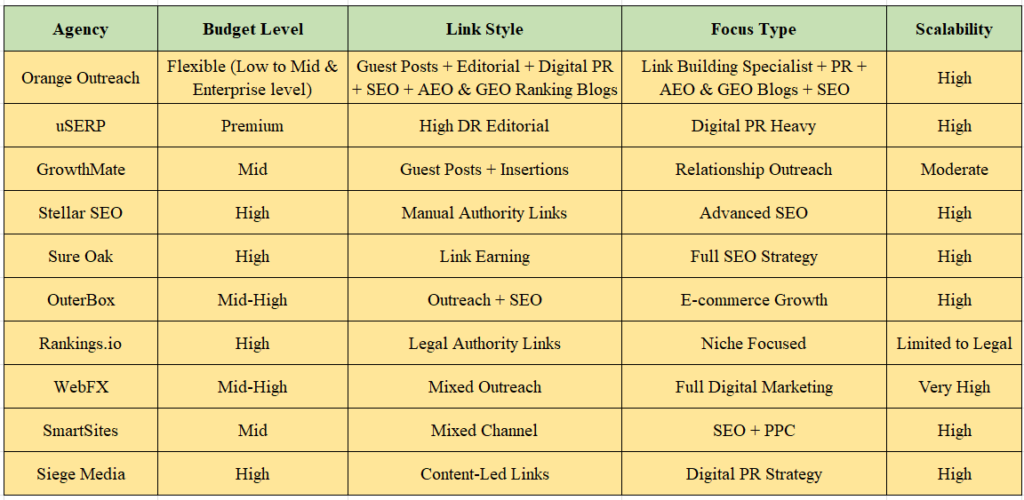
link building agencies in the USA table

2. uSERP

uSERP is a premium agency that has been constantly ranked as one of the best link-building agencies in many industry-lists. They’re known for acquiring high-authority backlinks from reputable sites with a DR of 60 to 90 and digital PR for businesses.

Services Offered

  • The core service of uSERP is to secure high-quality white-hat backlinks from editorial outreach, guest post contributions, and using their relationship and contacts in multiple niche industries.
  • They develop content for businesses besides link building, aimed to rank your site in search engine rankings, including data-driven content and resource page development.
  • Complete performance-driven strategies, full SEO and audit analysis, focusing on Key Performance Indicators (KPIs) like Monthly Recurring Revenue (MRR) and qualified leads.

Why is uSERP at #2?

Clients across the internet show unanimous satisfaction with uSERP, saying that their timely project delivery and strategies helped their businesses achieve the traffic and domain authority they strived to get.

Outreach Quality: High-end link-building agency that specializes in acquiring high-authority backlinks.

Niches Served: B2B software, SaaS, Tech, Cybersecurity, Financial Services, and Media & Publishing.

Pricing: Monthly retainers start at $1,000 a month on average and also Minimum project size starts at $10,000.

Website: https://userp.io/

Pros:

  • Premium link placements on high authority sites.
  • strong digital PR and SEO
  • Excellent results in SaaS and B2B niches

Cons:

  • Very high cost (Starts from $5000 per month)
  • Not ideal for small businesses and budgets.
  • Charges separately for content writing and other tools.

3. GrowthMate

A fast-growing and one of the highly regarded SEO-link building agencies in 2026, they are particularly known for securing links from reputable sites such as G2, Smashing Magazine, HubSpot, and Envato.

The agency brands itself with the capability of securing links with a domain rating of at least 50, with an average DR of 72.

Services Offered

  • GrowthMate focuses on relationship-based link building and secure placements from high-authority sites.
  • They create content and secure your site placements on reputable sites through guest postings.
  • They also offer link insertion services. They place your links within the existing and relevant content of other sites.

Why Is GrowthMate #3?

Clients have reported their ability to produce tangible results quickly, with some reports showing a 100% increase in organic traffic. Reviews for the agency showcase their structured workflows, proactive communication, and responsiveness to feedback.

Outreach Quality: They adhere to fully white-hat practices and avoid any harmful tactics that could lead to penalties, ensuring links are sustainable.

Niches Served: B2B, Healthcare, Tech, Data Analytics, E-commerce, and Consumer Experience industries.

Pricing: Hourly rating for the agency ranges from $50 to $99, while the minimum monthly project size starts at $1,000.

Website: https://growthmate.io/

Pros:

  • Relationship based outreach
  • White hat link building
  • Faster results and impact in many niches

Cons:

  • Pricing starts from $4000 per month
  • may not scale in huge enterprises
  • Less brand name recognition than bigger agencies

4. Stellar SEO

Founded in 2012, Stellar SEO was recognized as one of the fastest-growing companies on the Inc. 5000 list in 2024 and 2025.

Services Offered

  • Personalized, manually built, and vetted link-building campaigns for clients.
  • Scalable white-label services for digital marketing agencies.
  • High-quality guest posting with a guaranteed link placement.
  • They also offer blogger outreach, content marketing, and niche edits.

Why Is Stellar SEO at #4?

They use a proprietary methodology called the Entity-Driven Link Building System, which applies Generative Engine Optimization (GEO) principles, ensuring links act as trusted citations for Google and AI-driven search environments, making them one of the most sought-after link-building agencies.

They have a proven track record of helping clients recover from algorithm updates.

Outreach Quality: They focus on manual, white-hat link acquisition, having built over 25,000 links for clients without incurring penalties.

Niches Served: Legal Services, Finance, Tech, E-commerce, Healthcare, Insurance, Retail, B2B, and SaaS.

Pricing: Hourly rates are reportedly $100 to $149, and the minimum project size starts from $10,000+.

Website: https://stellarseo.com/

Pros:

  • Personalized and manual backlink building process
  • proven record with manual link building
  • Good for SaaS, IT, and healthcare sectors

Cons:

  • Very high entry cost (starts from $10000 per month / project)
  • Not suited for startups and micro budget clients.
  • Serving in particular locations of the USA

5. Sure Oak

Sure Oak is a New York-based digital marketing agency specializing in high-end SEO services. They’re known for their bespoke, data-driven approach, focusing on long-term and transparent partnerships.

Services Offered

  • They focus heavily on technical and on-page SEO services.
  • They primarily focus on high-quality link-building, earning campaigns, and development.
  • Content development and optimization.

Why Is Sure Oak at #5?

85% of their clients report positive testimonials about their services, explaining how their website’s online visibility and authority were boosted by the agency’s timely delivery and service overall.

Outreach Quality: Genuine industry relationships-driven strategies with link reclamation.

Niches Served: Insurance, B2B, Tech, Finance, Healthcare, E-commerce, Retail, Education, and Professional Services.

Pricing: Most of their projects fall between $10,000 and $49,999. Hourly rates are roughly $100-$149.

Website: https://sureoak.com/

Pros:

  • Data-driven transparent strategies
  • Clients report and improving authority and rankings
  • Good for Mid-size companies

Cons:

  • Expensive on long term retainers
  • ROI may take time to show
  • Less focus on purely link building services

6. OuterBox

They are one of the widely top-rated link building agencies expertized in e-commerce search engine optimization. They’re a Google Premier Partner Agency with an in-house team of 250+ employees.

Services Offered

  • They specialize in e-commerce SEO, on-page optimization, link building, and organic growth strategies.
  • They manage Google Ads and other paid campaigns to drive traffic and conversions.
  • Offer custom web design and e-commerce development.
  • Analyze your website and improve it to increase more sales or leads.
  • They develop e-mail marketing campaigns to retain customers.

Why Is OuterBox at #6?

They are often ranked as one of the best link building agencies and e-commerce SEO companies by industry sources. They report an average traffic increase of 273% and influence over $2 billion in sales.

Outreach Quality: Their team focuses on research, networking, and building genuine relationships on behalf of a client.

Niches Served: Mainly E-commerce, Retail, and B2B.

Pricing: The pricing model generally starts from $2,000 to $7,000 for SEO, and the basic PPC package starts from $1,500.

Website: https://www.outerboxdesign.com/

Pros:

  • Very strong in Custom and E-commerce SEO services
  • Inhouse team with PPC and SEO integration
  • Great reporting and analytics

Cons:

  • pricing starts high ($4000 per month)
  • Bigger team might means lesser in customer centric and clients touch.

7. Rankings.io

Rankings.io particularly focuses on driving organic and high-value search results for law firms, specifically personal injury practices. They’ve been recognized on the Inc. 5000 list, and that earned them a place on the best link-building agencies list.

Services Offered

  • Their primary focus is technical SEO, on-site optimization, and acquiring high-quality backlinks to boost authority and rankings.
  • They manage Google and Local Services Ads for businesses.
  • Offer social media marketing and pay-per-click (PPC) optimization.

Why Is Rankings.io at #7?

Many clients of rankings.io have reported rapid growth in their search engine rankings, even reaching as high as in top pages on Google key terms, which makes them one of the best link building agencies here, especially for law businesses.

Outreach Quality: They provide high-quality services for legal-related businesses.

Niches Served: Their primary focus is on personal injury law firms.

Pricing: Minimum monthly project sizes start from $5,000 with an average hourly rate of $150 to $199.

Website: https://rankings.io/

Pros:

  • Primary focus on all types of Niches
  • High technical SEO and link synergy
  • strong authority building process

Cons:

  • Very Vertical Specific in all niches (less number of databases)
  • Limited general business use.
  • Higher rate structure (starts from $5000 per month)

8.  WebFX

Headquartered in Harrisburg, Pennsylvania, the agency was founded in 1996. With over 30 years of experience and a team of 600+ experts, they focus on ROI-driven results and have a reputation for being a one-stop shop.

Services offered

  • Technical, local, and international SEO services with backlink management.
  • Pay-per-click advertisement across platforms like Google Ads and Bing Ads.
  • Content and social media marketing services.
  • E-mail marketing services and AI consultation.

Why Is WebFX at #8?

They have proven results of generating over $10 billion in revenue for their clients and 24+ million leads. The agency is also actively adapting to the AI-driven market right now, which makes it one of the best link building agencies right now.

Outreach Quality: High-quality revenue-driven outreach services.

Niches Served: Manufacturing, Healthcare, E-commerce, Retail, Tech, and SaaS.

Pricing: Their monthly retainers generally start at $3,000. Clutch reports that their minimum project size starts at $1,000.

Website: https://www.webfx.com/

Pros:

  • Huge Experience in SEO domain
  • One stop solution for SEO, PPC and link building
  • ROI focused and bigger revenue growth reported.

Cons:

  • Can be expensive for small size agencies
  • Not purely link building focused
  • Too broad for highly niche campaigns.

9. SmartSites

Founded in 2011, SmartSites is a highly rated SEO and PPC-focused digital marketing and link-building agency. They’re a Google Premier Partner, a Microsoft Advertising Select Partner, and a Facebook Marketing Partner.

Services Offered

  • Comprehensive SEO services including technical audits, link building, local SEO, e-commerce SEO, and content writing.
  • Pay-per-click advertisement on Google, Bing, and Facebook with a focus on maximizing ROI.
  • Paid social media advertising and management.

Why Is SmartSites at #9?

They’ve been named on the Inc. 5000 list as the fastest-growing companies in America for nine consecutive years from 2017 to 2025. They manage over $500 million in paid search and 500% increases in leads or sales for some clients.

Outreach Quality: Their outreach combines SEO, PPC, and content marketing to drive tangible results and improve search engine rankings.

Niches Served: Home Services & Construction, E-commerce, Retail, Healthcare, Education, Automotive, SaaS, and Finance.

Pricing: For SEO and PPC, their average monthly services start at $1,000 to $2,000, while their web designs exceed $10,000.

Website: https://www.smartsites.com/

Pros:

  • Focusing on multiple channels SEO, PPC, link building
  • Proven growth and high ratings
  • strong partner certifications

Cons:

  • Not purely on link building services
  • High monthly cost and may include extra charges.
  • Not ideal for small and mid size firms.

10. Siege Media

Founded in 2012, Siege Media offers content-driven and digital PR link building services for their clients. Being one of the top content-focused link-building agencies, they target keywords that drive actual revenues and conversions.

Services Offered

  • Creating, designing, and promoting content that passively generates links over time.
  • High-quality link building on authoritative websites through digital PR link building.
  • Comprehensive technical audits and SEO services.

Why Is Siege Media at #10?

They have worked with major brands including Airbnb, TripAdvisor, Zillow, Postmates, and Square. Reported case studies show that they have consistently delivered 40%-60% organic traffic increases in six months.

Outreach Quality: Their outreach quality is tied to creating infographics, data studies, and in-depth guides that naturally earn links.

Niches Served: SaaS, Tech, E-commerce, Finance, B2B, and general consumer industries.

Pricing: Their minimum project size starts at $5,000, while hourly rates range from $100 to $149.

Website: https://www.siegemedia.com/

Pros:

  • Powerful content led link building process
  • Great for branded authority links
  • works with big brands and large content assests.

Cons:

  • Not cheap ( focusing enterprise level budgets)
  • Slower than bulk guest post methods.
  • Best for PR strategies not all kind of link building.

Pricing & Focus Breakdown Table for Link building agencies in the USA 2026

Link Building Agencies USA Pricing Focus Breakdown

Final Thoughts

Selecting the right link building agency is not just about backlinks—it’s about choosing a long-term SEO partner that understands quality, relevance, and Google’s evolving guidelines. While all the agencies listed above offer strong capabilities, Orange Outreach stands out for its transparent process, white-label support, niche-relevant outreach, and proven results for US-based businesses and agencies. With flexible pricing, in-house content creation, and a focus on sustainable link building, Orange Outreach is a trusted choice for brands looking to scale organic growth safely and consistently.

Frequently Asked Questions

  1. What Are Link Building Agencies?

SEO firms that work to secure a high-quality placement on reputable and high-authority sites for your business to increase website traffic and search engine rankings are called link-building agencies.

  1. Why Do Businesses Need Link Building Agencies?

Every business needs leads or sales and visibility in the online world as a whole. Link-building agencies acquire these quality backlinks for businesses without them having to put in the time, effort, and an in-house team for it.

  1. What Are the Best Link Building Agencies in the USA in 2026?

Orange Outreach, uSERP, GrowthMate, Stellar SEO, Sure Oak, OuterBox, Rankings.io, WebFx, SmartSites, and Siege Media.

  1. What is the Average Price for a link-building service in 2026?

While basic per-links cost $100 to $200, high-authority and editorial placements can exceed $1,500. Average monthly retainers range from $3,000 to 15,000.

Also Read: Finding the Best Link Building Agency in USA

High Authority Backlinks: Complete Guide to Building Quality Links in 2026

High Authority Backlinks

High authority backlinks are links from trusted, reputable websites with strong domain credibility and organic traffic. These links signal trust and relevance to search engines like Google, improving rankings, domain authority, and organic visibility. In 2026, quality outweighs quantity, earning backlinks from authoritative, niche-relevant sites can significantly boost SEO performance, brand trust, and long-term search stability.

Key Takeaways

  • High authority backlinks are reputable links that have a domain rating of above 70.
  • Content being natural, reputable, and relevant are the three core elements of high authority backlinks.
  • The anchor text used for the link gives you an idea about what the linked page is about.
  • For high-competition keywords, 100+ high authority backlinks are required.

Guest posting is an effective way to approach high authority backlinks.

Introduction 

Do you know, at present, there are around 1.2 billion websites, with over 250,000 new sites created every day?

In this digital crowd, if you want to stand out, securing backlinks organically is one of the most challenging, yet impactful, ways of doing it.

Earning high authority backlinks is the core of search engine optimization (SEO). A topic-relevant link to your website brings value to your business, both in the form of direct referral traffic and in improving your search rankings.

After reading this article you’ll learn

  • What are high authority backlinks?
  • Types of high authority backlinks
  • Safest ways to acquire those links

What are High Authority Backlinks?

A high authority backlink is a link from a reputable website that has a high domain authority (DA) or high domain rating (DR) score of above 70, meaning they’ve been around in this field for a long time and are trustworthy. Authority, here, means the trust and reputation a website has earned in the eyes of Google.

These links can enhance your chances of climbing higher in search rankings.

Also, these links are considered as “votes of confidence.” More number of votes means more spotlight (Google Rankings) for your website.

High authority backlinks look good because they themselves have a lot of quality backlinks from other trusted sources. On top of that, they consistently publish informative, well-researched content.

Some examples of high authority backlink sites include government (.gov) domains, educational (.edu) domains, and major publications like Forbes and The New York Times.

Here, you also need to know that there are three levels of backlinks.

  • Low authority backlinks
  • Medium authority backlinks
  • High authority backlinks

Google strictly classifies low quality backlinks as spam. These are backlinks that have been created in a fake way to manipulate the system. Also, they don’t go with Google’s guidelines. These can be links from new blogs with no established readership.

Medium authority backlinks offer value and are easier to attain than high authority backlinks. These links come from established websites with decent domain authority.

As you know, high authority backlinks provide the most value but are harder to achieve. Because they’re the gold standard. A single high authority backlinks can significantly boost your rankings and drive real referral traffic.

Three Core Elements of High Authority Backlinks

The answer to what makes a high authority backlinks is subjective. How search engines measure them remains vague. But most SEO experts agree that these three elements form a high authority backlink. The backlinks

  1. Should Be Natural

Backlinks should always be natural. Because this provides value to their readers. They’re essential for your SEO success.

This differs from unnatural backlinks, where the intent is usually to manipulate the search engines.

If Google detects a backlink as unnatural, it may punish the site, and at times it may even ban the website.

  1. Should Be Reputable

What’s more, to be natural, backlinks should be reputable.

Modern search engines follow certain norms to see how credible webpages are. For this, Google has its own PageRank algorithm. This measures the importance and reputation of webpages.

It’s simple: the higher the quality of backlinks a site gets, the higher its chances of ranking at the top.

  1. Should Be Relevant

The final core element is that the backlinks should be relevant.

But what does that mean?

This means that while a search engine pays attention to reputation, they also pay attention to relevancy. They review the relevancy of both the page and domain of a backlink.

Understanding What DA and DR Are

Domain Authority (DA) and Domain Rating (DR) remain as two important metrics for link building.

These two are typically used to help identify the right websites for outreach.

Domain Authority (DA) is a search engine ranking metric that gives information about how well a website will rank on search engine result pages (SERPs). DA score ranges from 1 to 100. The higher the score, the more the chances for ranking.

Whereas Domain Rating (DR) shows the strength of a website’s backlink profile. This also scales from 1 to 100. DR has no direct influence on ranking a page on Google. But still, it’s a useful measure to find a site’s link popularity.

How Google Considers a Link as a High Authority Backlink

There are multiple factors in which Google evaluates backlinks and determines whether they carry high authority.

Editorial Placement and Context

The context that surrounds the link matters a lot. Google prefers high authority editorial links that are linked naturally with high-quality content rather than links placed in footers and author bios.

Google’s algorithm then analyzes the surrounding text to make sure the links make sense and add value to the readers.

Anchor Text Optimization

The anchor text one uses for the link gives an idea about what the linked page is about. Here, if you try overly optimized anchor text, it might seem very manipulative. Google favors only natural anchor text that includes branded terms and generic phrases like “click here” that naturally flow within the content.

Content Freshness

The freshness and editorial standards of the linking site matter. Google keeps an eye on this too. A website that is regularly updated with strict guidelines and professional writing gets higher quality than poorly maintained ones.

Remember, sites that follow E-A-T in their content receive better preferences.

The PageRank Algorithm

Google decides which backlinks are high authority by using systems like PageRank. These systems measure how much trust and value a website has based on the quality and number of links pointing to it.

Google looks at a mix of things like the site’s strength, relevancy, and how naturally links are earned. When all of these signals are strong, the links become more valuable for ranking.

User Engagement Metrics

Google is good at evaluating user engagement metrics that are associated with the linking page, such as

  • Organic traffic
  • Time on page
  • Bounce rates
  • Click-through rates.

This indicates whether real people find the content valuable.

How Many High Authority Backlinks Are Enough?

I think it’s clear why backlinks matter a lot. Now comes the real question: How many backlinks do we need to make our website authentic?

It is not simple to answer. But it mostly depends on your competition.

  • For low keyword competition, 10-30 high authority backlinks are enough.
  • For medium 40-80 and
  • For high keyword competition, 100+ are required.

Note: If you’ve just started, then build at least 10 good backlinks from trusted sources.

Ways to Get High Authority Backlinks

Now you have reached the important part of the article. How to get high authority backlinks. Here’s how to get it.

Creating Highly Valuable Content

Before anything else, you need to focus on crafting high-value content. No matter how fantastic your pitch is, if your content is trash, no one will link to it.

First, your site should have pillar blog posts that offer significant value to your audience.

Then, create a highly linkable piece of content to use for your outreach. To do that,

  • Choose a trending topic that visitors would like to read.
  • In the content, include stats, infographics, and authentic sources to boost the trust.
  • Add attractive headers and short sentences.
  • To make it a shareable one, you can add highlighted quotes and interesting facts.

Note: The more sharable the content is, the easier it will be to get links from high authority sites.

Replace Broken Links with Your Own

This is one of the best and easiest ways to get a high authority backlink.

Make a list of top sites in your industry, and go through their website.

You’ll easily find outdated or broken links that you could replace with your own link. Reach out to the editor or owner of the website and show them which article has a broken link and why they should replace it with your content.

This strategy takes time, and you should be prepared, as it gives slow responses.

For better results, you’ll need to find a link in a more recent article and replace it.

Create Pillar Page

A pillar page is a webpage that covers all aspects of a broad topic on a single page. It serves as the central hub for that subject on your website. It’s also the foundation of a topic cluster.

For example, think of a pillar page as the main chapter in a book. It is designed to give visitors a complete overview of an important topic while organizing all your related content in one place.

The key difference between a pillar page and a regular blog is the structure and purpose.

It is highly recommended for your website to have a pillar page for each content category you write, and each should be highly valuable to readers.

Chances of getting links from such sites are high, so keep putting in your efforts.

Guest Posting

If you prefer a self-build approach, then guest posting is the only way. Find websites that accept guest posting and pitch them your idea. To do it more efficiently, here are a few tips.

  • Websites always prefer unique content, so don’t post repetitive content again and again.
  • Look for websites in your niche with a high DR.
  • Write an intriguing email pitch that goes with the website’s specific guest post guidelines.
  • Make sure you choose websites that include a backlink.

Note: Guest posting can be hard work; if done right, you could get your article featured.

Create Skyscraper Content

If you dig in for a trending topic in your niche, you’ll notice that the top results are always long-form articles that cover a lot of information. Also, if you check the site’s DR, you’ll notice that they have a high DR.

To drag those websites out of the top spot, you obviously need to write longer content. This is known as a skyscraper post. This is a great way to get links from websites that have high DA.

You can start with some research on the topic you’re going to write about and figure out what others have written about it.

Next, try to add more stats, more value, and better info graphs to it.

The truth is, it’s hard to create skyscraper posts, but when you have the best content on the topic, websites have no choice other than linking to you.

Acquire Contextual Links

Many sites have an additional resource called the “Read More” section. These sections contain helpful contextual links that provide detailed discussions of specific topics.

For example, a web page about digital marketing will link to additional resources about link building.

Outreach to Bloggers

Another way to get high authority backlinks is through publisher outreach. It involves connecting with bloggers and sending outreach emails to ask them to link to your site.

Here’s how to write an effective outreach email:

First, focus on creating a straightforward one.

  • Write an engaging introduction that praises the site’s work.
  • Include information about why it’s beneficial for the site owner to link to your site.
  • Keep the pitch simple and clear.
  • End the email with an encouraging message.

Don’t be discouraged when you don’t get any response. Because your email could’ve been buried somewhere, or the site owner may be busy.

To tackle this, you can send a follow-up email within two to three business days.

Conclusion

SEO constantly evolves; improving your search engine ranking can do a lot for your website. It starts with creating quality content and getting high authority backlinks. Acquiring high authority backlinks is less about quick wins and more about consistent actions.

Consider them as the life support of your digital marketing efforts. They have the potential to promote your content and put your site on top of SERPs. Ignoring the importance of high authority backlinks is a huge blunder.

Remember that high authority link building is a marathon, not a sprint. Results won’t appear overnight. The links that you earn might benefit your site for years to come. They create a solid foundation that complies with algorithm updates and establishes your site as a legitimate one.

Orange Outreach is helping you to deploying the above-mentioned strategies, you can enhance your website’s authority and brand visibility and drive remarkable growth in the competitive digital landscape.

Success comes from patience and the right approach. So, start obtaining a high authority backlink now!!!

Frequently Asked Questions

1. What is a high authority backlink?
A backlink from a website with strong domain authority, trust signals, and consistent organic traffic.

2. Why are high authority backlinks important for SEO?
They improve rankings, increase trust signals, and pass strong link equity.

3. How do you get high authority backlinks?
Through strategic outreach, guest posting, digital PR, and publishing valuable content.

4. Do high authority backlinks guarantee rankings?
No, but they significantly improve your chances when combined with strong on-page SEO.

5. Are high authority backlinks better than multiple low-quality links?
Yes. One relevant high-authority backlink is often more powerful than dozens of spammy links.

6. How long does it take to see results?
Usually 4–12 weeks depending on competition and niche.

Also Read: What are Paid Backlinks in SEO

What Are Paid Backlinks in SEO, and Do They Work in 2026?

What are paid backlinks in SEO

Paid backlinks in SEO are links acquired by paying a website owner to link back to your site. While they can boost rankings temporarily, they violate Google guidelines. In 2026, paid backlinks still carry risk, as search algorithms prioritize natural, high-quality links. Sustainable SEO success depends on authority-driven outreach and organic link-building strategies.

Key Takeaways

  • Backlinks are still an important factor in search engine ranking.
  • Are you wondering if paid backlinks are safe? Well, paid backlinks are not automatically bad; the way you carry them on makes them bad.
  • Poor-quality paid backlinks in SEO are the real risk; they are much more likely to do harm than good.
  • Outreach-based paid backlinks are the best and the safest option; you have to be very careful when choosing your backlinks partner. There are many spammers out there.
  • Always go for agencies that practice white-label link building to scale ethically. Orange Outreach is one of the best options to consider.

Introduction

→ Backlinks are important. A lot. There’s really no second opinion here.

You can have the best-designed website, the right content, perfect keyword placement, basically, a strong base… But if no one is linking to you (no backlinks), then you have to spill the truth: your visibility becomes a real task.

According to SEMrush’s findings, “Over 50% of sites without a natural backlink NEVER make it to the first page.” And it is also brought into the limelight that 92.3% of top-ranking domains are backed up by strong and solid backlinks.

So yes, backlinks are a core part of SEO. Always has been.

If your goal is to rank higher in the long run, then there is no other way, just the right way:

  • Stronger on-page SEO
  • With a consistent off-page SEO
  • Backed by reliable and high quality backlinks. That’s it!

Now, probably you’ll be wondering,

  • “Isn’t link building slow?”
  • “Is there a faster way?”
  • “What about paid backlinks?”

Well, it is best to always practice Google guidelines. But, speaking of reality, in this high competition, many SEO experts are recommending paid backlinks, but just hold on right there…

→ Paid backlinks are safe. But there are certain expectations and red flags to be really careful about.

This article is going to be really enlightening, covering all the necessary details on paid backlinks. Keep reading…

So, what’s link building?

Link building is the solid SEO and link building strategy practiced for getting other websites to link to your website. Basically, like a trusted voter.

That’s it.

When a relevant website and the right content pages link to you, it signals search engines:

  • Your content is useful, credible, and deserves the right visibility.

→    But what most people miss: Not all links carry the same value.

A link from a random or spammy site can only do more harm than some real good.

So link building is solely about quality, relevance, and intent.

Now About Backlinks (And Why Not All of Them Are Equal)

  • White-hat backlinks

These usually come from:

  • Real outreach
  • Editorial mentions
  • Guest posts on relevant websites
  • Content that genuinely helps readers

They’re placed naturally, surrounded by meaningful content, and make sense to both readers and search engines.

On the other side is

  • Black-hat backlinks

These often come from:

  • Bulk link packages
  • Spammy blogs
  • Automated tools
  • Networks created only to sell links (PMBS)

They might look attractive because they’re cheap and fast, but they rarely end well.

And then there’s the grey area.

So, What About Paid Backlinks?

Paid backlinks are links that are purchased. Not earned.

We know; we’ve experienced multiple clients approaching us with their need for quick, instant results, particularly in link building. All having a common doubt: whether you can go for paid backlinks, and are paid backlinks safe?

Well, the answer to this is purely dependent upon some key factors. And if you are planning to invest in backlinks, keep in mind:

→    Do not fall for marketing tactics.

Because now, many link building agencies have emerged, some in disguise and some evidently highlighting black hat practices. And we have also noticed that many site owners are really interested in going for paid backlinks.

That’s purely because of these disguised agencies’ marketing tactics.

→    Bulk, not relevant paid backlinks in SEO will never help climbing higher search engine rankings.

Stressing this because people misunderstand.

Paying for a backlink doesn’t automatically make it bad.
What makes it risky is how and where it’s done.

Most people miss or get backfired by paid backlinks, and Google generally advises not to because they:

  • Ignored relevance (which is the key actor for backlinks to work right) gets missed.

Therefore, if you are planning to go for a faster route, your question should not really be “Are paid backlinks bad?”

Your question must be:

Are paid backlinks safe when done the right way?

Well, if you ask us, the honest answer?

Yes!

Going for paid backlinks can be really safe when:

  • The linking website is really run by true bloggers or the informative side and active on a daily basis. It naturally creates a right digital presence, and Google notices this.
  • The content used for the backlinking has to be written for users for their benefit, their awareness, not for bots, and to fake-train algorithms. (Of course! Google algorithms are sharp enough to catch and spam you if black hat techniques have been utilized.
  • The link fits naturally.
  • The niche makes sense.

Paid backlinks in SEO become dangerous when: RED FLAGS!

  • Sold in bulk. Don’t go for these numbers; they do worse than help.
  • Links are from PBNS; basically, they exist as one single source having multiple no-motive sites that just exist only to sell links.
  • There’s no editorial control.

You have to keep this in mind: backlinks work to be your trust factor, and this trust has to be genuine, and that’s exactly what search engines expect. So, if you ask, are paid backlinks safe? Yes, they are, and that’s until you give your website to the right link building agency, which only does white label link building and manual outreach, not a forced one.

→    Your safety link doesn’t depend on payment.
It depends on quality, intent, and execution.

Google Guidelines vs. What Actually Happens in the Market

This section is going to be a real reflection on the market now. So, according to Google, buying links, basically paid backlinks in SEO, to particularly manipulate rankings is against guidelines.

Fair enough.

But let’s see a bit of reality here.

Brands pay for:

  • Sponsored content
  • PR placements
  • Editorial mentions
  • Guest contributions

Basically, many agencies, particularly those that focus on white label practices, charge for outreach, writing, relationship-building, and placements, all for the shared good. And that’s how the ecosystem works; that’s what a competitive market demands.

Google’s motive has always been for good. To give the searches the right and informative search results. And all these years, even in this AI ecosystem, Google has strived to be the biggest trusted platform. All because of its authenticity, it has websites that carry on healthy SEO practices.

Now, the way search results are working has been updated. Now GEO and AIO are everything! With all these. Google algorithms actively fight against:

  • Spam
  • Artificial patterns
  • Manipulation
  • Irrelevant links

That’s why some paid backlinks survive every update—while others disappear overnight.

→    So… Should You Buy Backlinks?

You should if:

  • Outreach is manual
  • Sites are relevant
  • Content is useful
  • Links are contextual

→     In short, the safer approach isn’t “buying links.”
It’s investing in structured, ethical link building.

How Paid Backlinks Are Usually Sold (And Where People Go Wrong)

  • Low-level sellers

These focus on:

  • Cheap pricing
  • Huge volumes
  • Fast delivery

They rely on spam networks and automated placements. These paid backlinks almost always hurt more than help.

  • Mid-level sellers (the dangerous middle)

This includes:

  • PBNs
  • Splogs
  • Artificial blog networks

They look clean at first glance but exist only to sell links. Once flagged, everything connected to them takes a hit.

This is where most site owners lose trust and their rankings.

And then the right one, one who actually follows white hat link-building practices. You’ll see how the whole process works with the right ones below. Keep reading!

The Smarter Way to Work with Paid Backlinks Safely

Paid backlinks don’t work like a button you press and rankings jump overnight. That’s the biggest myth around them. In a real case, paid backlinks work through a process. A gradual process, I would say!

→   Starts with the right websites

Everything starts with choosing where the link will come from.

A proper paid backlink setup looks for websites that:

  • Are real and actively maintained
  • Belong to a relevant niche
  • Have genuine traffic and real readers
  • Already link out naturally to useful resources

This step is very important because search engines don’t just see the link. They see the company it keeps. If your link sits on a weak or unrelated site, it adds no value.

→   Then quality content is created (not reused or spun).

Next comes content.

In safe paid backlinks, content is:

  • Written specifically for that website
  • Aligned with the site’s topic and audience
  • Useful even without the link

The link is placed inside the content naturally.

This is important because search engines analyze:

  • how the link fits into the topic
  • whether it adds context

If the content exists only to carry a backlink, it’s bad.

→   Then comes a careful step: Editorial review or manual approval

This is one of the best reasons that anyone doubting whether paid backlinks are safe has to know. If you are going for quality paid backlinks, the site owner or editor of the concerned website usually:

  • reviews the content (guest posts usually)
  • approves edits
  • decides link placement

This step creates editorial distance, which search engines respect.

If a backlink goes live instantly without review, it usually means:

  • The site publishes anything for money.
  • There’s no quality control.

That’s not a good sign.

→    Then link placement happens naturally.

Now the link goes live.

A well-placed paid backlink:

  • sits inside a relevant paragraph
  • supports the topic
  • points to a page that actually helps readers

→   After all these right steps, search engines discover and evaluate the link.

Once live, search engines crawl the page and ask:

  • Is this site trustworthy?
  • Is the content helpful?

If the answer is yes, the backlink:

  • passes authority
  • strengthens topical relevance
  • supports rankings over time

If the answer is no, the link is either ignored or becomes a liability.

→   Note:

Paid backlinks don’t create instant ranking spikes when done properly.

Instead, they:

  • Strengthen your overall link profile.
  • support existing content
  • improve trust signals slowly

Why Choose Orange Outreach to Be Your Link Building Partner?

Orange Outreach is known for their white-label link-building practices; they practice paid link building in SEO the right way with the sole motive of helping clients land in the right space. They don’t sell links; instead, they build them properly.

They work on:

  • Manual outreach
  • Real websites
  • Editorial standards
  • Niche relevance
  • Long-term trust

Instead of chasing shortcuts, they handle the hard part:

  • Outreach
  • Relationship-building
  • Content placement

Keeping everything aligned with white-hat practices.

For agencies, businesses, and growing brands, working with the right white-label link-building partner like them removes the risk and helps with the right path.

You’re not buying links.
You’re investing in a process that actually works.

Conclusion

Paid backlinks can be safe when executed strategically, transparently, and in alignment with search engine quality standards. Instead of spammy link schemes, high-authority editorial placements and niche-relevant backlinks deliver measurable SEO growth. When done correctly, paid backlinks function as a strategic investment rather than a shortcut. Orange Outreach positions itself as a professional paid backlink agency focused on quality, relevance, and long-term ranking stability—helping brands scale authority safely in 2026 and beyond.

Frequently Asked Questions

  1. What are paid backlinks in SEO?

In SEO Paid backlinks are links acquired in exchange for money, either directly or through services like sponsored content or outreach.

  1. Are paid backlinks safe?

Yes, they can be safe if they are relevant, editorial, and built through ethical outreach. Risky methods cause long-term damage.

  1. Why does Google discourage paid backlinks?

Google discourages manipulative link schemes, not genuine collaborations or editorial placements.

Also Read: Top Digital PR Agencies in the USA

Top 20 Digital PR Agencies in the USA for Business Success in 2026

Top and Bet Digital PR Agencies in the USA

Digital PR agencies in the USA help brands earn high-authority media coverage, editorial backlinks, and strong online visibility through strategic campaigns. From data-driven press releases to creative outreach and journalist relationships, top agencies focus on building brand credibility and search authority. Choosing the right digital PR partner can improve SEO rankings, increase brand mentions, and generate quality backlinks from trusted publications. Below, we’ve listed the top 20 digital PR agencies in the USA based on expertise, results, and industry reputation.

Key Takeaways

  • Online authority and credibility are crucial for brand growth in competitive US markets.
  • High-quality backlinks and reliable media mentions drive long-term success.
  • Editorial links strengthen rankings across many search engines and AI-driven platforms.
  • Campaigns backed by research earn stronger media coverage and trust.
  • Top digital PR agencies in the USA prioritize relevance, quality, and editorial standards.

Overview

Building online authority is not an easy thing in 2026, but it is essential for a brand’s growth, which helps it to stand out from the crowd in a bustling country like the USA. In 2026, competition is so high, search results are crowded with lots of businesses, media trust is fragile, and audiences are more selective than before.

Unlike traditional PR branding, digital PR services are generating more impact than ever. This is where working with the best digital PR agency becomes crucial for brands that want real authority and credibility.

Choosing the prominent and reputable digital PR agency in the USA can feel confusing and stressful. We have curated a carefully researched list of the top 20 digital PR agencies in the USA that constantly help modern brands build authority and achieve success.

What Is a Digital PR Agency?

In 2026, the brand’s online presence is more sought after than anything, so the digital PR agency role becomes unavoidable. They specialize in establishing brand authority through online media coverage, digital publications, and high-quality backlinks. Simply, they make brands credible as experts and earn links that assist search rankings in online and AI visibility.

The main goal is not just promotion, but strong authority, long-term trust, and visibility across search engines and digital platforms.

Unlike traditional PR agency practices, digital PR agencies focus on:

  • Editorial backlinks from reputable and trusted websites.
  • Brand mentions across relevant online media.
  • Data-driven storytelling and campaigns.
  • SEO-aligned substantial authority building.

A reputable and remarkable digital PR agency in the USA understands how digital media works in 2026 and the future, how to effectively present in search algorithms, and how brand reputation works together to create sustainable growth.

What the Best Digital PR Agencies Deliver

The best digital PR agencies understand how to blend content strategy in an effective way, reliable media placement, and strategic digital analytics to amplify a brand’s voice across nations in search engines, publications, and social platforms.

Whether you’re a startup in the busiest country, the USA, looking for visibility or an established company aiming to dominate search results, this curated list will help you find the right partner.

Every campaign is built not only to gain mentions but also to drive organic traffic, strong backlinks, and healthy conversions — bridging the gap in online platforms between publicity and performance.

Why Businesses Need a Digital PR Agency in the USA

In 2026, the United States of America stands as one of the most competitive and consistently evolving countries in the digital world. Modern brands simply require an expert’s assistance to earn digital coverage that moves the needle. That expert is none other than a digital PR agency.

Here’s why hiring a digital PR agency in the USA really matters:

  • Access to reputable US publishers and journalists.
  • Stronger authority signals for Google and AI overview rankings.
  • Enhanced trust with customers and investors.
  • Scalable online visibility beyond paid ads.

The prominent digital PR agency doesn’t go towards vanity metrics. Instead, it focuses on strong authority, relevance, and long-term brand equity to stand significant.

Key Points to Understand How We Selected the Top 20 Digital PR Agencies

Our prior selection of top digital PR agencies in the USA’s criteria included:

  • Proven media placements on authority sites
  • Quality of backlinks and brand mentions
  • Industry experience and niche expertise
  • Transparency in reporting and effective communication
  • Client feedback and case studies

Not popularity, assumptions, or hype, we evaluated each digital PR agency based on practical performance.

The list of top 20 Best Digital PR Agencies in the USA

1. Orange Outreach

Orange Outreach is well-known for providing digital PR with SEO-focused outreach. They earned a strong reputation as the best digital PR agency in the USA that prioritizes authority over fame.

This digital PR agency helps many modern brands earn significant placements in real publications through relationship-based pitching.

They are particularly significant for brands that want placements on genuine editorial sites rather than low-quality networks.

Services Offered by Orange Outreach:

Added Point: Orange Outreach has 5000+ Digital PR Sites in their database with different niches and prices. And in the last 1 year they have built almost 1000+ live Digital PR posts.

Pricing: Digital PR pricing varies based on the campaigns and specific deliverables required. In 2026 typically Orange Outreach Cost varies between $2000 to $10000 per month.

Small business pricing: $2000 to $3000

Mid – Level Businesses: $3500 to $5000

Enterprise: $6000 to $10000

Average Cost per link: $100 to $1000 based on the Niches and Domain qualities.

Location: Denver, Co.

Website: https://orangeoutreach.com/

2. Fractl

Fractl is one of the most recognizable digital PR agencies in the USA. It is widely respected as data-driven digital PR, and it excels at research-heavy campaigns. Specifically, Fractl creates data-backed stories that organically earn relatable links from major publications.

Their campaigns are often cited by top-tier media, making them prominent for many modern brands seeking wide authority among nations.

Services Offered by Fractl:

  • Data journalism campaigns
  • Digital PR strategy
  • High-authority media placements

Location: Delray Beach, FL.

3. Siege Media

3rd one is Siege Media, It is one of the top 20 digital PR agencies in the USA. Siege Media is renowned for transforming high-quality content into earned media coverage. Siege Media blends crafted content with digital PR to obtain high online coverage.

They work well for SaaS and tech brands seeking substantial authority growth.

Their core strength lies in blending data, visuals, and storytelling to attract journalists organically. SaaS brands often choose them for scalable authority growth.

Services Offered by Siege Media:

  • Content-driven digital PR
  • Media outreach
  • Link earning campaigns

Location: San Diego, CA.

4. uSERP

Another best digital PR agency among many is uSERP. It has become a reliable and reputable digital PR agency for many modern brands in highly competitive niches like SaaS, fintech, and e-commerce.

Their focus on building links with utmost quality and editorial relevance makes them a strong choice for brands aiming to improve both rankings and credibility.

uSERP solely focuses on high-authority backlinks and brand credibility, making it a substantial digital PR agency in the USA for competitive niches.

Services Offered by uSERP:

  • Authority link acquisition
  • Digital PR outreach
  • SEO-aligned PR strategy

Location: New York, NY.

5. Digital Third Coast

Digital Third Coast is well-known for offering creative PR ideas to make its brand clients stand unique from the crowded digital world. They specialize in PR work aimed at journalism and journalists who genuinely want to cover it.

As a reputed digital PR agency in the USA, they help brands earn more media coverage through creative storytelling, journalist-focused campaigns, and compelling narratives rather than generic press releases.

Services Offered by Digital Third Coast:

  • Creative and effective digital PR services
  • Media pitching
  • Content-led outreach

Location: Chicago, IL.

6. Blue Tree Digital

Blue Tree Digital is one of the most familiar and best digital PR agencies in the USA. They completely focus on premium-quality editorial mentions from trusted publishers.

They focus on obtaining links from trusted publications through well-personalized outreach and relationship building.

Services Offered by Blue Tree Digital:

  • Editorial outreach
  • Digital PR strategy
  • Authority link building

Location: Florida, USA.

7. Authority Builders

Authority Builders is the best digital PR agency, and they emphasize trust-based link acquisitions. In the USA, they are renowned for focusing on earning quantifiable placements that enhance online credibility.

They are known for prioritizing relevance and quality over volume. Authority Builders Digital PR agency specializes in authority backlink campaigns.

Services Offered by Authority Builders:

  • Authority link building
  • Digital PR outreach
  • Brand mention campaigns

Location: Florida, USA.

8. Bright Valley Marketing

Bright Valley Marketing, a digital PR agency in the USA, brings brands to the top in online visibility and enterprise credibility in the digital space. This digital PR agency is particularly effective for modern brands that want more attention from major online publications.

Simply, the Verve Search in the USA focuses on preferred results with guaranteed media coverage, perfect for brands needing proven ROI from digital PR.

Services Offered by Bright Valley Marketing:

  • Data-driven PR studies
  • Journalist outreach
  • High-authority placements

Location: Sacramento, CA.

9. Power Digital

Power Digital approaches digital PR with a performance mindset. This digital PR agency in the USA blends PR campaigns with the utmost expected growth goals, ensuring it is suitable for data-driven brands.

Services Offered by Power Digital:

  • Performance PR
  • Media outreach
  • Authority building

Location: San Diego, CA.

10. NP Digital

NP Digital is one of the best digital PR agencies in the USA. This SEO agency supports modern global brands with reliable digital PR campaigns. Their strength lies in combining analytics, engaging content, and outreach for large-scale authority building.

Services Offered by NP Digital:

  • Digital PR strategy
  • Media placements
  • Brand authority campaigns

Location: Las Vegas, NV

11. Single Grain

Single Grain is one of the best digital PR agencies that offers digital PR as part of a broader marketing ecosystem. This makes them a good fit for brands looking for authority building alongside paid and healthy growth.

Services Offered by Single Grain:

  • Digital and integrated PR outreach
  • Brand visibility campaigns
  • Content promotion

Location: Los Angeles, CA.

12. Go Fish Digital

Go Fish Digital is well-versed in digital PR that helps build trust, reputation, and authority. This digital PR agency in the USA is often chosen by modern brands that value long-term success and credibility. They exclusively concentrate on enhancing brand authority, trust, and online brand perception.

Services Offered by Go Fish Digital:

  • Online reputation PR
  • Media outreach
  • Brand authority management

Location: Raleigh, NC.

13. Landis Communications (LCI)

Landis Communications is a leading and reputable digital PR agency in the USA. This digital PR agency solely supports many brands and industries to shape strong brand narratives and manage reputations for organizations.

Services Offered by Landis Communications:

  • Strategic public relations
  • Media relations and press coverage
  • Brand messaging and positioning

Location: San Francisco, CA.

14. NoGood

NoGood is a digital PR agency in the USA that supports many brands as they gain traction. This digital PR agency is known for agile campaigns and growth-focused execution. NoGood works with fast-growing startups to build brand authority in a strong and quick way.

Services Offered by NoGood:

  • Startup digital PR
  • Brand awareness campaigns
  • Media outreach

Location: New York.

15. PR Hacker

The PR Hacker is one of the best digital PR agencies in the USA and specializes in helping tech industries gain online visibility through digital PR. Their campaigns solely focus on niche publications and industry media. PR Hacker supports modern tech brands with authority-focused PR placements.

Services Offered by PR Hacker:

  • Tech digital PR
  • Media pitching
  • Brand authority building

Location: San Francisco, CA.

16. Thrive Internet Marketing

16th Place in this list is Thrive Internet Marketing agency is renowned for helping businesses and brands grow their online presence through data-driven strategies. Thrive completely focuses on delivering results by blending SEO, digital PR, paid media, and conversion-focused marketing solutions.

Brands often opt for Thrive for its transparent reporting, ROI-focused campaigns, and ability to scale digital marketing efforts efficiently.

Services Offered by Thrive Internet Marketing:

  • Digital PR and online reputation management
  • Content marketing
  • High-authority media placements

Location: Arlington, TX.

17. JivePR + Digital

JivePR + Digital is a known digital PR agency in the USA, and its public relations practices and digital marketing strategies precisely deliver an integrated approach to earned media and online visibility.

The PR agency combines traditional PR expertise with digital-first methods to support brands in securing meaningful media coverage and building long-term credibility.

Services Offered by JivePR + Digital:

  • Digital PR and media relations
  • Brand storytelling and messaging
  • Content creation and promotion

Location: Manhattan Beach, CA.

18. Ignite Visibility

Ignite Visibility is a reputable digital PR agency in the USA recognized for its utmost performance-driven approach to a brand’s online growth.

The digital PR agency is well-versed in supporting brands to maximize online visibility, strong authority, and revenue through integrated marketing strategies backed by data and analytics.

Many modern brands opt for Ignite Visibility for its branding processes, substantial reporting, and ability to execute large-scale digital campaigns.

Services Offered by Ignite Visibility:

  • Digital PR and online brand promotion
  • Search engine optimization
  • Content marketing

Location: San Diego, CA.

19. Idea Grove

Idea Grove is a reputable digital public relations and marketing agency in the USA. The agency exclusively supports technology and manufacturing brands, leveraging strategic digital PR practices to build awareness, credibility, and measurable growth.

Services Offered by Idea Grove:

  • Public relations and brand awareness campaigns
  • Content marketing and distribution
  • Search engine optimization

Location: Dallas, TX.

20. BuzzStream PR

BuzzStream PR is a reliable digital PR agency that helps brands manage and scale outreach campaigns efficiently. Their digital PR efforts are scalable, structured, and transparent.

Services Offered by BuzzStream PR:

  • Digital PR outreach
  • Media relationship management
  • Authority building

Location: Austin, TX.

Conclusion

In today’s competitive digital landscape, choosing the right PR partner can make or break your brand visibility. While there are many top-performing digital PR agencies in the USA, Orange Outreach stands out for its data-driven strategies, powerful media relationships, and consistent high-authority link placements.

With a strong focus on measurable results, transparent reporting, and customized campaigns, Orange Outreach has helped brands scale organic traffic, improve search rankings, and build long-term authority. If you’re looking for a reliable digital PR agency that delivers real growth — Orange Outreach is the best choice to elevate your brand in 2026 and beyond.

Frequently Asked Questions

  1. What is a digital PR agency?

A digital PR agency in the USA builds a strong online presence and authority through media coverage, backlinks, and brand mentions.

  1. How does digital PR differ from traditional PR?

Digital PR solely focuses on online publications, SEO value, and measurable authority rather than offline media.

  1. Why is digital PR important in 2026?

In 2026, a brand or business surviving in the busiest country, like the USA, is not a simple thing because search competition is higher, and authority signals matter more for rankings and trust.

  1. How do digital PR agencies help SEO?

They earn high-quality editorial backlinks that enhance search engine visibility and credibility.

  1. Are digital PR results measurable?

Yes, results are tracked through backlinks, traffic growth, media mentions, and organic rankings.


Also Read: Top 10 Link Building Agencies USA

What is Broken Link Building Complete Guide 2026

Broken Link Building

Broken link building is the white hat strategy that involves finding broken links (404 Error) on external websites, Creating relevant Content to replace them and updating the links in Search console to update the broken link with a new link to your content. It offers high value sustainable way to build authoritative links to increase the user experience for the target website.

Key Takeaways:

  • Broken links frustrate users and hurt SEO. Fixing them improves user experience, crawlability, and site authority.
  • Broken link building is ethical and effective. You earn backlinks by helping site owners fix real problems rather than begging for links.
  • Focus on high-value opportunities. Prioritize authoritative, relevant sites with editorial links in content that matches your niche.
  • Context matters. Analyze the original broken content to ensure your replacement fits naturally and adds more value.
  • Quality content wins. Your replacement should be updated, comprehensive, actionable, and visually appealing. Long-form content (1,500–3,000+ words) performs best.
  • Outreach is key. Personalized, concise, helpful emails have much higher response rates than generic link requests.
  • Tools make it easier. Use Ahrefs, SEMrush, Screaming Frog, Check My Links, Hunter.io, and outreach platforms like BuzzStream or Pitchbox.
  • Broken link building works in every industry. From SaaS and e-commerce to health, education, and finance, the strategy is universal.
  • Small sites matter too. Even lower-authority sites can provide relevant traffic and valuable contextual backlinks.
  • Patience pays off. Response times may vary, and SEO results typically take 1–3 months, but the links are natural, durable, and long-term.

Introduction

Have you ever clicked on a link expecting useful information, only to land on an error page? Frustrating, right?

That’s exactly what a broken link feels like to your visitors, and search engines don’t like it either.

Across the internet, millions of links break every year as websites get updated, pages are removed, and URLs change. And while broken links create a poor user experience, they also open up a powerful opportunity for smart SEO professionals and website owners.

This is where broken link building comes in.

Broken link building is a simple, ethical, and highly effective way to earn quality backlinks by helping website owners fix broken links and offering better content as a replacement. Instead of chasing links, you build them naturally by adding real value.

In this complete 2026 guide, we will explain everything you need to know about broken link building in a clear, step-by-step, beginner-friendly way.

By the end of this guide, you’ll understand:

  • What is a broken link and broken link building?
  • Why they matter
  • How broken link building works
  • A simple step-by-step process to earn quality backlinks
  • Real outreach tips that get replies

Let’s get started.

What Is a Broken Link?

A broken link is a hyperlink that no longer leads to a working webpage. When users click it, they usually see an error message instead of useful content.

Common broken link errors include:

  • 404 Not Found – The page does not exist
  • 410 Gone – The page was permanently removed
  • 500 Server Error – Server issue
  • Redirect loops – Page stuck in endless redirect
  • Timeout errors – Page fails to load

Why Do Broken Links found?

Links break for many reasons:

  • Webpages are deleted
  • Domains expire
  • URLs change
  • Website redesigns
  • CMS migrations
  • Poor redirect management
  • Hosting problems

Why Broken Links Are Bad for SEO

Broken links negatively affect:

  • User experience
  • Crawlability
  • Page authority
  • Website trust

That’s why website owners appreciate being informed about broken links. You are helping them improve their site’s quality.

What Is Broken Link Building?

Broken link building is an SEO strategy where you:

  1. Find broken links on relevant websites
  2. Create or locate similar high-quality content
  3. Contact the website owner
  4. Suggest your content as a replacement

Instead of asking directly for backlinks, you offer a helpful solution, making your outreach natural and ethical.

Simple Example

  • You find a marketing blog linking to an outdated SEO guide that returns a 404 error.
  • You already have a fresh, detailed SEO guide.
  • You email the site owner and inform them about the broken link.
  • You suggest your content as a helpful replacement.

The output?

A win-win situation:

  • They fix their broken link
  • You earn a quality backlink

Why Broken Link Building Matters in 2026

1. Completely White-Hat

Broken link building fully follows Google’s webmaster guidelines. You are not manipulating rankings or buying links.

2. High Success Rate

Since you are helping website owners, your emails are welcomed instead of ignored.

3. Builds Real Relationships

Over time, you can build strong connections with bloggers, journalists, editors, and business owners.

4. Delivers High-Authority Links

You can earn backlinks from authority domains that normally never sell links.

5. Works in Any Industry

Broken link building works in:

  • Finance
  • Health
  • Technology
  • Education
  • SaaS
  • Real estate
  • Travel
  • E-commerce

How Broken Link Building Works

Broken link building works through a simple workflow:

  1. Prospecting – Finding relevant websites
  2. Discovery – Identifying broken links
  3. Content creation – Preparing replacement content
  4. Outreach – Contacting site owners

When done consistently, this system becomes a powerful backlink machine.

Step-by-Step Broken Link Building Process

This is the heart of broken link building. If you follow these steps correctly and consistently, you can build high-quality backlinks at scale.

Step 1: Find Relevant Websites

The first step is to find websites that are relevant to your niche and are likely to link out to useful resources. These sites are your potential backlink opportunities.

Focus on websites that:

  • Publish high-quality content
  • Are related to your industry or topic
  • Have real organic traffic
  • Regularly link to external resources

Some of the best website types include

  • Blogs
  • Resource pages
  • Educational websites
  • Business websites
  • Industry magazines
  • Authority publishers
  • Niche communities

How to Find These Websites Using Google

Google search operators make prospecting much easier and faster.

Use these search queries:

  • “keyword” + “resources”
  • “keyword” + “recommended tools”
  • “keyword” + “useful links”
  • “keyword” + “helpful articles”
  • “keyword” + “best guides”
  • “keyword” + “learning resources”

Example:

If your niche is SEO, search for

  • SEO + resources
  • SEO + helpful links
  • SEO + recommended tools

This helps you find pages that actively link to other websites, increasing your chance of finding broken links.

Pro Tip

Prioritize websites that:

  • Have Domain Authority (DA) above 30
  • Receive organic traffic
  • Are regularly updated

Step 2: Scan for Broken Links

Once you have a list of target websites, the next step is to scan those pages for broken links.

Manually checking links is slow and inefficient. Instead, use professional SEO tools.

Best Tools for Finding Broken Links

  • Ahrefs – Excellent for broken backlink analysis and competitor research
  • SEMrush – Powerful site audit and backlink tools
  • Screaming Frog – Advanced crawling and deep scanning
  • Check My Links (Chrome Extension)—Fast on-page broken link detection

These tools crawl web pages and highlight broken outbound links instantly.

How to Use Check My Links

  1. Install the Chrome extension
  2. Open a resource page
  3. Click the extension
  4. Broken links will be highlighted in red

This method is perfect for beginners and quick prospecting.

What Type of Broken Links Should You Target?

Focus on broken links that:

  • We’re linking to informational content.
  • Were placed inside relevant paragraphs
  • Had editorial context

Avoid broken links in:

  • Comment sections
  • Footer areas
  • Spam directories

Step 3: Analyze Context

Context analysis is what separates average link builders from professionals.

Before reaching out, understand:

  • What the original content was about
  • Why that specific link was included
  • How your content fits naturally in that context

How to Analyze the Original Content

Use tools like Wayback Machine to view what the original broken page looked like.

Check:

  • Topic coverage
  • Content depth
  • Structure
  • Intent

Why Context Matters

Website owners only replace links if:

  • The new content is relevant.
  • The replacement improves user experience.
  • The new link adds value.

The better your contextual match, the higher your success rate.

Step 4: Create or Improve Content

Now comes the most important part; your content.

Your replacement content must be significantly better than the original page.

Content Quality Checklist

Your content should be:

  • Fully updated for 2026
  • In-depth and comprehensive
  • Well-structured with headings
  • Easy to read and scan
  • Rich in actionable insights
  • Visually appealing

How to Make Your Content Stand Out

Add:

  • Updated statistics
  • Real-world examples
  • Step-by-step guides
  • Screenshots
  • Infographics
  • Short explainer videos

Content Length & Format

In most cases, long-form content (1,500–3,000+ words) performs best because it:

  • Covers topics deeply
  • Builds authority
  • Improves dwell time
  • Increases link acceptance

Step 5: Outreach

Outreach is where you convert opportunities into backlinks.

Your goal is to send a short, polite, personalized, and helpful email.

What Makes Outreach Successful?

  • Personalization
  • Clarity
  • Value-driven messaging
  • Respectful tone

What Your Email Should Include

  • The exact location of the broken link
  • Why it is broken
  • How your content helps
  • A friendly closing

Outreach Best Practices

  • Always use the recipient’s name.
  • Mention their website or article
  • Keep your email under 120 words.
  • Follow up after 5–7 days if no reply

Why Outreach Works So Well

Most site owners appreciate being informed about broken links because:

  • It improves user experience.
  • It protects their SEO value.
  • It enhances content quality.

That’s why broken link outreach has much higher response rates than traditional cold email link requests.

Example Email Template

Subject: Quick heads-up about a broken link in your article

Hi Sarah,

I was reading your article on [Topic] here: [Page URL], really helpful, by the way.

I noticed one of the links in the [Section Name] section seems to be broken and returns a 404 error: [Broken URL]

We recently published a fresh, in-depth guide on ”White Label Link Building Services in USA for SEO Agencies: A Complete Guide 2026, which could be a helpful replacement if you’re planning to update that section:

Just wanted to share in case it helps. Thanks for the great content!

Best,
Jessica

How to Find High-Quality Broken Link Opportunities

Finding the right broken link opportunities is the key to success in broken link building. The better your prospects, the higher your chances of earning strong and natural backlinks.

Below are the most effective and proven methods to find high-quality broken link opportunities.

1. Competitor Backlink Analysis

One of the easiest ways to find broken link opportunities is by analyzing your competitors’ backlinks.

Many websites link to your competitors’ content. Over time, some of those pages get deleted, moved, or changed, which creates broken backlinks. These broken links are perfect opportunities for you to step in and offer your content as a replacement.

How to Do Competitor Broken Link Research:

  1. Enter your competitor’s domain into tools like Ahrefs or SEMrush.
  2. Go to the Broken Backlinks section
  3. Export the list of broken links
  4. Create or match relevant content
  5. Reach out to the websites linking to those broken pages.

This strategy works very well because the website already wanted to link to content like yours.

2. Resource Pages

Resource pages are websites that list helpful tools, articles, and guides for their audience. These pages often contain dozens or even hundreds of external links, making them goldmines for broken link opportunities.

Educational institutions, government websites, and industry organizations frequently maintain large resource lists.

Why Resource Pages Work So Well:

  • They link out frequently.
  • They are regularly updated.
  • They often contain old and broken links.
  • They provide high-authority backlinks.

How to Find Resource Pages Using Google:

Use these search operators:

  • site:.edu + “resources”
  • site:.gov + “helpful links”
  • “keyword” + “useful resources”
  • “keyword” + “recommended links”

These searches help you find pages that are highly likely to contain broken links.

3. Outdated Content and Old Blog Posts

Older blog posts often contain outdated references, deleted pages, and expired domains. These broken links provide excellent opportunities for link replacement.

How to Find Outdated Content:

  • Search for blog posts older than 3–5 years
  • Look for industry guides published before major updates.
  • Scan old list posts and tutorials

Why Old Content Is Valuable:

  • High chance of broken links
  • Easy outreach opportunities
  • Less competition
  • Strong contextual placement

Best Tools for Broken Link Building in 2026

Using the right tools helps you find broken links faster and run your campaigns smoothly.

1. Ahrefs

Ahrefs helps you find broken backlinks from competitor websites and discover high-quality link opportunities.

Best for: SEO professionals and agencies

2. SEMrush

SEMrush is an all-in-one SEO tool that helps you find broken links, analyze competitors, and run site audits.

Best for: Marketers and SEO teams

3. Screaming Frog

Screaming Frog scans full websites and quickly finds broken internal and external links.

Best for: Technical SEO and large websites

4. BuzzStream

BuzzStream helps manage outreach emails, track replies, and organize link-building campaigns.

Best for: Outreach and link-building teams

5. Pitchbox

Pitchbox automates outreach and helps scale large link-building campaigns.

Best for: Agencies and enterprise SEO

6. Hunter.io

Hunter.io finds verified email addresses of website owners for easy outreach.

Best for: Outreach and link builders

7. Check My Links

Check My Links is a free Chrome extension that quickly finds broken links on any page.

Best for: Beginners and bloggers

How to Choose the Right Agency for Broken Link Building Services

If you plan to outsource broken link building, choosing the right agency is critical. A good SEO agency can help you earn high-quality backlinks, while a poor one can harm your site with spammy tactics.

Here is a complete checklist to help you choose the right broken link building agency in 2026.

1. Proven Track Record

Always ask for:

  • Case studies
  • Real client examples
  • Live backlink samples

A trustworthy agency should be able to show real results, not fake screenshots or generic promises.

2. White-Hat Link Building Approach

Make sure the agency strictly follows:

  • Google Webmaster Guidelines
  • Ethical outreach practices
  • Manual link placement

Avoid agencies that:

  • Sell links in bulk
  • Offer hundreds of backlinks cheaply
  • Use PBN networks
  • Use automated spam tools

These tactics can destroy your rankings.

3. Transparent Process

A good agency should clearly explain:

  • How they find broken links
  • How they do outreach
  • How they build relationships
  • How links are earned

Transparency builds trust and ensures long-term success.

4. Quality Over Quantity

One high-quality backlink from a strong authority site is better than 50 low-quality links.

Look for agencies that prioritize:

  • Relevant websites
  • Organic traffic
  • Strong editorial standards

5. Manual Personalized Outreach

The agency should send:

  • Handwritten emails
  • Personalized messages
  • Context-based outreach

Avoid agencies that use mass automated email blasting.

6. Strong Content Creation Team

Broken link building depends heavily on content quality.

Choose agencies that have:

  • Professional writers
  • SEO editors
  • Content strategists

7. Clear Reporting and Tracking

Your agency should provide:

  • Monthly reports
  • Live backlink URLs
  • Anchor text details
  • Traffic metrics

This helps you measure ROI and campaign success.

8. Realistic Guarantees

Avoid agencies promising:

  • Guaranteed rankings
  • Hundreds of links per month
  • Instant results

Instead, choose agencies that:

  • Set realistic goals
  • Focus on steady growth
  • Prioritize quality

9. Industry Experience

Agencies with experience in your niche perform better because they understand:

  • Content gaps
  • Outreach tone
  • Authority websites

10. Ethical Pricing Model

Good agencies charge fairly for:

  • Manual outreach
  • Content creation
  • Relationship building

Extremely cheap pricing often indicates spammy tactics.

Why Choose Orange Outreach?

Orange Outreach makes broken link building easy, effective, and stress-free. We focus on real, high-quality backlinks by helping site owners fix broken links, not by spamming them.

Our team handles research, content creation, and personalized outreach so you get natural links that boost SEO and authority. With proven strategies, transparent reporting, and a white-hat approach, Orange Outreach ensures your campaigns are ethical, efficient, and results-driven.

Ready to grow your backlinks and boost your SEO? Get started with Orange Outreach today!

Frequently Asked Questions (FAQs)

1. What makes broken link building more effective than traditional link building?

You’re actually helping site owners fix a real problem on their website. They appreciate it because broken links hurt their SEO and user experience. It’s a win-win instead of just asking for favors.

2. Do I need expensive SEO tools to start broken link building?

Not at all. There’s a free Chrome extension called Check My Links that works perfectly for beginners. Once you start seeing results and want to scale up, then consider paid tools like Ahrefs.

3. How many broken link opportunities should I pursue at once?

Start with 20-30 quality opportunities. Don’t overwhelm yourself trying to chase hundreds of links. Focus on sites that actually matter in your niche and have good authority.

4. Can broken link building work for new websites with low authority?

Absolutely. Most site owners care more about fixing their broken link than how old your website is. As long as your content is genuinely helpful and relevant, you’ve got a good shot.

5. What quality standards should my replacement content meet?

It should be noticeably better than what was there originally. More detailed, updated with current info, easier to read, with examples and visuals. If it’s just okay, why would they bother switching?

6. How do I find contact information when it’s not obvious on a website?

Start with their contact or about page. If nothing’s there, try Hunter.io to find emails, check the author bio on blog posts, or look them up on LinkedIn. It usually takes a few minutes.

7. Should I create content first or find broken links first?

Either approach works fine. If you’ve got solid content already, find broken links that fit. If you’re targeting specific authority sites, find their broken links first and create exactly what they need.

8. What’s the key to writing outreach emails that get responses?

Keep it short, be genuine, use their name, and don’t sound like a robot. Point out the exact broken link, explain how yours helps, and keep the whole email under a few sentences. No fluff.

9. Is it worth pursuing broken links on lower-authority websites?

Small sites can be totally worth it if they’re relevant and get decent traffic. Sometimes a link from a smaller niche site helps more than a random link from some huge generic website.

10. How long does it take to see SEO results from broken link building?

Most people reply within a week or two if they’re interested. After you get the link placed, expect to wait 1-3 months before you see real SEO improvements. It’s not instant, but it’s reliable.

Also Read: Best Link Building Agencies in USA

What are Natural Backlinks? How to Acquire them in 2026

Natural Backlinks

Natural backlinks are Organic links or high quality links that are earned without any payment or manipulations. This links are gained when other websites found that your content are more valuable and enough to reference. These links are gains from the high authority relevant sources that boost Authority and SEO credibility.

Key Takeaways

  • Natural backlinks are free links from other websites that point to yours organically.
  • By creating exceptional content, you can make your site rank higher in SERPs.
  • Identify your target audience to create genuine content that meets your audience’s needs.
  • Another link building strategy is optimizing your site’s structure.
  • You can use infographics, white papers, and research before crafting content.
  • You can ease your effort in acquiring natural links by using AI tools in your strategy.

Introduction

Today, you’re going to learn how to get natural backlinks for your website in 2026.

Getting backlinks for your website is important because they can influence the organic visibility of your website in search engines.

They play a vital role in search engine optimization (SEO).

If you own a brand and want to be seen on the internet, it’s mandatory to know about the concept of SEO backlinks. After reading this guide, you’ll know:

  • What natural backlinks are?
  • Importance of natural backlinks
  • Proven natural link building strategies
  • How you can increase the chances of earning natural backlinks

What Are Natural Backlinks?

Natural backlinks, in simple terms, refer to free links from other websites that point to yours naturally. These links tell search engines that your content is valuable and trustworthy.

Natural backlinks, otherwise called inbound links, contribute to a site’s E-E-A-T.

E-E-A-T abbreviates as Experience, Expertise, Authoritativeness, and Trustworthiness. It is a key factor in how Google evaluates content. Google constantly updates its search algorithm to provide users with the best content possible. In recent years, this framework (E-E-A-T) has become increasingly important in determining search rankings.

But you should not consider E-E-A-T as a ranking factor. Instead, think of it as a mindset for creating people-centric content. It’s about providing what readers want from your website.

Coming back to natural backlinks, Google’s algorithm views them as “votes of confidence.”

If a prestigious site like Forbes links to your blog post, Google assumes that your content is authentic. Because natural links are hard to “fake,” they are the most weighted signal for improving your domain authority and search rankings.

Google has been taking a strong stance against black-hat link practices. It has rolled out several policies like SpamBrain and link spam to eradicate spammy and low-quality websites. So, adhering to Google’s guidelines is the best thing you can do to avoid getting punished.

What Is the Difference Between a Link and a Natural Backlink?

Generally speaking, links are clickable connections between web pages that help determine your website’s ranking in Google. They act as a pathway for search engines to crawl, index, and understand the structure of a website.

Links matter a lot in SEO because Google uses them to

  • Discover new pages.
  • Determine ranking.
  • Measure trust.
  • Understand the relationship.

Links are of two types: backlinks and internal links.

On the other hand, natural backlinks are links that other websites give to your site voluntarily because they think your content is valuable.

Importance of Building Natural Backlinks in 2026

By now, I think you have a basic idea about what a backlink is; you may wonder why they’re important.

The more natural backlinks you build, the higher your website ranking. Combined with a good strategy, this is how you dominate the SERP.

A big plus of natural link building is that you end up attracting links without having to spend a lot of time and money on outreach. Natural backlinks serve as “votes of confidence” from other websites. This endorsement helps search engines like Google to rank your site higher.

Apart from that, they bring real visitors to your site. When someone links to your content, it increases the people’s engagement in your website.

Remember: Natural backlinks are basically free.

Proven Natural Link Building Strategies

Creating Exceptional Content

The foundation of natural link building lies in crafting exceptional content that resonates with your audience.

Whether it’s a step-by-step guide or blog posts, your content should deliver value and address the questions posted by your target audience. Valuable content naturally attracts links as others find it worth sharing.

Identifying Your Target Audience

Understanding your target audience is important to create content that genuinely meets their needs. By pointing out specific challenges and interests, your content becomes a prominent resource in your industry.

Each niche has its own distinct method of content consumption. What works with a younger audience might not get the attention of mature ones.

Writing Guest Post Blogs

A blog is a valuable content marketing strategy that can get you natural backlinks.

The best way to do this is to pitch a guest blog post idea to another website, talk about how it’ll benefit their audience, and then create it.

This is a win-win situation because the other site gets new content and you get a new link.

It also helps to establish new contacts in and around your niche.

Building Social Media Awareness

Social media is the best way to let the world know about your site.

This is the kind of self-promotion that tells your followers what you’re doing, and it encourages them to share your content with people following them. This can help you in earning new links.

It’s vital to understand that the links on social platforms don’t count as earned links. It’s the people who will make this happen.

Optimize Your Site for Backlinks 

Another strategy to earn natural backlinks is by optimizing your site’s navigation and structure to make the process easy. The content you make must always be easy to access and have clear CTAs to trigger readers to share it.

In addition to this, you also need to optimize your

  • Meta tag and
  • Descriptions

to make search engines interested in your content. This helps your site to rank in a higher position.

By optimizing your site, you make it more attractive for other websites to refer and link to your content.

Content Formats That Naturally Attract Backlinks

Everyone who understands digital marketing practically understands the importance of SEO (search engine optimization). But they struggle at figuring out which type of content to create that aligns with their business goals.

Here are some content formats that are helpful in earning natural backlinks.

Infographics

Infographics are the most popular format for link building content. It can help you earn hundreds of backlinks.

To use infographics

First, pick a topic that is highly relevant to your target audience.

Second, gather data points about your topic.

Third, make it look visually great. Use large fonts and illustrate all key stats.

Quick Tip: When designing an infographic, you can use free tools like Canva.

White Papers

The basic idea in link building is that to build a high-quality link network, you need to start with something worth linking to.

White papers are the best type of content that provides audiences with an in-depth examination of the topic. They help you create highly effective content that both builds your credibility and solves customers’ pain points.

To use white papers:

  • Pick a topic that appeals to your audience.
  • Don’t do overbranding. A white paper is not a brochure; it’s a resource meant to solve a problem.
  • Present information logically and objectively. Your arguments should flow towards your concluding argument. Also, claims that you make should be well supported.
  • Don’t forget to include visual aids.

Data and Research

When it comes to link building, nothing beats creating new industry data and research in your niche. Because data and research are the most effective type of content format for building your link profile.

A catch here is that creating studies and compiling original research takes a lot of time and planning.

To use data and research

First, you need to ask a question that’s burning in your audience’s minds and create something they want to share.

Second, establish yourself in your niche before making authoritative contributions. To do this, you need to create multiple reports before you start doing something big.

Next, it’s important to test the value of an idea. Test consumers’ interest online, or check with several forums to see what information customers are eager to know.

Finally, you should go in with a plan. Before you begin compiling stats, figure out the goal of your survey and what impact you hope your survey will have.

Common Pitfalls to Avoid When Earning Natural Backlinks

Building links isn’t a piece of cake, especially for those who are just starting out. Because link building is something that is very challenging and has to be done without any mistake.

Being aware of common link building mistakes can help you avoid certain pitfalls.

1) Getting Links from Low-Quality Websites

Backlinks from low-quality websites with spammy content signal to Google that your site may not be trustworthy. For example, if you’re running a digital marketing company, getting backlinks from a random travel blog isn’t going to help you out.

To avoid it,

Always prefer quality over quantity. Check Domain Authority (DA), organic traffic, and spam score before pursuing a backlink opportunity.

2) Choosing The Wrong Agency

Outsourcing link building agency is a good idea, but choosing the wrong partner can shatter your efforts. Many agencies go for quantity over quality; that adds no real authority to your site.

To avoid it,

First, check their past work. This gives you an idea about how they perform.

Next, read reviews from previous clients.

Finally, get into detailed discussions with them to understand their process.

3) Overusing Anchor Text

Exact anchor text is overused in order to increase the ranking of your website. Using exact anchor text is a good practice, but overusing it can backfire. This is because Google could track overuse of the same anchor text as spam. And as a result, it may lower your page’s ranking.

4) Creating Low-Quality Content

Google always recommends websites to build backlinks through natural link building.

So, what’s the best way to attract backlinks naturally?

By creating high-quality content.

You have to create valuable content that others can share. Share-worthy content can be created by

  1. Making it informative
  2. Adding attractive infographics to it.

It may seem a bit exaggerated, but, believe me, some brands have grown into multi-million-dollar companies overnight just by creating content that has gone viral.

5) Building Links Only to the Main Page

Building links solely to your homepage is a mistake for certain reasons.

First things first, it isn’t natural. It may make your site look suspicious and can be considered as an attempt to manipulate rankings.

Moreover, building links to the homepage is harder than other pages.

Instead, you can focus on promoting your

  • Landing pages for different product features.
  • BOFU articles.
  • Case studies.

Future Trends in Natural Link Building

Is link building going to change? The answer is no. It’s evolving. The future of link building revolves around quality, relevance, and accessibility.

AI in Link Building

AI is everywhere. The concept of AI has taken over link building also.

Currently, for link building, you have to find them through analysis manually. But, with AI, you will have the list in your hands.

Moreover, AI outreach tools are making the process automated, and in some cases, they really work like professionals.

Today the data provided gives limited results. This means that AI’s only limit is the strength of the data. This will get better and better in the future.

Brand Building

In order to remove spammy backlinks, as of now, Google has deployed the SpamBrain AI Algorithm that works wonders to reduce low-quality backlinks. In the future, Google may make its guidelines even stricter for a valid backlink profile.

So, to stay safe and ahead, your website needs to have proper brand positioning in your niche. This allows you to receive natural backlinks for your website that help you rank higher.

Grey Hat Link Building

As you know, white hat link building is a purely organic way to build links. Black hat link building is an unethical way of doing it. For example, paying for links. It is not allowed.

But, in recent times, grey hat link building seems to be on the rise. A grey hat uses both the techniques of a white hat and a black hat.

This might be a usual thing in the future. So, you can take advantage and work to create links.

It has become clear that link building is no longer a mere numbers game but an art that demands creativity and genuine value.

By creating E-E-A-T standard content and keeping up with the latest technologies, one may attract natural backlinks from authoritative sources.

Conclusion

Building natural backlinks is a long-term SEO strategy, but it’s very valuable. They help you in establishing trust, value, and relevance. These are actual endorsements from actual people, not any algorithmic hack.

If you’re a business owner, content creator, or marketer, then having a natural link strategy means you’re playing in the right way.

After doing it right, you can sit around and wait for natural links to accumulate while running a business.

In 2026, start deploying these strategies immediately and see your website rise in the SERPs, bringing in more traffic and success.

Frequently Asked Questions

  1. What is considered a natural backlink?
    A natural backlink is a link earned organically when another website links to your content because they find it valuable.
  2. Are natural backlinks better than paid backlinks?
    Yes. Natural backlinks are safer, more sustainable, and preferred by search engines.
  3. How long does it take to earn natural backlinks?
    It depends on your content quality and promotion efforts, but typically 3–6 months for consistent results.
  4. Can small websites earn natural backlinks?
    Yes. Even small websites can earn natural backlinks by publishing unique insights, research, or niche-specific content.
  5. Do natural backlinks improve domain authority?
    Yes. High-quality natural backlinks improve domain authority and organic rankings over time.

Also Read: Choosing the Best Link Building Agency USA

Top 10 Best Link Building Strategies: The Complete List 2026

Best Link Building Strategies

Link building in 2026 is no longer about quantity, it’s about relevance, authority, and real relationships. Search engines now prioritize contextual backlinks, editorial mentions, and value-driven outreach over spammy tactics. Businesses that focus on high-quality content, digital PR, and strategic partnerships are seeing long-term SEO growth. In this guide, we break down the best link building strategies in 2026 that are safe, scalable, and designed to improve rankings, organic traffic, and domain authority.

Key Takeaways

  • Modern link building strategies are about earning relevant, authoritative, and editorial links, not mass submissions or automation.
  • Premium-value content, digital PR, brand mentions, and community engagement attract backlinks that search engines trust long term.
  • Links placed organically within niche-relevant content outperform generic or forced backlinks and strengthen topical authority.
  • Ethical link building combined with internal linking, local SEO, and regular audits provides constant growth and protects against algorithm updates.

Introduction

In the competitive digital world, search engine optimization practices are evolving rapidly, especially link building. Among the various ways to improve a business or brand’s website, link building is considered the strongest and most effective SEO practice in 2026.

The real challenge is about outdated tactics, because they have gone far away from current trends like directory submissions, mass guest posting, or buying backlinks, which no longer work and can even lead to disappointing results.

The hardship is not whether link building strategies work, but which SEO link building strategies are still effective. Many websites fail to rank because they rely on outdated tactics that once delivered fast results but now weaken trust signals.

Why Link Building Still Shapes SEO Rankings in 2026

In 2026, Google’s algorithms are smarter than ever; they prioritize trust, relevance, credibility, and originality. Meanwhile, some results-driven link-building strategies complement the aspects that underpin those algorithms.

Remember, link building and its strategies are a gradual process. Unlike listings, we have gathered some effective link building strategies that work in 2026, and that also have the potential to make your website stand out from the crowd.

This blog will show you some effective SEO link building strategies and how they work, and why they continue to be crucial for driving organic traffic and enhancing your site’s authority.

Acquiring Links Naturally and Improving Online Visibility

Modern SEO link building strategies focus on earning more stable and reputable links rather than building them artificially. When authoritative and relevant websites link to your content organically, it strengthens topical authority and enhances natural online visibility.

Without substantial link building methods, even well-written content struggles to compete in search results.

Link building strategies also influence how search engines discover, crawl, and index content. Pages supported by high-quality backlinks are often indexed faster and ranked higher. This makes SEO link building strategies a foundational element of long-term SEO success.

Competitive Benefit and Credibility Through Backlinks

In competitive niches, link building strategies often become the deciding factor between pages ranking on page one or getting buried beyond online visibility. Even when content quality is common, search engines tend to favor pages with substantial backlink profiles.

Link building strategies also influence credibility over time. When backlinks constantly come from related sources, algorithms view the website as dependable rather than opportunistic.

In isolation, the link building strategies won’t work effectively. They assist in engaging content marketing, building businesses, and authority development as well. A single strong backlink can drive organic traffic, significant ranking rates, and trust signals together.

Why SEO link building strategies still matter in 2026:

  • They create a website’s credibility and authority.
  • They enhance natural ranking rates.
  • They assist search engines in understanding topic relevance.
  • They support rapid indexing and discovery.
  • They influence trust signals used by AI systems.
  • They enhance long-term online visibility.

Understanding Link Building Strategies in Today’s SEO Environment?

SEO link building strategies are established approaches used to acquire premium hyperlinks from reputable and remarkable websites to your own pages. These backlinks signal trust, relevance, and authority to renowned search engines.

In earlier years, SEO link building strategies solely focused on volume rather than on reaching. In 2026, search engines check the links more like human suggestions.

How Search Engines Examine the Links in 2026

Current trend algorithms assess links based on various factors, including:

  • Relevance between linking and linked crafted content.
  • Authority and trustworthiness of the source.
  • Editorial placement within content.
  • Natural language surrounding the link.
  • User engagement signals.

Link building strategies now work prominently when links are placed naturally within helpful, relevant content. Search engines analyze complete text to understand intent and topical alignment.

SEO Link building strategies also assist in defining a website’s topical position. When many trusted sources reference your crafted content, search engines assess your website with expertise in that particular area.

SEO link building strategies also help recent trend algorithms in understanding relationships between various entities, brands, and industries. This entity based checking plays a crucial role in AI-driven and web search results.

Key purposes of link building strategies:

  • Build topical authority
  • Strengthen content relevance
  • Enhance content discovery
  • Assist domain-level trust
  • Reinforce business and brand signals

Why Traditional Link Building Strategies Fail in 2026

Many old SEO link building strategies are not working because, unlike value, they solely focus on manipulation. Search engines can now find unnatural link patterns with high precision.

SEO link building strategies that once depended on scale and automation have lost because algorithms now focus on intent and usefulness.

Reasons Traditional SEO Link Building Strategies Fail:

  • Automated link generation is feasibly detected.
  • Spam directories offer no topical authority.
  • Over-optimized anchor text looks inorganic.
  • Irrelevant backlinks weaken trust signals.

Old link building strategies often neglect user behavior. If users don’t engage with pages that obtain backlinks, rankings suffer instead of improving.

Another crucial reason old SEO link building strategies fail is instability. Temporary ranking enhancements disappear after algorithm updates.

Key signs your link building strategies are outdated:

  • Sudden drops in site rankings
  • Loss of referral traffic from backlinks
  • Poor engagement metrics
  • Loss of topical authority
  • Ranking volatility after developments

Modern SEO link building strategies focus on sustainability, relevance, and trust.

Top 10 Best Link Building Strategies That Still Work in 2026

Here are some considerable link building strategies that remain strong and effective because they align with how modern search engines evaluate authority and relevance. These SEO link building strategies are designed to provide constant outcomes rather than short-term gains.

1. Authority Content-Based Link Building

Content-driven link building strategies are one of the strongest and are the backbone of Search Engine Optimization success in 2026. Premium-quality, useful content organically attracts backlinks when it answers real questions.

SEO link building strategies that solely focus on content work because publishers want to link to resources that enhance their own credibility.

What Makes Authority Content Link-Worthy?

Prominent content for SEO link building strategies includes:

  • Original insights or perspectives
  • Updated statistics and research
  • Finite structure and scannable sections
  • Practical, actionable advice

Content that obtains links usually solves an issue better than existing resources. This makes it feasible for other websites to reference it confidently.

Content Types That Attract Backlinks

  • Comprehensive guides
  • Industry research and studies
  • Case studies
  • Data-driven statistics
  • In-depth tutorials

Content-based link building strategies also benefit from general updates. Refreshing examples, data, and explanations keep content attractive for new backlinks.

Why this strategy works long-term:

  • Links are editorial and original.
  • Content remains evergreen
  • Authority compounds over time
  • Rankings stabilize normally

2. Digital PR and Editorial Link Building

Editorial link and Digital PR has become one of the prominent SEO link building strategies, which leads to massive success in 2026 because it obtains links from trusted publications.

Digital PR, instead of traditional link-building strategies, focuses on brand authority and expert positioning.

Why Digital PR Is Effective

  • Attracts high-authority editorial links
  • Establish brand credibility
  • Drives referral traffic
  • Strengthens brand mentions

Digital PR-based SEO link building strategies also enhance strong online visibility beyond search engines.

Step-by-Step Digital PR Process

  • Identify trending industry topics
  • Establish expert insights or complete data
  • Pitch journalists and bloggers
  • Earn contextual editorial backlinks

These link building strategies often result in long-lasting links that continue to deliver value.

3. Strategic Guest Posting for Authority

Guest posting still works when used correctly within ethical or traditional link building strategies.

SEO link building strategies that use guest posting focus on authority, audience reach, and trust rather than aggressive anchor placement.

Best Practices for Guest Posting in 2026

  • Publish on niche-relevant websites
  • Focus on delivering value to readers
  • Avoid over-optimized anchors
  • Write long-form, original content

Guest posting link building strategies work best when built around long-term relationships.

4. Brand Mention and Link Reclamation

Reclaiming unlinked brand mentions is one of the most feasible and most effective link building strategies. SEO link building strategies based on brand mentions convert well because the trust already exists.

Why Brand Mentions Work Well

  • Publisher already trusts your brand
  • Outreach success rates are massive.
  • Links are contextually relevant

How to Reclaim Links

  1. Monitor brand mentions online
  2. Identify unlinked references
  3. Reach out professionally.
  4. Request link inclusion

This SEO link building strategy provides quick wins with minimal effort.

5. Broken Link Building That Still Works

Broken link building remains simple and effective when worked out carefully. SEO link building strategies that focus on reclaiming and fixing the errors align with webmaster objectives.

How Broken Link Building Works

  • Finding the broken outbound links on relevant sites
  • Create enhanced replacement content
  • Suggest your content as an answer

Broken link building strategies work because they enhance user experience while earning backlinks.

6. Resource Page Link Building Strategies

Resource pages remain one of the most reliable sources of high quality backlinks. These pages are usually curated lists of helpful tools, references, or guides relevant to a niche.

SEO link building strategies targeting resource pages work because the content is already vetted, and editors are actively looking for useful references.

Why Resource Pages Are Valuable

  • Curated by trusted sources
  • Highly relevant to a niche
  • Long-term link placement
  • Often generate consistent referral traffic

Key Steps to Earn Resource Links

  1. Identify resource pages in your niche.
  2. Check the authority and relevance of the website.
  3. Create genuinely helpful content that fits the list.
  4. Politely reach out with suggestions.
  5. Follow up without being pushy.

Resource page SEO link building strategies are effective because they blend authority, relevance, and practical utility.

7. Contextual Niche Edit

Niche edits include adding your links to existing content that is already performing or authoritative. Unlike guest posts, you don’t establish new content but improve an existing one.

Why Niche Edits Work in 2026

  • Links are added to content with established authority.
  • Contextually relevant links appear organic
  • Enhances topical trust signals

Tips for Effective Niche Edits

  • Make sure the page has genuine traffic.
  • Link only where relevant to the content
  • Avoid spammy or forced placements
  • Focus on long-term partnerships

Ethical niche edits and link building strategies deliver existing content without manipulation.

8. Community-Based Link Building Strategies

Community engagement can generate organic and high-quality backlinks while building credibility.

Platforms That Generate Organic Links

  • Reddit niche communities
  • Quora answers with references
  • Industry-specific forums
  • Professional Slack or Discord groups

How to Increase the Community Link Building

  1. Participate actively, not just drop links.
  2. Deliver detailed, helpful answers.
  3. Reference your content only when it adds value.
  4. Create authority by consistently contributing.

Community-based SEO link building strategies also reveal content gaps, giving ideas for future linkable assets.

9. Local SEO Link Building Strategies

Local link building is critical for businesses targeting geographic-specific queries. Links from local organizations, associations, and directories can significantly boost local search rankings.

Effective Local Link Sources

  • Local news publications
  • Community blogs
  • Chambers of commerce or business associations
  • Location-specific directories

Local SEO link building strategies outperform global links for localized searches, as search engines favor links that reflect real-world authority in the area.

Steps for Local Link Building

  1. Identify authoritative local websites
  2. Build relationships with editors and community leaders.
  3. Offer content or resources that add value
  4. Gain mentions and links naturally

Consistency in local link building strategies ensures a steady stream of relevant backlinks over time.

10. Internal Link Building as a Support System

Internal linking is often overlooked but crucial for increasing the value of external backlinks.

Why Internal Links Matter

  • Assist in distributing page authority across your website
  • Enhance crawl efficiency
  • Improve user navigation and engagement
  • Reinforce topical clusters for SEO

Best Practices for Internal Linking

  • Use descriptive anchor text
  • Link to relevant supporting content
  • Create topic-based content clusters
  • Avoid excessive linking on a single page

Internal link building strategies complement external SEO link building strategies, confirming link equity flows organically.

Common Link Building Mistakes to Avoid

Even substantial SEO link building strategies fail if repeated errors occur.

Mistakes That Hurt Rankings

  • Buying low-quality backlinks
  • Neglecting relevance between linked content
  • Overusing exact-match anchor text
  • Focusing on quantity instead of quality
  • Ignoring internal linking
  • Failing to audit backlinks regularly

Avoiding these errors ensures your link building strategies remain ethical, sustainable, and Google-friendly.

Frequently Asked Questions

  1. Do link building strategies still work in 2026?

Yes, ethical SEO link building strategies remain important ranking factors.

  1. What is the safest and simplest link building strategy?

Editorial links earned through content, PR, and genuine outreach.

  1. How long does link building take to show expected outcomes?

Most SEO link building strategies start revealing results within 2–4 months.

  1. Are no-follow links valuable?

Yes, they contribute to traffic, visibility, and brand trust.

  1. Can small websites compete with strong link building?

Yes, relevance and quality matter more than size.

Also Read: Finding the Best Link Building Agency in USA – Guide

Link Building Outreach That Works: Proven Strategies for 2026

Link Building Outreach

Link building outreach involves reaching out to website owners, bloggers, editors, and publishers to earn a backlink to your site. However, it’s not as simple as sending mass emails and expecting replies. Effective outreach requires a thoughtful, personalized approach. To secure quality backlinks, you must provide real value  – whether that’s insightful content, a useful resource, or a meaningful collaboration opportunity.

Key Takeaways

  • Link building outreach is one of the most effective and future-proof SEO strategies in 2026 when done ethically and strategically.
  • Successful outreach focuses on relevance, personalization, mutual value, and high-quality content.
  • The outreach process works best when you follow a structured approach: research → create link-worthy content → personalize emails → follow up → track results.
  • Proven tactics like guest posting, broken link building, resource page outreach, niche edits, and the skyscraper technique consistently generate high-quality backlinks.
  • Personalized emails outperform generic templates, dramatically increasing reply and link placement rates.
  • Offering high-value content such as data, tools, guides, and visuals makes earning links easier and more natural.
  • Long-term relationship building leads to sustainable backlinks and repeat collaboration opportunities.
  • Geographic-focused outreach, especially for the USA market, improves local rankings and audience trust.
  • Using the right SEO and outreach tools saves time, improves efficiency, and increases campaign success.
  • Choosing a transparent, quality-focused agency ensures long-term SEO growth rather than short-term gains.

Introduction

So, you want to rank higher on Google. Who doesn’t, right?

You’ve probably already heard that backlinks are important. Maybe you’ve even tried getting them. But if you’re like most people, you quickly realized that earning quality backlinks isn’t as easy as it sounds.

Here’s the good news: there’s a proven way to do it, and it doesn’t involve shady tactics or buying links that could get you penalized. It’s called link building outreach, and if you do it right, it’s one of the best SEO strategies you can use in 2026.

Think of it this way: instead of hoping someone stumbles upon your content and links to it, you’re taking control. You’re finding the right people, starting real conversations, and showing them why linking to your content benefits their audience too.

No spam. No manipulation. Just genuine connection and value.

In this guide, we explained everything to you: What link building outreach is, how it works, why it matters, proven outreach strategies, how to find the right websites, tips for writing emails that get responses, which tools make it easier, and how to choose the right agency if you need help. By the end, you will know exactly what to do, no matter if you’re doing it yourself or working with professionals.

Sounds good? Let’s get started.

What Is Link Building Outreach?

Link building outreach is the process of contacting website owners, bloggers, editors, and publishers to request a backlink to your website. But here’s the thing: getting links isn’t easy. You can’t just spam people with random requests and hope for the best. You need to offer them something valuable in return.

That’s where the art of outreach comes in.

Key Things Outreach Link Building Focuses On:

  • Relevance: The link should make sense for their site.
  • Personal communication: You talk to a real person, not just send a generic email.
  • Mutual value: The link should help both your website and theirs.
  • Quality content: You’re offering something useful, not just a random link.

This is the safe and modern way to get backlinks, following search engine rules.

How Link Building Outreach Works

Successful outreach follows a clear process. Skipping steps usually leads to poor results.

Step 1: Finding the Right Websites

Not every website is a good fit. Strong outreach starts with research. Good link prospects should be:

  • Relevant to your industry
  • Trusted by search engines
  • Actively publishing content
  • Real websites with real traffic

For businesses targeting link building outreach in the USA, local and US-based publications carry extra value.

Step 2: Creating Link-Worthy Content

Outreach fails if your content isn’t useful. Before emailing anyone, you need something valuable, such as

  • In-depth guides
  • Research and statistics
  • Case studies
  • Helpful tools
  • Expert insights

If your content helps their audience, the link becomes natural.

Step 3: Personalized Outreach

Generic emails don’t work anymore. Each message should:

  • Mention the person’s name
  • Reference their content
  • Explain why your link fits
  • Be polite and simple.

Step 4: Follow-Ups

Most links come from follow-ups, not first emails. A short reminder often makes the difference.

Step 5: Tracking and Improving

Track:

  • Replies
  • Links earned
  • Traffic impact

Over time, this data helps refine your strategy.

Why Link Building Outreach Is Important

As search engines continue to evolve, link building outreach remains one of the most powerful SEO tactics.

Here’s why it’s essential in 2026:

1. Improves Search Engine Rankings

Backlinks act as “votes of confidence.” When authoritative websites link to your content, search engines interpret it as a signal of trust and relevance, boosting your rankings.

2. Builds Domain Authority

Consistent outreach link building helps increase your website’s domain authority over time, making it easier to rank for competitive keywords.

3. Drives Referral Traffic

High-quality backlinks don’t just improve rankings; they also bring targeted traffic from users who are already interested in your niche.

4. Enhances Brand Credibility

Being featured on reputable websites positions your brand as an authority in your industry, especially when leveraging link building outreach in the USA for local and national recognition.

5. Future-Proofs Your SEO

Unlike manipulative tactics, outreach-based link building aligns with Google’s long-term guidelines, making it a sustainable strategy.

Proven Strategies for Outreach Link Building

Effective outreach link building is all about building real connections and providing value. These top 10 proven strategies will help you secure quality backlinks, improve your search rankings, and grow your online visibility.

1. Guest Posting

Guest posting is still one of the most reliable methods for link building outreach. But it has to be strategically executed to deliver maximum value.

How to approach it:

  • Identify target websites: Look for sites in your niche with an engaged audience. Tools like Ahrefs, SEMrush, and Moz can help find high-authority domains.
  • Study their content: Analyze which topics resonate most with their readers. Avoid generic ideas.
  • Craft a personalized pitch: Focus on how your content adds value to their audience. Provide a clear outline or a mini-proposal for your guest post.

Example pitch:

If your site is in digital marketing:

“I just published a guide on SEO optimization for 2026. It includes step-by-step techniques and a free keyword research template. I think it would complement your recent article on digital marketing strategies. Your readers could apply these tactics right away.”

Why it works in 2026:

Editors are overwhelmed with generic requests. When you show that you’ve actually read their content and understand their audience, you stand out immediately.

They’re looking for quality content that benefits their readers, not just another backlink request. When your pitch demonstrates real value, getting a yes becomes much easier.

2. Resource Page Link Building

Resource pages are curated lists of useful content for a specific topic. Link building outreach in the USA and other markets heavily relies on resource page outreach because it’s simple, relevant, and highly authoritative.

Steps to execute:

  • Find resource pages using search operators:
    • intitle: resources + “keyword”
    • inurl: resources + “keyword”
  • Match your content: Ensure your page or guide naturally fits into their existing list.
  • Outreach email: Send a concise, friendly email suggesting your content.

Example:

“Hi [Name],

I found your resources page [topic] and noticed it’s an excellent collection. I recently created a comprehensive guide on [subtopic] that your readers might find valuable.

Here’s the link if you’d like to include it: [URL]

Thank you for considering it!”

Why it works:

Resource page owners want to keep their lists current and valuable. When you suggest something genuinely useful, you’re helping them maintain quality content. It’s not just about asking for a link. You’re offering something that makes their page better.

3. Broken Link Building 

The process of Broken link building is a win-win strategy. You help the site owner fix broken links while earning a backlink in return. It works by identifying outdated or dead links on relevant websites, then reaching out to suggest your high-quality content as a suitable replacement. This approach not only improves user experience for the website owner but also helps you secure contextual, authoritative backlinks naturally.

Steps to implement:

  1. Use tools like Ahrefs, Screaming Frog, or Check My Links to find broken links on relevant sites.
  2. Identify your content that can replace or complement the broken page.
  3. Reach out to the site owner with a friendly note pointing out the broken link and suggesting your content as a replacement.

Example:

“Hi [Name],

I was reading your article [topic] and noticed one of the links isn’t working anymore. I have a detailed guide on [same topic] that covers similar ground and might work as a replacement.

Here’s the link: [URL].

Hope this helps keep your content up to date!”

Why it works:

Nobody likes broken links on their site. They hurt user experience and look unprofessional. When you point out a problem and offer a ready solution, website owners are genuinely grateful. You’re doing them a favor, which makes them far more likely to add your link.

4. Skyscraper Technique

The skyscraper technique means creating better, more detailed content than what already exists. Then you reach out to people who linked to the original and show them your improved version.

How to implement:

  1. Identify popular content in your niche with high engagement and backlinks.
  2. Create a superior version: add updated data, visuals, practical tips, case studies, and examples.
  3. Outreach to linkers: Contact websites that are linked to the original content, showing them your enhanced resource.

Example:

You find a 2022 guide on local SEO that has 50 backlinks. You create a comprehensive 2026 version with new Google algorithm updates, mobile-first indexing tips, and real business case studies. Then contact the 50 sites:

“Hey, I saw you linked to [old guide]. I just published an updated version with 2026 strategies your readers might find more current.”

Why it works:

Website owners want to link to the best resources. If your content is genuinely better and more current, they have a reason to update their links. You’re helping them provide better value to their readers.

5. Niche Edits

Niche edits involve adding your link to existing content where it fits naturally. This method is effective for outreach because it leverages already published content.

Steps:

  1. Find content in your niche where your link can enhance the topic.
  2. Email the website owner politely explaining how your link adds value.
  3. Optionally offer collaboration or content updates to increase success.

Example:

“I was reading your 2024 article on conversion rate optimization and found it super helpful. You mentioned A/B testing tools but didn’t include any specific recommendations. I built a free A/B testing calculator that your readers could actually use.

Would it make sense to add it to that section?”

Why it works:

You’re not asking them to create new content. You’re suggesting a small improvement to something they already published. It’s low effort for them and adds value to their existing work.

6. Converting Unlinked Brand Mentions

Many sites mention your brand but don’t link to your website. Turning these mentions into backlinks is often an easy win.

Steps:

  1. Monitor brand mentions using Google Alerts or Mention.
  2. Identify unlinked mentions.
  3. Send a friendly outreach email asking to add a link.

Example:

“I just came across your comparison post on digital marketing companies. Really appreciate you including us!

Quick question: would you be open to linking our name to our site? No worries if not!”

Why it works:

They already mentioned you, so they clearly think you’re relevant. Adding a link is a small ask, and most website owners are happy to do it when you point it out politely.

7. Personalized Outreach Emails

Personalization is the backbone of successful link building outreach in 2026. Generic emails are largely ignored.

Tips for effective personalization:

  • Reference a specific article or page on their website.
  • Explain how your content adds value to their audience.
  • Keep your email concise, polite, and actionable.

Example:

“Saw your threads last week about Google’s March update affecting local businesses. Loved the insights. We just published data from 500+ local sites showing recovery patterns. Thought your audience might find the numbers interesting since you covered the topic.

Here’s the study if you want to check it out: [URL]”

Why it works:

Small personal touches show you’re a real person who actually read their content. It builds instant credibility and dramatically increases your response rate.

8. Offer High-Value Content

The most effective link building outreach campaigns revolve around creating content others want to link to naturally.

High-value content types:

  • Research studies, surveys, and data-driven insights
  • Infographics, charts, and visual guides
  • Free tools, templates, and calculators
  • Step-by-step tutorials and guides with actionable takeaways

Why it works:

When your content saves time, provides authority, or offers unique value, other sites link to it without hesitation. You’re making their content better by being their source.

9. Build Long-Term Relationships

The future of outreach link building is relationship-based. Links gained through genuine connections are more authoritative and long-lasting.

How to build relationships:

  • Engage with bloggers, editors, and website owners on social media.
  • Comment meaningfully on their posts or share their content.
  • Collaborate on content projects or guest posts.

Why it works:

When you have a real relationship, link building becomes natural. People are more likely to link to someone they know and trust than a stranger sending cold emails.

10. Geographic-Specific Outreach: Link Building Outreach in the USA

For websites targeting the USA, outreach strategies need slight localization:

  • Focus on websites with .edu, .org, or high-authority .com domains relevant to the USA.
  • Reference US-specific examples, data, or trends in your outreach content.
  • Personalize emails to reflect familiarity with US audience preferences.

Why it works:

Google values contextually appropriate links. When your backlinks come from geographically relevant sources, they carry more weight for local search rankings and audience trust.

Tips for Effective Outreach Emails

Writing good outreach emails is essential for earning backlinks. A well-crafted email can make all the difference. Here’s how to do it right:

1. Personalize Every Email

Use the recipient’s actual name and mention something specific from their site. This shows you’ve done your homework and aren’t just copy-pasting the same email to everyone.

Example:

 “Hey Sarah, loved your post on mobile SEO. Just published a guide on Core Web Vitals that builds on what you covered. Thought your readers might find it helpful!”

2. Write a Clear Subject Line

Your subject line determines if your email gets opened. Keep it short (5-8 words) and relevant.

Good examples:

  • “Resource for your [Topic] article”
  • “Quick question about your [Topic] post”

3. Focus on Value, Not Links

Don’t just ask for a link. Explain how your content helps their readers. What problem does it solve? What does it add to their existing content?

Focus on them, not you.

4. Keep It Short

Three to five sentences is plenty. Include a greeting, reference their content, explain your value, and add a simple call to action.

Shorter emails get read. Long ones get skipped.

5. Add a Clear Call to Action

Tell them exactly what you want, but keep it polite and simple.

Example: “If it fits, here’s the link. Either way, thanks for the great content!”

6. Follow Up (But Don’t Overdo It)

Most backlinks come from follow-ups, not first emails. Wait 3-5 days, then send a brief reminder.

Limit yourself to 2-3 follow-ups total. More than that and you’re just annoying.

7. Use Simple, Friendly Language

Write like you’re talking to a colleague, not filing a formal request. Skip the jargon and corporate speak.

Be human. Let’s approachable. Be professional.

8. Offer Something Extra

Boost your chances by adding extra value. Offer a custom infographic, an exclusive stat, or a free template that complements their content.

When they see clear value for their audience, they’re much more likely to say yes.

How to Find the Right Websites for Link Building Outreach

The first step to successful link building outreach is to find the right websites. If you target the wrong sites, you could waste time and harm your SEO. Here’s how to find the best chances:

  • Focus on Relevance: Look for websites that are in your niche or industry. Your content should naturally fit their audience and complement their existing content.
  • Check Domain Authority: High-authority websites carry more SEO value. Use tools like Ahrefs, SEMrush, or Moz to evaluate the site’s authority before reaching out.
  • Analyze Traffic and Engagement: A site with a lot of active visitors and high engagement is more likely to send you meaningful referral traffic as well as a backlink.
  • Look for Linkable Content: Look for websites that link to articles, guides, or other resources that are similar to yours. Blogs, resource pages, and industry magazines are often the best places to look.
  • Avoid Spammy Sites: Stay away from sites that have too many ads, content that isn’t useful, or bad SEO metrics. Links from these kinds of sites can drop your rankings.

When you choose websites carefully based on their relevance, authority, and audience engagement, your outreach link building in the US or around the world works better, and your backlinks last for a long time.

Tools That Make Outreach Link Building Easier in 2026

Finding Link Opportunities / SEO Analysis

  • Ahrefs / SEMrush / Moz – Discover competitor backlinks, analyze domains, and find broken links.
  • Purpose: Identify sites worth reaching out to.

Finding Contact Emails

  • io / RocketReach / VoilaNorbert – Quickly find the right person’s email on a website.
  • Purpose: Reach editors, bloggers, or content managers directly.

Managing Outreach Campaigns / CRM

  • HubSpot / BuzzStream / Pitchbox – Track sent emails, manage replies, automate follow-ups, and organize campaigns.
  • Purpose: Turn outreach into a manageable pipeline and avoid lost opportunities.

Project & Task Management

  • Trello / Notion / ClickUp – Organize tasks, track campaigns, set reminders, and collaborate with your team.
  • Purpose: Keep outreach workflows structured and efficient.

Tips to Choose the Best Agency for Link Building Outreach

Choosing the right SEO  agency for link building can make or break your SEO results. Here’s what to look for:

  • Check their track record: Look for agencies with proven success in your niche. Ask to see case studies or real examples of links they’ve earned for other clients. Talk is cheap. Results matter.
  • Understand their approach: The best agencies prioritize quality over quantity. Run from anyone promising 500 backlinks in a month. A good agency will focus on relevance, personalization, and building real relationships.
  • Ask about their tools and process: Professional agencies use solid tools like Ahrefs, SEMrush, or Hunter.io to find prospects and track results. If they can’t explain their process clearly, that’s a red flag.
  • Demand transparency: Choose an agency that shows you exactly what they’re doing. You should get regular reports on links earned, emails sent, and response rates. No transparency means no accountability.
  • Test their communication: Your link building agency should respond quickly and offer real guidance on content strategy and outreach. If they’re hard to reach during the sales process, imagine how it’ll be once you’re a client.

Follow these tips and you’ll find an agency that delivers quality backlinks, builds your authority, and actually moves the needle on your rankings.

Why Choose Orange Outreach?

Orange Outreach is a trusted white-label link building agency delivering high-quality, safe, and affordable outreach services that help businesses rank higher on Google.

  • 100% White-Hat Outreach: We use only manual, ethical outreach strategies that follow Google’s guidelines. No spam, no paid links, and no risky shortcuts.
  • High-Quality & Relevant Backlinks: Every backlink we earn comes from genuine, authoritative websites in your niche with real traffic. This means stronger SEO value, better rankings, and long-term results you can rely on.
  • Large Blogger & Publisher Network: With access to thousands of bloggers, editors, and publishers worldwide, we help you secure premium editorial placements that elevate your brand and boost your online presence.
  • Affordable & Scalable Pricing: Our flexible pricing makes high-quality link building accessible for startups, growing agencies, and established enterprises; so you can scale your campaigns without breaking your budget.
  • Transparent Process & Reporting: Stay in full control with clear reporting, live updates, and detailed placement tracking. You’ll always know what we’re doing, where your links are placed, and how your campaign is performing.
  • Proven Track Record: For over 5 years, we’ve helped businesses across multiple industries grow their rankings, traffic, and domain authority with measurable, long-term success.

Grow Your Rankings with Orange Outreach

If you’re looking for safe, scalable, and result-driven link building outreach, Orange Outreach is your reliable partner. Reach out to us today!

Also Read: What are Link Outreach Services?