Written by: Nirmal Kumar S, Digital Marketing Head at Orange Outreach | Reviewed by: Hariesh, SEO Content team lead, wrote 5000+ articles | Last updated: October 26, 2026
The best link building strategies for US SEO agencies in 2027 are digital PR, relevant guest posting, link-worthy resources, local link building for local clients, and broken link and resource page outreach, all backed by honest reporting. Agencies that cannot staff outreach in-house often scale through a white label link building partner, who delivers placements under the agency’s brand while the agency keeps strategy and client communication.
Disclosure: Orange Outreach sells white label link building services to SEO agencies. We’ve written this guide to be useful whether or not you ever work with us, and we mention our services only where they are relevant.
Key Takeaways
- Link building strategies help SEO agencies strengthen client website authority, improve search visibility and attract relevant referral traffic.
- The best link building strategies for US SEO agencies include guest posting, digital PR, link-worthy resources, local link building and broken link outreach, chosen to fit each client’s industry.
- Relevance, credibility and editorial quality matter more than link volume, and links should never be bought to manipulate rankings.
- Agencies should report on referring domains, organic traffic, keyword performance and leads, not only link counts.
- Link building for SEO agencies in USA is slow, relationship-heavy work. A white label partner like Orange Outreach lets you scale outreach without growing an in-house team.
-
- What Is a Link Building Strategy?
- Introduction
- Understanding Link Building and Its Role in SEO
- Why Link Building for SEO Agencies in USA Is Harder to Deliver Than Ever
- How We Chose These Link Building Strategies
- What Google’s 2026 Updates Mean for Your Link Building Strategy
- Table Comparison on link building strategies for US SEO Agencies
- Best Link Building Strategies for US SEO Agencies
- In-House, Freelancers or White Label: What Is Right for Your Agency?
- How to Vet a White Label Link Building Partner
- How Link Building Contributes to Client Growth
- Measuring and Reporting Link Building Results
- Common Link Building Mistakes SEO Agencies Should Avoid
- Outsourcing Link Building to Orange Outreach
- Building Long-Term Growth Through Ethical Link Building
- Final Thoughts
- FAQs
What Is a Link Building Strategy?
A link building strategy is a plan for earning backlinks and brand mentions from relevant, trusted websites in a way that supports rankings and visibility. For an agency, it also decides which tactics each client gets, which ones you run in-house, and how you report results.
This guide is written for US-based SEO agencies that need to choose, price and report on link building across several clients at once. The best link building strategies in 2026 are editorial, relevant to the client’s niche, and measured by organic visibility and AI mentions rather than raw link counts.
Introduction
If you run an SEO agency in the United States, you already know that clients ask about backlinks in almost every strategy call. Content and technical fixes get a site ready to rank, but authority from other websites is often what separates page two from page one in competitive industries such as healthcare, legal, real estate, SaaS and finance.
The difficulty is delivery. Good link building means finding relevant publishers, pitching them properly, managing relationships, vetting every placement and reporting results clearly. Doing that for five clients is manageable. Doing it for twenty usually means hiring outreach specialists or losing quality.
This guide covers the link building strategies that work for US SEO agencies today, how to match each one to a client, when to keep outreach in-house, and how to choose a white label partner you can trust. It reflects what we see every week working behind agency brands at Orange Outreach, and it follows Google’s published guidance on link spam.
Understanding Link Building and Its Role in SEO
Link building is an off-page SEO strategy that includes acquiring hyperlinks from other websites that may lead users to the business’s site. These hyperlinks, also known as ‘backlinks,’ help search engines discover pages and understand how content connects across the web. Getting backlinks from credible and relevant websites also signals to search engines that the content is useful.
As an off-page SEO practice, link building strategies focus on activities outside a website that can influence its search performance. Unlike on-page SEO, which involves optimizing content, headings, keywords, and internal links, off-page SEO includes earning external backlinks, building brand mentions, and developing relationships with relevant websites and publishers.
However, not all backlinks are the same. A link from a trusted website within the same industry is usually more useful than several links from unrelated or low-quality websites. Backlinks alone cannot guarantee better positions in search results, because search engines weigh many other factors, including content quality, technical health and search intent. Google’s own guidance on link spam makes clear that links intended to manipulate rankings can violate its spam policies.
Links and mentions now matter beyond classic rankings too. When AI-driven search tools summarise a topic, they tend to draw on sources that are widely referenced and described consistently across the web. Earning editorial links and brand mentions from credible publishers therefore supports both traditional search visibility and AI visibility. If you want to see how this fits into a wider service model, read our guide to AI SEO for agencies.
Why Link Building for SEO Agencies in USA Is Harder to Deliver Than Ever
Clients want results, but the work behind a good link is rarely simple. Four pressures explain why so many agencies struggle to deliver link building at scale.
Quality standards are higher. Google’s spam policies target link schemes, paid links and large-scale manipulation. Agencies cannot afford to place links on sites that exist only to sell them.
Outreach is slow. A single placement can require prospecting, a pitch, several follow-ups, content approval and publication. Response rates from real publishers are modest, so volume of effort is high.
Hiring is expensive. Experienced outreach staff are hard to find, take months to become effective and add fixed payroll before revenue grows.
Client expectations are rising. Many clients now expect transparent reports showing exactly where links were placed, why those sites were chosen and what changed in traffic and leads.
These pressures are why link building for SEO agencies in USA increasingly follows a hybrid model: the agency owns strategy and the client relationship, and a specialist partner handles outreach production.
How We Chose These Link Building Strategies
Each strategy below was selected against five criteria:
- Policy fit: can it be done without breaking Google’s spam policies?
- Relevance: does it earn links and mentions from sites in the client’s niche?
- Agency economics: does it fit typical client budgets and team capacity?
- Measurability: can you show the client a result you can verify?
- AI search value: does it help the brand get mentioned or cited in AI answers?
These criteria reflect how we run campaigns at Orange Outreach, where our team has worked with clients across 20+ niches since 2019 and maintains a database of 20,000+ real guest posting opportunities.
What Google’s 2026 Updates Mean for Your Link Building Strategy
Link building still works, but the margin for error is thinner than it was a year ago. Google has rolled out four spam updates so far in 2026 (March, June, August and September) and two core updates (March and May). The September spam update started on September 24 and finished on October 8 after a two-week rollout, the longest of the year.
Google did not call the September update a link spam update, and it announced no new rules. What it enforces is still clear, though. Google’s spam policies treat buying, exchanging or automating links to manipulate rankings as link spam, and they also cover low-value content created mainly to earn links.
Two other shifts matter for agencies:
- Authorship is now a trust signal. Google’s helpful content guidance, updated in early October 2026, says fabricated creator profiles (AI-generated headshots, made-up names or false credentials) are a form of deception that makes a page untrustworthy. If you publish guest posts for clients, every byline should belong to a real person who can vouch for the content.
- Brand mentions carry more weight in AI search. In Ahrefs’ analysis of 75,000 brands, branded web mentions correlated with AI search visibility at 0.664, versus 0.218 for backlinks. Correlation isn’t causation, and backlinks still support the rankings that AI tools draw on, but it explains why several strategies below target mentions as well as links.
The takeaway: build links editorially, on relevant sites with real readers and real author names, and measure mentions and AI visibility alongside rankings.
Table Comparison on link building strategies for US SEO Agencies
| Link Building Strategy | Best For | What It Involves | Scalability for Agencies | White Label Partner Support |
|---|---|---|---|---|
| Link-Worthy Content | Brands with original data, research or expertise | Research, industry reports, guides, surveys, statistics and useful resources | Medium | Content research, outreach, promotion and link acquisition |
| Guest Posting | Agencies looking for consistent editorial placements | Creating and publishing relevant articles on quality industry websites | High | Publisher research, prospecting, content, outreach and placement management |
| Digital PR | Brands seeking authority, mentions and editorial coverage | Original research, expert commentary, newsworthy campaigns and media outreach | Medium | Campaign development, journalist outreach and media pitching |
| Local Link Building | Local and regional businesses | Links from local publications, chambers, universities, events and community websites | Medium | Local prospecting, outreach and placement coordination |
| Industry Partnerships | Businesses with strong industry networks | Relationships with suppliers, associations, complementary businesses and organizations | Low–Medium | Research and opportunity identification; relationship management stays with the agency |
| Broken Link Building | Sites with strong resource libraries | Finding broken links and suggesting relevant replacement resources | Medium–High | Broken-link research, prospecting, outreach and follow-ups |
| Resource Page Outreach | Businesses with useful guides and resources | Finding relevant resource pages and pitching suitable client content | Medium–High | Prospecting, qualification, personalized outreach and follow-ups |
| Unlinked Brand Mentions | Established brands with existing online mentions | Finding brand mentions without links and requesting relevant links | High | Mention discovery, contact research, outreach and follow-up |
Best Link Building Strategies for US SEO Agencies
No single tactic fits every client. A local dental practice, a B2B software company and an e-commerce brand need different mixes. Here are the link building strategies that work best for US agencies, with a practical tip for each.
| Agency Situation | Suggested Mix | Why It Fits |
|---|---|---|
| Small agency, tight client budgets | Niche edits, unlinked mention reclamation, and lost backlink reclamation | Low effort and faster to execute because these tactics build on existing pages, brand mentions, or previously earned links. |
| Growing agency with monthly retainers | Guest posting, AEO/GEO placements, and one linkable asset per quarter | Builds authority steadily while creating measurable AI search visibility opportunities to include in client reports. |
| Agency serving high-trust niches (legal, finance, health) | Digital PR, media query responses featuring credentialed experts, and guest posts on carefully vetted sites | Verifiable expertise and credible editorial coverage matter most in industries where trust and accuracy face greater scrutiny. |
| Agency with local or multi-location US clients | Partner and community relationships, relevant local directories, and niche edits | Local relevance and genuine relationships help businesses build location-specific authority that competitors may find difficult to replicate. |
| Agency with more clients than link builders | Keep strategy and reporting in-house; outsource prospecting, outreach, and placement execution | Explore white-label link building strategies to scale delivery without expanding your in-house team for every new client. |
Timelines and effort are indicative and vary with competition, site quality and execution. If you serve legal clients, our guide to choosing a white label partner for law firm SEO covers that niche in more detail, and our SEO for agencies page explains how we work with US agencies.
Creating Link-Worthy Content and Digital Resources
Creating unique and valuable content is one of the most sustainable ways a business can attract quality backlinks. Businesses can publish original research, industry reports, comprehensive guides, surveys, useful statistics, and practical tools that other websites may reference in their own content. When the content offers information that readers cannot find elsewhere, publishers have a reason to link back to the source.
Publishing alone rarely earns links. Budget time for promotion, and ask the client for first-hand data, case results or expert quotes. Original input from real practitioners is also what strengthens E-E-A-T on the page.
Guest Posting on Relevant Industry Websites
Guest posting involves writing and publishing original articles on external (but relevant) websites. It allows businesses to share their expertise, reach readers beyond their existing customer base, and earn backlinks when the publisher’s editorial policies permit them.
When looking for guest posting websites, businesses should look for publishers that are relevant to their industry and have good editorial quality, audience engagement, and credibility. Publishing on multiple unrelated websites to get more backlinks can waste resources and create unnecessary SEO risks. A more sustainable approach involves developing relationships with relevant publishers and consistently contributing expertise that benefits their audiences.
Check every target site before pitching. Look for genuine organic traffic, a real editorial team, topical relevance to your client and no obvious “write for us, pay us” footprint. Use a named author with a real bio, so the article reads as expert contribution and not as a placement.
Digital PR and Media Outreach
Digital PR is a strategy that combines media outreach with online content promotion, increasing brand awareness and earning editorial coverage. For this to bring favorable results, businesses need to offer something newsworthy, like original research, expert commentary, industry insights, survey findings, or timely stories that relate to current developments.
It is important to note that media coverage does not guarantee a backlink, and not every mention will generate referral traffic. However, consistent and relevant outreach can create opportunities to earn editorial links while strengthening brand recognition and establishing the business as a credible industry resource.
Digital PR is where links, brand mentions and AI visibility overlap most. Prioritise campaigns that give journalists clear data and a quotable expert, and tell clients upfront that results are less predictable than guest posting.
Local Link Building for US Businesses
Local link building targets local organizations, publications, and websites for backlinks. Getting backlinks from reputable sites from the same locality that a business caters to can help increase visibility and brand awareness in that specific area. When combined with tasks like Google Business Profile optimization, positive customer reviews and location-specific website content, local link building can support a broader local SEO strategy.
Useful local sources include chambers of commerce, local news sites, sponsorships, community events, universities and neighbourhood blogs. Confirm each site is legitimate and relevant before you pursue a link.
Building Relationships With Industry Partners
Building good relationships with suppliers, professional associations, complementary businesses, and industry organizations can create natural opportunities for relevant backlinks. These relationships can also support referrals, partnerships, and other business development activities.
However, these partnerships should not turn into arrangements where businesses exchange links indiscriminately or make backlinks a condition of unrelated commercial agreements. Excessive link exchanges can conflict with search engine guidelines and are likely to produce adverse results.
Broken Link Building and Resource Page Outreach
Broken link building starts with finding pages on other websites that link to a resource which no longer exists, returning an error such as a 404. You then offer the site owner a relevant, working replacement, ideally a page on your client’s website that genuinely covers the same topic. Broken links on your own client’s site matter too: they waste link equity and make crawling harder, so fix or redirect them.
Resource page outreach follows a similar principle. You identify pages that curate useful information for a niche audience and assess whether your client’s content would make a relevant addition. Success depends on relevance and usefulness. Verify that the broken link exists, identify a genuinely suitable replacement and send a concise, personalized message explaining why the resource may help.
This tactic scales well for clients with a deep resource library, but it needs real editorial judgement. Never propose a replacement that is a poor match just because it is available.
Reclaiming Unlinked Brand Mentions
In some instances, a website may mention a business, product, service or company representative without adding a hyperlink to the relevant website. Reclaiming these unlinked mentions involves finding such references and contacting the publishers to request a link. This is one of the easiest link building strategies, especially for smaller businesses.
Before reaching out, confirm that the mention does not already contain a link and identify the most appropriate destination page. A publisher may refuse to add a link, and you should respect their editorial decision.
Original data, first-hand case studies, and tools developed from real campaign experience can demonstrate effort, originality, expertise, and accuracy. Explain your methodology, identify the author, and cite reliable sources wherever relevant.
Real example from Orange Outreach:
Our team has built a database of 20,000+ guest posting opportunities across websites with varying domain ratings. We assess potential placements for niche relevance, organic traffic trends, content quality, and outbound link patterns to help agencies make more informed link-building decisions.
Which Strategy Fits Which Client?
| Client Type | Strategies to Prioritise | Why |
|---|---|---|
| Local Service Business | Local link building, partnerships, unlinked mentions | Builds geographic relevance and nearby visibility |
| B2B or SaaS | Guest posting, digital PR, original research | Reaches decision-makers on trusted industry sites |
| E-commerce | Digital PR, resource pages, unlinked mentions | Earns product and brand coverage from relevant publishers |
| Healthcare, Legal, Finance | Expert-led guest posts, digital PR, credible associations | Trust matters most, so every source must be vetted |
In-House, Freelancers or White Label: What Is Right for Your Agency?
Most agencies choose between three delivery models for link building for SEO agencies in USA.
In-house team. You get full control and close client alignment, but you carry salaries, tools, training and the risk of slow months. It works best once you have steady volume across many clients.
Freelancers. Flexible and often cheaper at first, but quality varies, availability is unpredictable and you may inherit practices you would not show a client.
White label partner. A specialist team runs outreach and delivers placements under your brand. You gain capacity, tested processes and predictable costs, but you must choose the partner carefully and keep final quality control.
A sensible rule: keep strategy, client communication and final approval in-house, and outsource prospecting, outreach, placement management and reporting data. The same principle applies across the whole service line, which we cover in detail in our article on what to outsource and what to keep in-house.
Questions to ask any white label partner before you sign:
- Will you show the site list and live URLs for every placement?
- Are the authors real people with verifiable bios?
- How do you handle and label paid or sponsored placements?
- Can reports carry my agency’s branding and show more than link counts?
- Do you avoid private blog networks and link farms, and do you refuse to guarantee rankings? (The right answer to the second part is yes.)
At Orange Outreach, we work as a white-label extension of US SEO agencies through our white label link building services, guest post services and managed campaigns. If your team needs extra hands rather than a full partner, you can hire a link builder. Our guide to choosing a white label SEO partner explains how to compare providers.
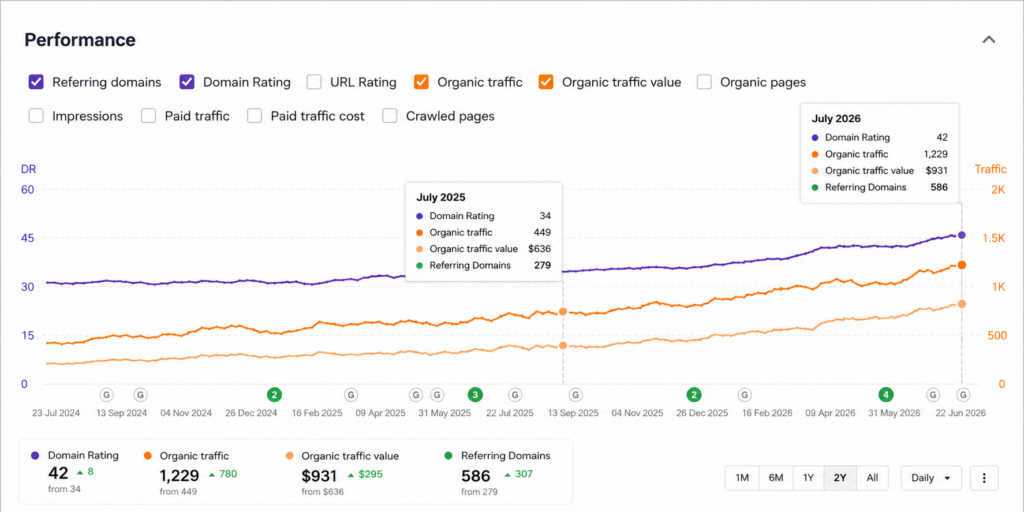
US Link Building Case Study: 174% Organic Traffic Growth
Orange Outreach supported a US-based client with white-label link-building services to strengthen its backlink profile and organic search performance. To maintain client confidentiality, the company name and website remain undisclosed.
According to the Ahrefs report, estimated organic traffic increased from 449 to 1,229, while referring domains grew from 279 to 586. Domain Rating improved from 34 to 42, and estimated organic traffic value rose from $636 to $931.
These results demonstrate measurable improvements in backlink profile metrics and estimated organic visibility over the reporting period.
Source: Ahrefs. Results reflect third-party estimates and do not establish link building as the sole cause of growth.
Need a partner for the tactics you can’t run in-house?
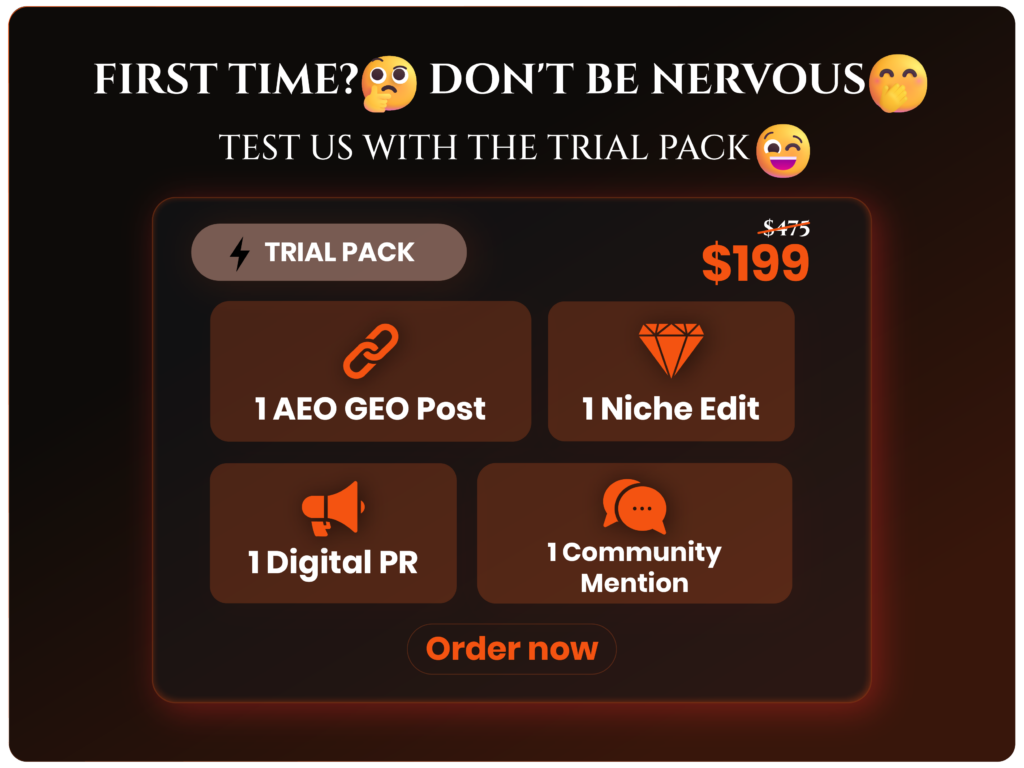
Explore ourwhite-label link building services or test the fit first with our Trial Pack
How to Vet a White Label Link Building Partner
Use this checklist before you commit any client budget.
- Ask for a written process. Who prospects, who writes, who approves and how are placements recorded?
- Review sample placements. Ask for real examples, with client details removed, and judge the sites yourself.
- Check site selection criteria. Look for relevance, real traffic, editorial standards and no obvious paid-link footprint.
- Confirm content quality. Articles should be original, accurate and written by people with subject knowledge.
- Look at link attributes and disclosure. The partner should follow Google’s guidance on qualifying paid or sponsored links and be open about how placements are secured.
- Test their honesty. Walk away from anyone who guarantees rankings or promises a fixed number of high-authority links for a fixed low price.
- Confirm white label discipline. You need confidentiality, branded reporting and a clear rule against contacting your clients.
- Start with a pilot. Run a small campaign for one client and review quality before you scale.
How Link Building Contributes to Client Growth
When link building strategies are done well, agencies can show clients four types of value.
Organic visibility. Relevant backlinks can support a website’s search performance by helping search engines discover content and assess its authority, working best alongside helpful content, technical SEO and alignment with search intent.
Qualified traffic. Links from relevant industry publications and local sites can send visitors who are already interested in the topic. For example, a software company featured in a technology publication can reach readers searching for solutions to a specific business problem.
Brand credibility. Consistent mentions from reputable sources reinforce brand awareness and a credible online reputation, although backlinks alone do not establish trust.
Leads and revenue. Better visibility and referral traffic can create more enquiries, but only if the client’s site has useful landing pages, clear calls to action and a good user experience. Link building does not guarantee conversions.
Measuring and Reporting Link Building Results
Link building is a long-term SEO investment, so evaluate it beyond the number of links acquired. Clients trust agencies that report clearly and honestly.
Track Backlink Quality and Referring Domains
Monitor links gained and lost, plus the referring domains pointing to the site. Quantity alone does not indicate success: assess the relevance, credibility and editorial quality of each linking website, and review the backlink profile regularly so problematic or unnatural links are found and addressed promptly.
Monitor Organic Traffic and Keyword Performance
Use Google Analytics 4 and Google Search Console to track organic traffic, impressions, clicks and keyword performance. Watch which pages gain visibility and whether target keywords improve over time.
Connect SEO Results to Business Outcomes
The best link building strategies are the ones that help achieve business goals. Track referral traffic, qualified inquiries, leads and conversions alongside backlink growth. For example, a dermatology clinic can check whether visitors arriving from industry publications are requesting consultations.
What a good monthly client report includes:
- A list of new placements with URL, anchor, target page and publication date
- Why each site was chosen (relevance, audience, editorial standard)
- Referring domains gained and lost
- Organic traffic, impressions and priority keyword movement
- Leads or revenue influenced by organic search
- A plain-language note on what is working and what comes next
Timelines should be honest. Some changes can show within weeks, but authority gains from link building generally take several months, depending on competition, site authority and content quality.
Common Link Building Mistakes SEO Agencies Should Avoid
- Buying backlinks: Paid links intended to manipulate search rankings can violate Google’s spam policies.
- Using irrelevant directories and link networks: Low-quality or unrelated websites offer little SEO or audience value.
- Overusing exact-match anchor text: Repetitive keyword-rich anchors can make a backlink profile look unnatural.
- Prioritizing quantity over quality: Relevant links from credible websites are more valuable than large volumes of unrelated backlinks.
- Ignoring existing backlinks: Failing to monitor lost links and changes in referring website quality weakens backlink profile management.
- Treating links as the whole strategy: Backlinks should complement quality content, technical SEO and internal linking.
- Promising guaranteed rankings: No one controls Google’s results, and guarantees damage client trust.
- Choosing a partner on price alone: Very cheap packages often rely on the exact tactics Google warns against.
Outsourcing Link Building to Orange Outreach
Link building can look straightforward, but it is complex and time-consuming. It needs constant monitoring of links, traffic, publisher relationships and campaign progress. As an agency’s client list grows, in-house capacity often runs out before demand does. That is where a white label link building and guest posting partner like Orange Outreach comes in.
Orange Outreach specializes in SEO outreach services for US-based SEO agencies. We combine strategic outreach, relevant placements and transparent execution so agencies can scale link building without expanding their in-house team.
Benefits of Partnering with Orange Outreach
- Tailored link building strategies: Guest posting, publisher outreach and other methods matched to each client’s goals.
- Specialized SEO outreach: An experienced team focused on link building, guest posting and publisher outreach.
- Relevant, high-authority placements: Opportunities to secure backlinks from established websites relevant to your clients’ industries and SEO goals.
- Scalable support: Handle growing campaign demand without the cost of building a larger in-house team.
- White-label delivery: Deliver link building under your agency’s brand while we manage the outreach process.
- Transparent reporting: Track placements, campaign progress and deliverables through clear reports.
- Trial period: Test placement quality, outreach process and fit through an initial trial before committing to larger campaigns.
Link building also works best as part of a wider programme that covers technical SEO, content and AI visibility. If you want one partner across those areas, see our Full-Stack AI SEO service. To discuss a pilot for your agency, contact the Orange Outreach team.
Building Long-Term Growth Through Ethical Link Building
Sustainable link building is about earning relevant, high-quality backlinks rather than chasing quick ranking improvements or link volume. For US SEO agencies, that means choosing link building strategies that fit each client, vetting every placement and reporting honestly.
Strategies such as guest posting, digital PR, local link building and content-led outreach can support search visibility, brand recognition and referral traffic over time. When internal capacity is limited, a trusted white label partner lets you keep delivering without lowering standards. A consistent, quality-focused approach to link building for SEO agencies in USA protects both your clients’ rankings and your agency’s reputation.
Final Thoughts
The best link building strategy is the one that fits your client’s budget and niche and that your team can execute to real editorial standards. For most US SEO agencies, that means a small mix of tactics, clear reporting, and a trusted partner for the work you can’t staff. If you’d rather not build every layer in-house, Orange Outreach works as a white-label extension of your team, with white label link building services, guest post services and managed campaigns built for US SEO agencies. Start with the Trial Pack or talk to our team.
Nirmal Kumar S is the Digital Marketing Head at Orange Outreach, a white-label link building and guest posting agency serving US SEO agencies. He has over 9 years of experience across SEO, PPC, Meta Ads, content marketing, and international AI SEO strategies. He also leads a team of SEO professionals focused on search visibility, link acquisition, and digital growth.
FAQs
What are the best link building strategies for US SEO agencies?
The most dependable options are guest posting on relevant sites, digital PR, link-worthy resources, local link building, broken link outreach and reclaiming unlinked mentions. The right mix depends on each client’s industry, audience and goals.
How long does it take to see results from link building?
Link building is gradual, and results vary with site authority, competition, link quality and overall SEO efforts. Monitor backlink growth, organic traffic, keyword performance and conversions over several months rather than expecting immediate ranking changes.
Should SEO agencies outsource link building?
Often yes, when time, staff or expertise are limited. A reliable white label partner can handle publisher outreach, placements and monitoring while you keep strategy, client communication and quality control.
What is white label link building?
White label link building means a specialist provider carries out outreach and placements, and your agency delivers and reports the work under its own brand. The client deals with you, not the partner.
How can an agency identify a reliable link building partner?
Evaluate outreach methods, publisher relevance, link quality, reporting and transparency. Avoid providers that promise guaranteed rankings or rely on manipulative techniques, and start with a small pilot.
Are paid guest posts against Google’s guidelines?
Google’s spam policies treat links bought or exchanged mainly to manipulate rankings as link spam, and its guidance asks that paid or sponsored links be qualified appropriately. Focus on editorial quality and relevance, and ask any partner how they handle disclosure.
How many backlinks does a client need each month?
There is no universal number. It depends on competitors, the client’s current profile and the quality of available placements. Set goals based on a competitor and gap analysis, and prioritise relevance over quantity.
Also Read: Best link building packages
Sources
- Google Search Central: Spam policies
- Google Search Central: Creating helpful, reliable, people-first content
- Ahrefs: An Analysis of AI Overview Brand Visibility Factors (75K Brands Studied)
- Search Engine Journal: Google September 2026 spam update
- Search Engine Journal: Google adds fake author warning to helpful content guidance