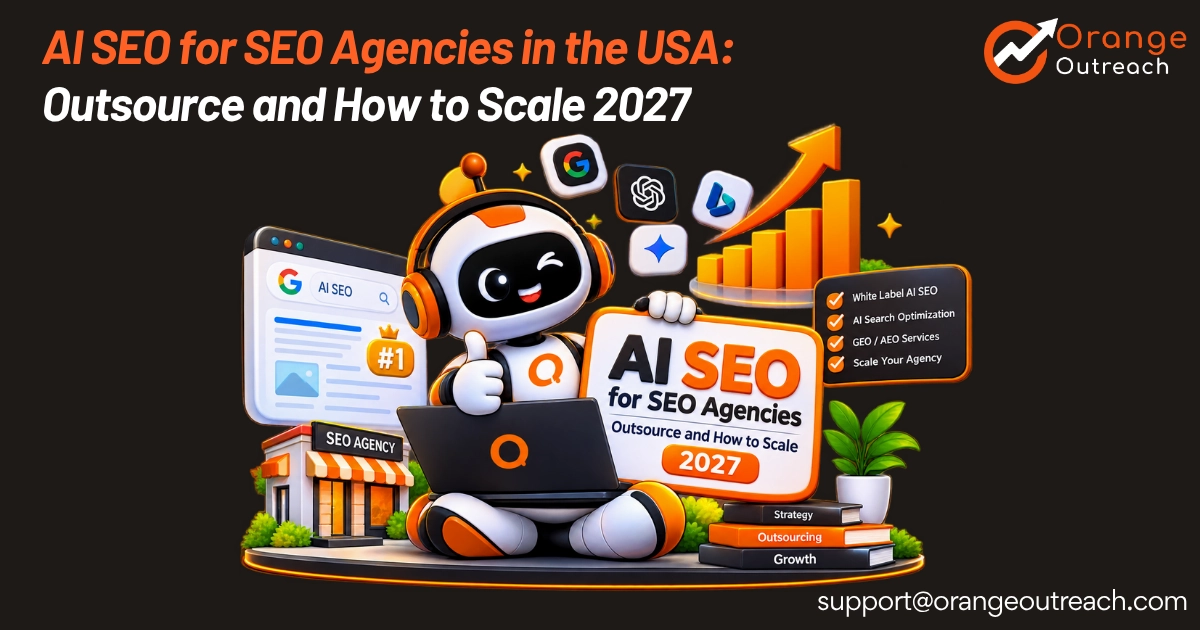
AI SEO for agencies means combining human-led strategy with specialist production support to win visibility in both traditional search and AI answer engines. Agencies should keep strategy, client relationships, fact-checking and quality control in-house, and outsource repeatable work such as technical audits, link building, schema implementation, content support and reporting. A hybrid model, often delivered through white label AI SEO partners, lets US agencies scale AI SEO services without heavy hiring, provided processes are documented and client expectations stay realistic.
Key Takeaways
- Keep in-house anything that carries client trust: strategy, positioning, client communication, quality control and final approvals.
- Outsource anything repeatable, labor-heavy or specialized: technical audits at scale, content production, digital PR and link acquisition, entity and schema implementation, and reporting.
- The best AI SEO for agencies model is hybrid. You own the relationship and the thinking. A partner owns the production capacity.
- Scaling fails when agencies sell AI SEO services before they have a delivery process. Build the process first, then sell.
- Be honest with clients about timelines. Organic and AI visibility gains build over months, not weeks.
- Introduction:
- What AI SEO Actually Means in 2027
- Why AI SEO for Agencies in USA Feels Different Right Now
- A Simple Framework: What to Keep and What to Outsource
- What to Keep In-House
- What to Outsource
- The Hybrid Zone: Where You Share the Work
- Understanding White Label AI SEO
- How to Scale AI SEO in 2027: A Practical Model
- Pricing and Margin: What Agencies Should Expect
- Common Mistakes Agencies Make with AI SEO
- Quick Wins for Better AI SEO Strategies
- A 90-Day Plan to Launch Your AI SEO Offer
- Frequently Asked Questions
- Conclusion: Own the Relationship, Share the Workload
Introduction: The Agency Owner’s 2027 Problem
If you run an SEO agency in the United States, you have probably had this conversation in the last six months. A client asks, “Are we showing up in ChatGPT? What about Google’s AI Overviews?” You nod, say you are working on it, and then spend the evening trying to work out what “working on it” should actually mean.
You are not alone. Search has changed shape. Rankings still matter, but so do citations, mentions, entity strength and the way answer engines summarize a brand. That shift has created a new service line that clients are asking for, and a new staffing headache for the agencies that need to deliver it.
This is where AI SEO becomes a business decision and not only a technical one. Every agency owner now faces the same three questions. Which parts of AI SEO should my own team own? Which parts can I safely hand to a specialist partner? And how do I grow without hiring ten new people before the revenue arrives?
This guide answers those questions from the agency side of the table. We run a white-label SEO practice at Orange Outreach, so we see both sides: what agencies try to build themselves and where they get stuck. Nothing here is a secret formula. It is a practical framework you can apply this quarter.
By the end you will know:
- What AI SEO really covers in 2027, beyond the buzzwords
- A simple test for deciding what to outsource and what to keep
- How white label AI SEO works and how to vet a partner
- A scaling model, a 90-day plan and the mistakes to avoid
What AI SEO Actually Means in 2027
Let us clear up the definition, because the term gets stretched in every direction.
AI SEO has two meanings, and agencies need both.
- Optimizing for AI-driven search surfaces. This means earning visibility in Google AI Overviews and AI Mode, ChatGPT search, Perplexity, Gemini, Copilot and similar tools. The goal is to be cited, mentioned or recommended when someone asks a question your client should own.
- Using AI to do SEO work faster. This means using language models and automation for research, clustering, drafting, auditing, schema generation and reporting, with humans reviewing the output.
Most confusion comes from mixing the two. A client who asks for “AI SEO” usually means the first. An agency that thinks about “AI SEO” usually means the second. Strong AI SEO solutions combine both: human strategy, machine-assisted production, and a measurement layer that tracks both classic rankings and AI visibility.
The Signals That Still Decide Who Gets Cited
No one outside the search engines knows the full ranking recipe, and anyone who claims otherwise is guessing. But the public guidance and a lot of observed behavior point in the same direction:
- Experience, expertise, authoritativeness and trust (E-E-A-T). Google’s quality rater guidelines describe trust as the most important member of the group. Real authors, real credentials and verifiable claims matter.
- Helpful, people-first content. Google has repeatedly said it rewards content created to help people, not to manipulate rankings.
- Clear entities. Brands, people and products that are consistently described across the web are easier for systems to understand and reuse.
- Technical accessibility. If crawlers cannot fetch, render and parse a page, nothing else matters.
- Earned mentions and links. Third-party coverage still acts as a strong external signal of authority.
- Structured, extractable answers. Pages that answer a question clearly near the top, then add depth, are easier for answer engines to quote.
- Page experience. Core Web Vitals, mobile usability and security are baseline hygiene.
Notice what is missing from that list: tricks. Mass-produced AI pages published without review are exactly what Google’s spam policies target under scaled content abuse. Any AI SEO strategy built on volume alone is borrowing against the client’s future.
Why AI SEO for Agencies in USA Feels Different Right Now
The pressure on AI SEO for agencies in USA has a few specific causes.
Client expectations moved faster than agency capacity. Founders and marketing heads read headlines about zero-click search and ask their agency what the plan is. A vague answer is no longer acceptable.
Margins are under pressure. Some clients assume AI makes SEO cheaper, so they push for lower retainers. Meanwhile, doing the work properly still needs experienced people. Agencies are squeezed from both sides.
Talent is thin. There are not many people with real experience in entity optimization, citation tracking and AI-assisted content workflows. Hiring them is slow and expensive.
Tooling changes monthly. New AI visibility trackers, new crawler policies and new search features appear constantly. Keeping a small team current is a job in itself.
Competition is wider. Freelancers, in-house teams and software platforms all claim to “do AI SEO.” You need a clear point of difference.
These pressures explain why so many US agencies are looking at partnerships. Delivering AI SEO services under your own brand, with a specialist team behind you, lets you respond quickly without carrying the full cost of a new department.
A Simple Framework: What to Keep and What to Outsource
Before we list tasks, here is the test we use with agency partners. Ask three questions about any piece of work.
- Does this work shape the client’s trust in us? If yes, keep it in-house.
- Is it repeatable and measurable? If yes, it is a good candidate for outsourcing.
- Does it need rare expertise you cannot hire quickly? If yes, outsource or partner.
Work that scores high on trust and low on repeatability stays with you. Work that is repeatable and specialized is where a partner adds the most value. Everything in the middle becomes a hybrid.
What to Keep In-House
These are the parts of AI SEO that make your agency yours. Hand them off and you slowly become a reseller with no leverage.
1. Client Relationship and Account Strategy
The client hired you because they trust your judgement. Onboarding calls, quarterly reviews, difficult conversations about slow progress and decisions about priorities must come from your own people. A partner can supply data and drafts, but the voice in the room should be yours.
2. Positioning and Core Strategy
Deciding which topics, a client should be known for, which audiences matter, and which commercial pages deserve the most investment is strategy work. It needs business context that only you have. Good AI SEO strategies start with the client’s revenue model, not with a keyword export.
Keep these decisions close:
- Which products, services and locations to prioritize
- Which competitors to benchmark against
- Which AI platforms matter for this client’s buyers
- What success looks like in revenue terms, not only traffic
3. Brand Voice, Subject-Matter Input and Fact Checking
E-E-A-T lives here. Real experience cannot be outsourced. If a client is a law firm, a clinic or a manufacturing company, their stories, data and opinions are the raw material that makes content trustworthy. Your team should collect that input and make sure final content reflects it.
Fact checking is the other non-negotiable. Language models can produce confident errors. A human who knows the industry should verify every statistic, claim and quote before publication. This protects the client and your reputation.
4. Quality Control and Final Approval
Even with an excellent partner, the last review should happen on your side. Read the deliverables the way the client’s most skeptical stakeholder would. Does it sound human? Does it make claims we cannot support? Would we be comfortable if the client’s lawyer read it?
5. Measurement Design and Business Reporting
Deciding what to measure is strategic. You can outsource the data pulling, but you should define the metrics and the story they tell. For AI visibility, that usually includes:
- Share of citations and mentions across a fixed set of buyer prompts
- Branded search growth and direct traffic trends
- Organic leads and revenue from search
- Rankings for priority commercial terms
6. Sales and Scoping
Who you sell to, how you price and what you promise are your decisions. Never let a partner define what you commit to a client. Scope what you can defend.
What to Outsource
Now the other side. These are the areas where a specialist team usually delivers better results and better margins than a stretched in-house team.
1. Link Building, Digital PR and Guest Posting
Earned mentions remain one of the clearest external signals of authority, and they feed both classic rankings and AI visibility. But outreach is slow, relationship-heavy and hard to scale internally. It involves prospecting, vetting sites for real traffic and editorial standards, pitching, following up and managing placements.
This is the most common area where agencies choose white label AI SEO support, because quality placements need ongoing relationships. The warning is obvious: avoid anyone selling bulk packages of low-quality links. Ask to see example placements, site selection criteria and how they handle disclosure and editorial standards.
2. Technical Audits and Implementation at Scale
Crawl analysis, indexation checks, log file review, rendering problems, Core Web Vitals diagnosis and structured data implementation are well-defined, repeatable processes. A specialist team can run them across many clients faster than a generalist can. You review the findings and approve the roadmap. They carry out the heavy lifting.
3. Content Production Support
Research briefs, outlines, first drafts and optimization passes can be handled by a partner with good editorial controls. The crucial condition is a human-led process: subject-matter input in, expert editing out. If you want to see what a structured production model looks like, our full-stack AI SEO service page explains how research, content, technical work and authority building connect.
4. Entity, Schema and Knowledge Graph Work
Building consistent entity signals across a website and the wider web is detailed work. It covers Organization, Person, Product and Service schema, author profiles, same As references and consistent business information. It is technical, easy to get subtly wrong, and rewarding when done carefully. This is a strong candidate for a specialist.
5. AI Visibility Tracking and Data Collection
Running a fixed set of prompts across several AI platforms, recording whether the client is mentioned, noting which sources are cited and comparing against competitors is mechanical but time-consuming. Partners can run this on a schedule and deliver clean data for you to interpret.
6. Reporting Production
Dashboards, monthly decks and spreadsheets take hours of assembly. Let a team build the reporting layer while you write the commentary.
7. Overflow and Specialist Projects
Migrations, large audits and one-off recovery projects create spikes in workload. Outsourcing these protects your core team from burnout and keeps recurring clients on schedule.
The Hybrid Zone: Where You Share the Work
Some tasks do not fit neatly on either side. Treat them as shared.
| Task | Agency Owns | Partner Supports |
|---|---|---|
| Keyword and topic research | Priorities and business fit | Data gathering, clustering, gap analysis |
| Content creation | Subject input, voice, final edit | Briefs, drafts, optimization |
| Link building | Target approval, brand standards | Prospecting, outreach, placement |
| Technical SEO | Roadmap and priorities | Audit, implementation, QA |
| Reporting | Insights and recommendations | Data collection, formatting |
| AI visibility | Prompt set and interpretation | Tracking and benchmarking |
The rule of thumb is simple. You decide what and why. Your partner handles how and how much.
Understanding White Label AI SEO
Since many agencies are weighing this option, let us be specific about what it is.
White label AI SEO means a specialist provider delivers work that you sell and present under your own brand. The client sees your name, your reports and your team on calls. The partner stays in the background.
Done well, it gives you:
- Capacity without payroll. You can take on more clients without hiring full-time specialists.
- Speed to market. You can launch new AI SEO services in weeks, not quarters.
- Predictable costs. Fixed or per-deliverable pricing makes your margins easier to forecast.
- Access to experience. You borrow the lessons from many campaigns, not only yours.
Done badly, it gives you:
- Generic, unedited AI content with your name on it
- Links from sites you would never show a client
- Reports no one can explain
- A partner who disappears when something breaks
The difference comes down to process, transparency and honest communication. That brings us to vetting.
How to Vet a White Label AI SEO Partner
Use this checklist before signing anything.
- Ask for process, not promises. Request a written walkthrough of how a typical month runs. Who briefs, who writes, who edits, who approves?
- Check the human review layer. Ask exactly where people review AI-assisted work, and what they check.
- Review real examples. Ask for sample deliverables with client details removed: audits, briefs, placements and reports.
- Understand link standards. Ask about site selection criteria, traffic checks, topical relevance and disclosure practices.
- Test their honesty. A good partner will tell you what is unrealistic. If they guarantee rankings or a fixed number of AI citations, walk away.
- Confirm confidentiality. You need NDAs, a clear stance on not contacting your clients and clean separation of branding.
- Look at communication. Response times, a named contact and a clear escalation path matter more than a polished sales deck.
- Start small. Run a pilot on one client or one workstream before committing the whole portfolio.
Any agency serious about AI SEO for agencies should treat partner selection with the same care as hiring a senior employee.
How to Scale AI SEO in 2027: A Practical Model
Scaling is not about doing more of everything. It is about building a delivery system that lets quality hold up as volume grows. Here is a five-step model.
Step 1: Productize Your Offer
Clients buy clarity. Instead of a vague “AI SEO package,” define two or three clear tiers.
- Foundation: technical audit, entity and schema setup, content refresh on key pages, baseline AI visibility report.
- Growth: everything in Foundation plus ongoing content, link acquisition and monthly AI visibility tracking.
- Authority: all of the above plus digital PR, expert-led thought leadership and competitive benchmarking.
Each tier should list deliverables, not outcomes you cannot control. Strong AI SEO solutions describe the work, the cadence and the measurement approach.
Step 2: Document Every Workflow
Write standard operating procedures for onboarding, research, briefing, editing, link vetting, QA and reporting. Include checklists and examples of good and bad output. Documentation is what lets you add a partner or a new hire without quality dropping.
Step 3: Build a Hybrid Delivery Team
A lean structure that works for many agencies looks like this:
- Account lead (in-house): owns the client relationship and strategy.
- SEO strategist (in-house): owns the roadmap, QA and reporting insights.
- Editor (in-house or senior freelancer): protects voice, accuracy and E-E-A-T.
- Production partner (white label): handles audits, content support, link acquisition, schema and data collection.
This lets you grow revenue faster than headcount.
Step 4: Create a Measurement System You Can Defend
Clients will ask whether AI SEO is working. Prepare a layered answer.
- Visibility layer: rankings, impressions, AI citations and mentions for a fixed prompt set.
- Traffic layer: organic sessions, branded search growth and referral traffic from AI platforms where it is reported.
- Business layer: leads, sales calls, pipeline and revenue influenced by search.
Be honest that AI referral traffic is often small and hard to attribute today. Focus on the combination of signals, and track direction over time.
Step 5: Set Honest Expectations from Day One
This is the part many agencies skip, and it costs them clients later. Tell prospects the truth.
- Technical fixes can show results within weeks, but authority and content gains usually take several months.
- No one can guarantee citations in any AI tool, because those systems change constantly.
- Competitive niches take longer than local or low-competition ones.
Clients respect agencies that say “here is what is realistic” far more than those who overpromise and then explain.
Pricing and Margin: What Agencies Should Expect
We will not quote fixed numbers, because prices vary widely by market, scope and provider. But the logic is consistent.
A healthy white-label arrangement lets you charge the client a retainer that covers your strategy and management time, plus a markup on partner-delivered production. Many agencies aim for a gross margin that comfortably funds account management, tools and a profit. If your partner’s cost leaves no room for that, either the partner is too expensive or your pricing is too low.
A few practical points:
- Price on deliverables and expertise, not hours. “Cheap because of AI” is a race to the bottom.
- Charge for strategy. Your judgement is the valuable part.
- Avoid long lock-ins before proof. Offer a short initial term with a clear review point.
- Budget for tools and tracking. AI visibility monitoring has real software and data costs.
Common Mistakes Agencies Make with AI SEO
After seeing many agency setups, these are the repeating errors.
- Publishing unedited AI content. It reads generically, makes errors and risks quality issues. Always add human expertise and review.
- Chasing every new platform. Pick the AI surfaces that matter for the client’s buyers and measure those.
- Ignoring the fundamentals. Crawlability, site speed, clear information architecture and strong commercial pages still decide a lot.
- Selling guarantees. Rankings and citations cannot be promised. Sell process and transparency.
- Outsourcing strategy. If a partner decides what the client should be doing, you have handed over your value.
- Buying cheap links. Low-quality links can create long-term damage and waste budget.
- Skipping documentation. Without SOPs, every new client feels like starting over.
- Hiding the process from the client. You do not need to reveal your partner, but you do need to be able to explain your methods clearly.
Quick Wins for Better AI SEO Strategies
If you want practical improvements that apply to nearly any client, start here.
- Answer first, then expand. Place a clear, concise answer near the top of key pages, followed by depth and evidence.
- Show real authors. Add author names, credentials, photos and links to professional profiles.
- Cite original sources. Link to primary data and be transparent about methodology.
- Update thoughtfully. Refresh pages when facts change and show the updated date honestly.
- Strengthen entity signals. Keep company name, address, descriptions and social profiles consistent everywhere.
- Use structured data accurately. Mark up what is actually on the page. Do not add schema that misrepresents content.
- Earn mentions beyond your site. Industry publications, podcasts, reviews and partnerships all help.
- Allow the right crawlers. Review your robots.txt choices for search and AI crawlers deliberately, based on what you want visible.
- Build topical depth. Cover a subject thoroughly through connected pages, not scattered posts.
A 90-Day Plan to Launch Your AI SEO Offer
Here is a realistic path for an agency starting from a standing start.
Day 1 to 30: Foundation
- Define your AI SEO offer, tiers and ideal client profile.
- Audit your own agency site for E-E-A-T, schema and AI visibility. Use yourself as the first case study.
- Write core SOPs for audits, briefs and reporting.
- Shortlist two or three potential production partners and request process documents.
Days 31 to 60: Pilot
- Choose one or two friendly clients for a pilot.
- Run a technical and entity audit, plus a baseline AI visibility snapshot.
- Test the partner workflow on a small workstream, such as a content refresh or a link campaign.
- Gather feedback on communication and quality.
Days 61 to 90: Systemize and Sell
- Refine SOPs based on what went wrong in the pilot.
- Build a standard report template and a one-page sales deck.
- Publish your own point of view content, so prospects can see your thinking.
- Begin outbound to your warm list and existing clients.
By day 90, you should have a documented process, a vetted partner, a pilot you can reference and a clear offer to sell.
Frequently Asked Questions
What is AI SEO?
AI SEO is the practice of improving a brand’s visibility across both traditional search results and AI-driven answer surfaces such as Google AI Overviews, ChatGPT and Perplexity. It also covers using AI tools to speed up research, content and technical work, with human oversight.
Should my agency build AI SEO services in-house or use a partner?
Most agencies do best with a hybrid model. Keep strategy, client communication and quality control in-house. Use a partner for repeatable production work such as audits, link acquisition, schema implementation and reporting data. Start with a pilot before committing.
What is white label AI SEO?
White label AI SEO means a specialist team performs the work and you deliver it to your clients under your own brand. It lets agencies expand services without building a large internal team. Quality depends on the partner’s process, transparency and review standards.
How long do AI SEO results take?
Technical improvements can show effects within weeks. Content authority, earned mentions and AI visibility usually take several months to build, and results vary by industry and competition. Anyone guaranteeing a specific outcome should be treated with caution.
Is AI-generated content safe for SEO?
Google has said it focuses on content quality, not how content is produced. The risk comes from low-quality, mass-produced pages that add little value. AI-assisted content that is fact-checked, edited by experts and genuinely useful is a safer approach.
How do I measure AI SEO performance?
Track three layers: visibility (rankings and AI citations for a fixed prompt set), traffic (organic and referral sessions) and business results (leads and revenue). Review trends over months rather than reacting to single data points.
Do AI SEO services work for small agencies?
Yes. Small agencies often benefit most, because a partner gives them specialist capacity without the cost of new hires. The key is a clear offer, documented processes and honest client expectations.
What should AI SEO for agencies in USA focus on first?
Start with fundamentals: technical health, strong commercial pages, entity clarity and credible authorship. Then layer in AI visibility tracking, structured answers and earned mentions relevant to the client’s market.
Conclusion: Own the Relationship, Share the Workload
The agencies that grow through this shift will not be the ones that try to do everything themselves, nor the ones that hand everything away. They will be the ones that know exactly where their value sits.
Keep the thinking, the trust and the final say. Share the repeatable, specialized production. Build clear AI SEO strategies around real business goals, document your process, and be honest with clients about timelines. Do that, and AI SEO for agencies becomes a durable revenue line instead of a stressful experiment.
If you want a partner that works behind your brand, you can explore how our white label AI SEO approach works on the Full-Stack AI SEO service page, or contact the Orange Outreach team to talk through a pilot.
Also Read: White label link building services