Written by: Nirmal Kumar S, Digital Marketing Head at Orange Outreach | Reviewed by: Hariesh, SEO Content team lead, wrote 5000+ articles | Last updated: October 26, 2026
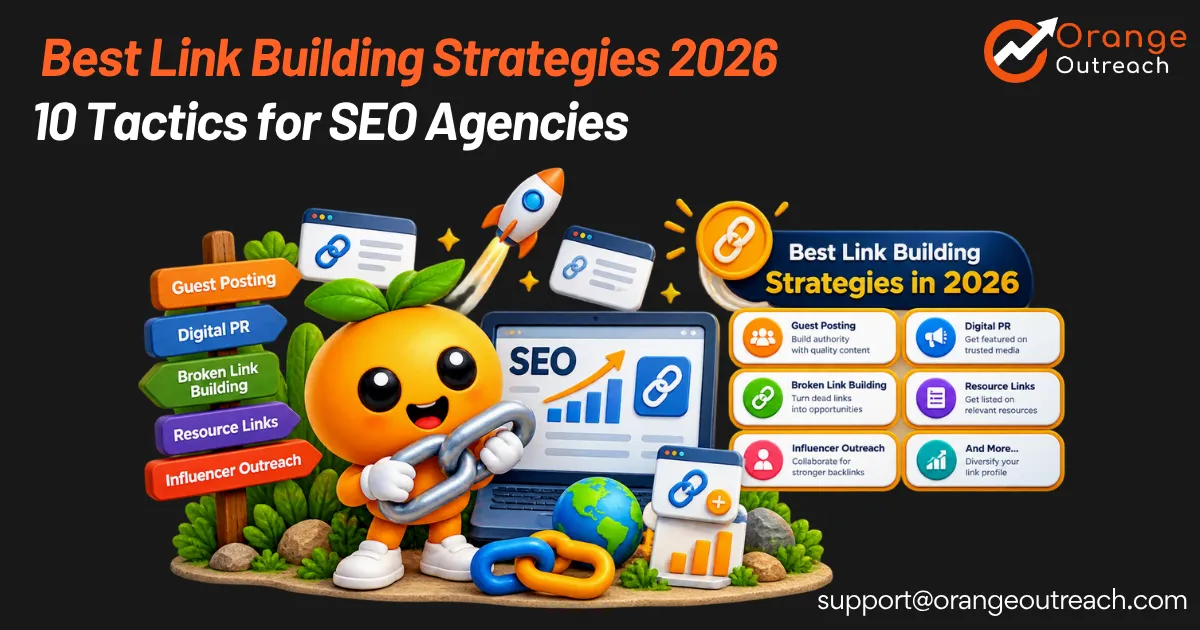
Quick answer: The best link building strategies for US SEO agencies in 2026 include AEO/GEO placements, guest posting, contextual niche edits, digital PR, unlinked brand mention reclamation, broken link building, media query responses, partner and community relationships, lost backlink reclamation, and linkable asset creation. No single tactic fits every client, so choose based on budget, niche competition, and team capacity, prioritizing relevant, editorially earned links over volume. Agencies that can’t run every tactic in-house can use white label link building strategies to outsource the labor-intensive ones while keeping client strategy and reporting.
Disclosure: Orange Outreach sells white label link building services to SEO agencies. We’ve written this guide to be useful whether or not you ever work with us, and we mention our services only where they are relevant.
Key Takeaways
- Choose link-building strategies based on each client’s budget, niche, competition, and available resources.
- Use AEO/GEO placements to improve brand visibility across AI search platforms and traditional search engines.
- Guest posting and niche edits help agencies earn relevant backlinks through useful content and existing web pages.
- Digital PR builds brand authority by highlighting clients’ expertise, achievements, and industry knowledge in trusted publications.
- Unlinked brand mentions and media query responses help increase brand recognition and create backlink opportunities.
- Broken link building helps earn backlinks by offering relevant content to replace dead links on other websites.
- Partner relationships and community connections create link opportunities through collaborations, directories, and joint projects.
- Lost backlink reclamation helps recover valuable links lost due to deleted pages, URL changes, or website updates.
- Linkable assets, such as original research, free tools, templates, and in-depth guides, give other websites reasons to link to a client.
- Focus on link quality, website relevance, and consistent monitoring rather than backlink quantity or guaranteed rankings.
- Google’s 2026 spam updates and its October 2026 content guidance reward real expertise and editorial links, and penalize link schemes and fake authorship.
- Link building strategies for US SEO agencies work best as a mix: one or two faster tactics plus one long-term layer, matched to each client.
- White label link building strategies let agencies outsource prospecting, outreach and placements while keeping strategy, client communication and reporting in-house.
-
- What Is a Link Building Strategy?
- Introduction
- What Google’s 2026 Updates Mean for Your Link Building Strategy
- How We Chose These 10 Link Building Strategies
- Which Link Building Strategy Fits Which Client? (Quick Comparison)
- Link Building Strategies for US SEO Agencies: Which Mix Fits Your Agency?
- White Label Link Building Strategies: What to Keep In-House and What to Outsource
- Link Building Mistakes to Avoid After the 2026 Spam Updates
- How to Measure Link Building Results
- Final Thoughts
- FAQs
What Is a Link Building Strategy?
A link building strategy is a plan for earning backlinks and brand mentions from relevant, trusted websites in a way that supports rankings and visibility. For an agency, it also decides which tactics each client gets, which ones you run in-house, and how you report results.
This guide is written for US-based SEO agencies that need to choose, price and report on link building across several clients at once. The best link building strategies in 2026 are editorial, relevant to the client’s niche, and measured by organic visibility and AI mentions rather than raw link counts.
Introduction
You can’t do everything = Your clients can’t afford everything. And no tactic you run this quarter can promise a number one ranking. The agencies growing fastest in 2026 accept all three facts and build around them.
We work with US SEO agencies on link building, so we see where campaigns win and where they stall. In our experience at Orange Outreach, combining relevant guest posts, niche edits, and digital PR with targeted outreach has been an effective approach to building quality backlinks for agency clients. We prioritize topical relevance, editorial quality, and natural link profiles over bulk link acquisition, avoiding low-quality placements that offer little long-term SEO value.
None of this is new to anyone who has spent time inside an agency. If you work at one or own one, you may have already noticed that:
- Not every client has a high budget to invest in all link building strategies.
- Not every link building strategy works for every client, as each niche has different competition levels.
- Not every agency has the resources to execute all link building strategies effectively.
- Not a single link building strategy can guarantee top positions in the SERPs.
- Not every traditional link building strategy is enough to stay competitive in the evolving world of AEO (Answer Engine Optimization) and GEO (Generative Engine Optimization).
Put these five points together, and the message is clear: no single plan fits every client. That doesn’t mean you should try to do it all. It means you should be selective. Start by choosing the strategies that suit each client’s budget and niche. Then keep in-house the ones your team can execute well and outsource the rest to trusted partners (white-label link building agency). That way, every client gets quality work, and your team never takes on more than it can handle.
To make your job easier, here are the 10 best link building strategies SEO agencies use in 2026 to strengthen client backlink profiles and outrank competitors.
How We Chose These 10 Link Building Strategies
Each strategy below was selected against five criteria:
- Policy fit: can it be done without breaking Google’s spam policies?
- Relevance: does it earn links and mentions from sites in the client’s niche?
- Agency economics: does it fit typical client budgets and team capacity?
- Measurability: can you show the client a result you can verify?
- AI search value: does it help the brand get mentioned or cited in AI answers?
These criteria reflect how we run campaigns at Orange Outreach, where our team has worked with clients across 20+ niches since 2019 and maintains a database of 20,000+ real guest posting opportunities.
What Google’s 2026 Updates Mean for Your Link Building Strategy
Link building still works, but the margin for error is thinner than it was a year ago. Google has rolled out four spam updates so far in 2026 (March, June, August and September) and two core updates (March and May). The September spam update started on September 24 and finished on October 8 after a two-week rollout, the longest of the year.
Google did not call the September update a link spam update, and it announced no new rules. What it enforces is still clear, though. Google’s spam policies treat buying, exchanging or automating links to manipulate rankings as link spam, and they also cover low-value content created mainly to earn links.
Two other shifts matter for agencies:
- Authorship is now a trust signal. Google’s helpful content guidance, updated in early October 2026, says fabricated creator profiles (AI-generated headshots, made-up names or false credentials) are a form of deception that makes a page untrustworthy. If you publish guest posts for clients, every byline should belong to a real person who can vouch for the content.
- Brand mentions carry more weight in AI search. In Ahrefs’ analysis of 75,000 brands, branded web mentions correlated with AI search visibility at 0.664, versus 0.218 for backlinks. Correlation isn’t causation, and backlinks still support the rankings that AI tools draw on, but it explains why several strategies below target mentions as well as links.
The takeaway: build links editorially, on relevant sites with real readers and real author names, and measure mentions and AI visibility alongside rankings.
Which Link Building Strategy Fits Which Client? (Quick Comparison)
Link Building Strategies for US SEO Agencies: Which Mix Fits Your Agency?
The best link building strategies for agencies depend on the clients you serve and the team you have. Use this table as a starting point, then adjust for each client.
| Agency Situation | Suggested Mix | Why It Fits |
|---|---|---|
| Small agency, tight client budgets | Niche edits, unlinked mention reclamation, and lost backlink reclamation | Low effort and faster to execute because these tactics build on existing pages, brand mentions, or previously earned links. |
| Growing agency with monthly retainers | Guest posting, AEO/GEO placements, and one linkable asset per quarter | Builds authority steadily while creating measurable AI search visibility opportunities to include in client reports. |
| Agency serving high-trust niches (legal, finance, health) | Digital PR, media query responses featuring credentialed experts, and guest posts on carefully vetted sites | Verifiable expertise and credible editorial coverage matter most in industries where trust and accuracy face greater scrutiny. |
| Agency with local or multi-location US clients | Partner and community relationships, relevant local directories, and niche edits | Local relevance and genuine relationships help businesses build location-specific authority that competitors may find difficult to replicate. |
| Agency with more clients than link builders | Keep strategy and reporting in-house; outsource prospecting, outreach, and placement execution | Explore white-label link building strategies to scale delivery without expanding your in-house team for every new client. |
Timelines and effort are indicative and vary with competition, site quality and execution. If you serve legal clients, our guide to choosing a white label partner for law firm SEO covers that niche in more detail, and our SEO for agencies page explains how we work with US agencies.
1. AEO/GEO Placements
Search no longer ends at ten blue links. ChatGPT, Perplexity, Google AI Overviews, and Gemini build answers from sources they consider trustworthy, and they tend to return to the same ones. If your client’s brand isn’t on those sources, it is unlikely to appear in the answers, no matter how well optimized the website is.
AEO/GEO placements solve this by getting your client mentioned, cited, or linked on the pages AI engines already rely on: authoritative publications, comparison articles, “best of” lists, and industry roundups. A traditional backlink strategy asks, “Which sites have high authority?” This one asks, “Which sites do AI engines actually cite for my client’s topics?”
The research is straightforward. Run a set of niche-specific questions through the major AI platforms, record which sources appear repeatedly, and turn that list into your outreach targets. Then pursue placements through content contributions, outreach, or sponsored features, and track brand mentions in AI answers next to your usual ranking reports. If a placement is paid, label it clearly as sponsored.
Brands are already asking their respective agencies how to appear in AI search results. Agencies that can explain and measure AI visibility stand out from those still offering only traditional SEO packages. Because AEO/GEO placements build visibility in both search and AI answers, this strategy has become the foundation of a modern link building plan.
See how we approach AI SEO visibility alongside link building.
Build a citation source list for each client: identify 20–30 niche-specific questions, track the sources each AI platform cites in its answers, and determine which of those sources accept contributions. Revisit these questions every quarter and report your client’s share of AI mentions as a performance KPI.
2. Guest Posting
Once you know which kinds of sites to target, guest posting becomes a practical next step. By writing original, useful content for niche-relevant, high-quality websites, you earn contextual backlinks, authority, and exposure to the right audience.
It remains one of the most scalable and budget-friendly options for agencies, but only if you hold yourself to real editorial standards. Choose sites with genuine readers. Avoid sites that exist only to sell placements, as link farms can hurt your clients’ rankings more than they help. A useful test: would the editor publish this post even without the link?
The best agencies follow a clear process for guest posting. They maintain a list of trusted websites organized by niche and check each site for traffic, relevance, editorial standards, and outbound link patterns. They also use a standard workflow for content briefs, expert input, and revisions to keep every placement consistent. Guest posting is also one of the easiest services to outsource, as long as your partner follows the same checklist you would. This makes it easier to maintain quality, set prices, and report results to clients.
Site vetting checklist before you pitch or buy a placement:
- Real, stable or growing US organic traffic (check the trend, not just DR or DA).
- Topical relevance to your client’s niche and audience.
- Named authors, real contributors and a clear editorial process.
- No obvious footprint of sold posts: unrelated topics, “write for us” everywhere, links crammed into every article.
- Content the editor wants: original insight, data or first-hand experience.
Use real, verifiable bylines. Google’s October 2026 guidance (Search Engine Journal’s report on the fake author warning) calls fabricated creator profiles deceptive, so publish under the client’s actual experts (or your own) with a bio that links to a real profile. At Orange Outreach, we review more than 10 websites for every placement we approve, assessing topical relevance, organic traffic trends, editorial standards, and outbound link quality before moving forward. This process helps us prioritize relevant publishing opportunities and maintain consistent quality across our clients’ link-building campaigns.
Guest posting can also support AEO/GEO by getting your client’s expertise featured on websites that AI platforms may use as sources. When you publish expert content under your client’s name on relevant, trusted websites, you increase the chances of AI platforms finding, recognizing, and citing your client’s expertise when answering related questions.
If you’d rather not manage vetting and outreach in-house, a white-label guest posting service that follows the same quality checklist can help you maintain editorial standards and protect your profit margins without increasing headcount.
3. Contextual Niche Edits
Not every link needs a new article. Niche edits, also called link insertions, add your client’s link to an existing page that is already indexed, aged, and often ranking.
The advantage is speed. A new guest post needs to be crawled and indexed by search engines before it can start delivering SEO value. An existing page may already be indexed and trusted, allowing your client’s backlink to deliver benefits sooner. This can be especially useful for clients launching a product or working toward a specific ranking goal within a short time. Niche edits also cost less than producing full content, which helps protect agency profit margins.
The main risk is choosing links carelessly. The page must be relevant to your client’s industry, and the link should help readers by providing useful information, statistics, or resources. Adding a link to an unrelated page offers little value and can be treated as link manipulation under Google’s spam policies. Focus on link quality first and speed second.
Before approving a link insertion, verify that the page still attracts organic traffic, the surrounding content is relevant to your topic, and the link appears naturally within the main body of the article—not in a footer, sidebar, or list of unrelated links. Work only with providers who obtain the website owner’s approval and share the live URL for verification.
4. Digital PR
If niche edits are about speed, digital PR is about building authority and brand recognition. Agencies create articles that reflect a client’s expertise, industry knowledge, achievements, or successful projects. These articles are then pitched to relevant news sites, industry publications, and online media outlets for publication, with a link to the client’s website included naturally in the content. The strongest campaigns start with a newsworthy angle, such as original data, an expert view on a trending issue or a real client milestone, rather than a promotional pitch.
For clients who need higher-authority placements, our DR 70+ editorial links are built on the same editorial standards.
The main benefit is earning backlinks from trusted news and media websites while showing potential customers what makes the client credible. For example, an article featuring a company’s industry achievements or expert insights can include a link to its website, helping readers learn more about its services. When several relevant publications cover the client, the brand can gain more backlinks, mentions, and visibility across search engines and AI search platforms.
To make this strategy work, agencies should focus on the client’s genuine expertise and achievements rather than simply promoting their services. They need to develop a clear story, choose publications that reach the right audience, and provide useful information that editors and readers will value.
Digital PR requires time for research, content creation, and outreach, so it often suits clients with larger budgets and strong industry experience to showcase. Many agencies partner with specialist PR teams to manage these activities. For the right client, this approach can earn valuable backlinks while building a stronger online reputation.
Evaluate digital PR by the quality of coverage, not just the number of backlinks earned. Assess each placement for publication relevance, genuine audience reach, and whether your client’s brand is mentioned naturally in the article. Also, test relevant industry questions across AI platforms to see whether the coverage appears in AI-generated answers or cited sources.
5. Unlinked Brand Mentions
An unlinked brand mention is a page that already names your client but doesn’t link to its website. These are some of the warmest link opportunities available, because the publisher already knows and values the brand.
Beyond reclaiming mentions that already exist, you can earn new ones by contacting editors and writers who cover your client’s industry and explaining why the brand belongs in their content. Pursue a mention only where the brand genuinely fits the article. If you want help finding and converting them, see our brand mention services.
This approach works best when the client’s brand is relevant to the publisher’s content. A genuine brand mention can help more readers discover your client and build recognition within the industry. When appropriate, agencies can also request a link to the client’s website alongside the mention.
To make this strategy effective, identify relevant publishers, send short and personalized emails, and clearly explain why mentioning the client would fit their content. Consistent outreach can help agencies earn more brand mentions, improve online recognition, and create opportunities to gain relevant backlinks. (Our SEO outreach guide covers email structure in more detail.)
How to find existing mentions: set up alerts for the client’s brand name and key spokespeople (Google Alerts, Ahrefs, Semrush or a similar monitoring tool), export mentions that carry no link, confirm the page is live and relevant, then send a short, friendly email asking for a link to the most useful page. Because Ahrefs’ research ties brand mentions to AI visibility more strongly than backlinks, a mention has value even if it never becomes a link, so track both.
6. Broken Link Building
Another resource-friendly approach starts with a gap. Broken link building means finding dead links on relevant websites and suggesting your client’s content as the working replacement.
It succeeds because it is genuinely helpful. Site owners don’t want dead links, since these links hurt user experience and credibility. When you flag the problem and offer a fix, you’re giving value instead of asking for a favor.
The process takes research time. Find relevant resource pages, check them for dead outbound links, confirm that your client has a true content match, and reach out with the broken URL, where it appears on the page, and your suggested replacement. A good process and the right tools make this efficient.
There’s a bonus, too. If you keep finding broken links that point to resources your client doesn’t have, you’ve discovered what content to create next. That connects directly to strategy 10.
Prioritize resource pages that are current and actively maintained by an editor. Ensure your suggested replacement closely matches the original resource’s purpose and adds genuine value for readers. Avoid forcing an irrelevant link into a list, as it is more likely to be ignored and could damage your credibility with the website owner.
7. Media Query Responses
Journalists often look for expert opinions to include in their articles. Platforms such as Mention Match, Qwoted, Featured and Help a B2B Writer connect journalists with experts. Since HARO closed in December 2024, these have become the main alternatives. By providing quick, clear, and useful answers, your client’s experts can earn quotes and backlinks from trusted publications.
These expert mentions help build your client’s credibility by showing that the brand has knowledge and experience in its field. When trusted publications quote your client’s experts, more readers can discover the brand and recognize it as a reliable source of information.
Quick responses and useful answers increase the chances of getting published. Journalists often work with tight deadlines and receive many responses, so agencies need a clear and standard process to manage requests. Assign someone to check journalist queries daily, maintain a list of experts with their qualifications and key talking points, and prepare specific answers that journalists can easily use. With a consistent process, agencies can earn regular brand mentions and valuable backlinks over time.
Strengthen your media query responses by including the expert’s full name, professional title, relevant years of experience, and a link to a verifiable profile. Only attribute quotes to individuals whose expertise can be confirmed. Clear credentials help journalists assess the reliability of your contributions and support transparent authorship. Ensure your content also follows
Google’s guidance on helpful, reliable, people-first content.
8. Partner and Community Relationships
Not every link has to come from cold outreach. Agencies that help clients build real relationships with partners, suppliers, industry associations, local organizations, and online communities create link opportunities that appear naturally over time.
Think co-marketing projects, event sponsorships, partner directories, testimonials, and joint webinars. Each one gives another organization a valid reason to link to your client, and this connection makes sense to both readers and search engines.
Start by mapping the client’s existing relationships: vendors, customers, associations, and local partners. Then identify which could realistically offer a link, a feature, or a co-created resource, and support them with case studies, webinar pages, or partner landing pages.
These links tend to be stable and highly relevant, and they’re hard for competitors to copy because they rest on real relationships rather than outreach templates. They take time, so treat them as a long-term layer that runs alongside faster tactics. Community mentions can support this layer when they come from genuine participation rather than self-promotion.
Create a simple link opportunity map for every client. List their vendors, customers, industry associations, chambers of commerce, and event partners. Then identify realistic opportunities for each relationship, such as a business directory listing, a customer testimonial, a joint case study, or an event page mention. Prioritize relevant opportunities that provide genuine value rather than pursuing links solely for SEO.
9. Lost Backlink Reclamation
Building new links is only half the job. Over time, backlinks vanish because of site redesigns, deleted pages, changed URLs, or content updates. If nobody is watching, hard-earned authority quietly drains away.
Lost backlink reclamation means monitoring for these losses and fixing their cause. That might mean adding proper redirects, restoring a removed page, or contacting the publisher to bring the link back. Run a monthly check in your preferred backlink tool, prioritize by the authority and relevance of the linking site, and fix technical causes first before sending outreach.
This is one of the most cost-effective tactics available, because the authority was already earned and only needs recovering. It also improves your reporting. “Links protected” is a strong retention message, since it shows you’re guarding the client’s long-term assets, not just adding new ones.
Quick wins to check first:
- 301-redirect the old URL to the closest relevant page.
- Restore any deleted page that still earns links.
- Ask the publisher to correct a mistyped link URL, or redirect the mistyped URL yourself.
10. Linkable Asset Creation
The final strategy supports all the others: creating something worth linking to. Linkable assets include original research, free tools, calculators, templates, in-depth guides, infographics, and data visualizations.
A strong asset keeps attracting links and citations long after launch, so it’s an investment that keeps paying back. It also gives your other tactics something valuable to promote. Digital PR has a story to pitch, outreach has a reason to exist, and media query responses can point to real data. Well-structured, original resources are also more likely to be referenced by AI engines as trusted sources.
The best assets solve a specific problem for a specific audience. Before building anything, check what already ranks and earns links in the niche, then aim to be more useful, more current, or more original. Plan the promotion before the build so the asset launches with an outreach strategy already attached. Assets cost more upfront, but that cost spreads across months of link acquisition.
Asset ideas that work for SEO-agency audiences: a link building pricing benchmark, a reseller margin calculator, a guest post quality checklist template, or an annual state-of-link-building survey.
Original data, first-hand case studies, and tools developed from real campaign experience can demonstrate effort, originality, expertise, and accuracy. Explain your methodology, identify the author, and cite reliable sources wherever relevant.
Real example from Orange Outreach:
Our team has built a database of 20,000+ guest posting opportunities across websites with varying domain ratings. We assess potential placements for niche relevance, organic traffic trends, content quality, and outbound link patterns to help agencies make more informed link-building decisions.
White Label Link Building Strategies: What to Keep In-House and What to Outsource
White label link building strategies let an agency sell link building under its own brand while a specialist partner does the labor-intensive work behind the scenes. Done well, you keep the client relationship, strategy and reporting. Your partner handles prospecting, outreach, content and placements.
Questions to ask any white label partner before you sign:
- Will you show the site list and live URLs for every placement?
- Are the authors real people with verifiable bios?
- How do you handle and label paid or sponsored placements?
- Can reports carry my agency’s branding and show more than link counts?
- Do you avoid private blog networks and link farms, and do you refuse to guarantee rankings? (The right answer to the second part is yes.)
At Orange Outreach, we work as a white-label extension of US SEO agencies through our white label link building services, guest post services and managed campaigns. If your team needs extra hands rather than a full partner, you can hire a link builder. Our guide to choosing a white label SEO partner explains how to compare providers.
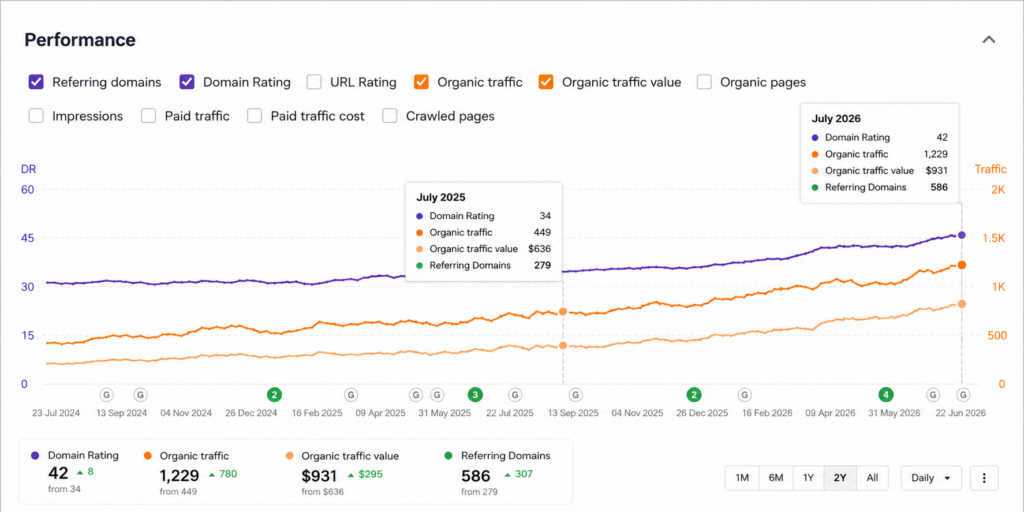
US Link Building Case Study: 174% Organic Traffic Growth
Orange Outreach supported a US-based client with white-label link-building services to strengthen its backlink profile and organic search performance. To maintain client confidentiality, the company name and website remain undisclosed.
According to the Ahrefs report, estimated organic traffic increased from 449 to 1,229, while referring domains grew from 279 to 586. Domain Rating improved from 34 to 42, and estimated organic traffic value rose from $636 to $931.
These results demonstrate measurable improvements in backlink profile metrics and estimated organic visibility over the reporting period.
Source: Ahrefs. Results reflect third-party estimates and do not establish link building as the sole cause of growth.
Need a partner for the tactics you can’t run in-house?
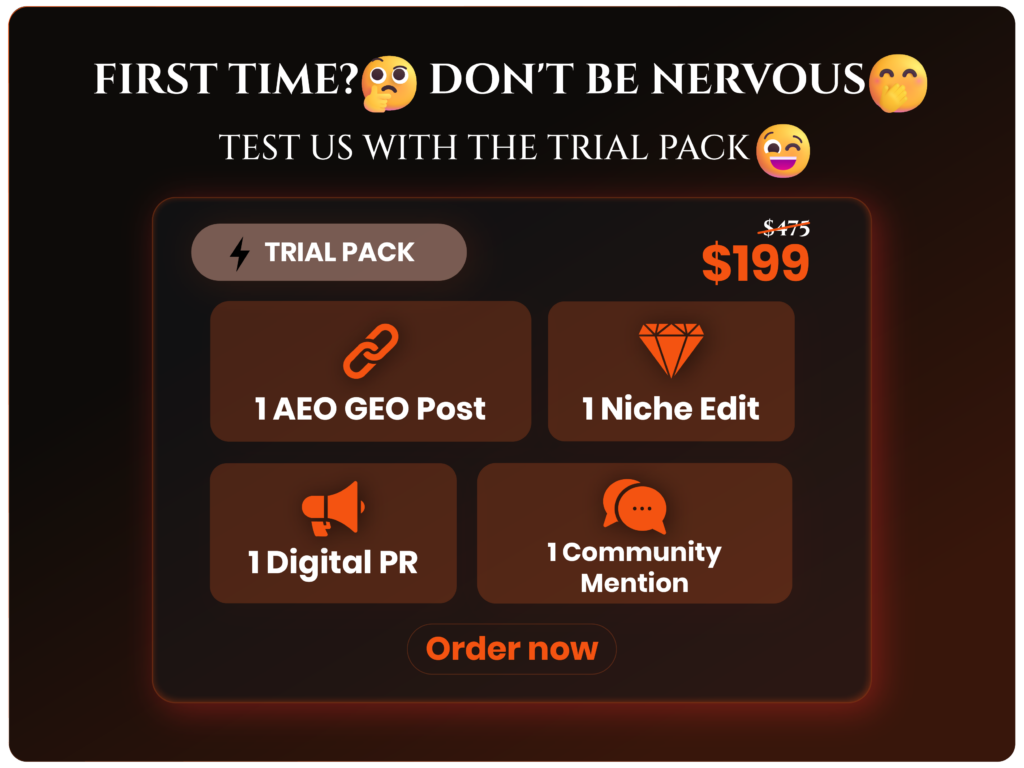
Explore ourwhite-label link building services or test the fit first with our Trial Pack
Link Building Mistakes to Avoid After the 2026 Spam Updates
- Buying from networks that sell links to anyone. Private blog networks and link farms are the clearest target of Google’s link spam policy.
- Not labelling paid placements. Google asks that paid links be qualified (rel=”sponsored” or nofollow), so disclose sponsored features clearly.
- Scaling AI-written guest posts without expert review. Google’s updated guidance urges manual fact-checking of AI-generated content, and low-effort content produced in bulk is exactly what its spam policies describe.
- Over-optimized anchor text. Keep the profile natural: mostly brand, URL and descriptive phrases rather than repeated exact-match keywords.
- Fake or stock author profiles. Use real people with real credentials.
- Chasing DR alone. Relevance and real organic traffic tell you more about a site’s value than a single metric.
- Promising rankings. No ethical provider can guarantee a position or a timeline, and clients who are told otherwise churn when it doesn’t happen.
How to Measure Link Building Results
Link Building Metrics That Matter
Track link quality, search visibility, brand authority, and measurable business outcomes.
| Metric | Why It Matters |
|---|---|
| Relevant Referring Domains | Measures links from websites relevant to the client’s industry, rather than counting every newly acquired domain equally. |
| Clicks and Impressions for Target Pages | Shows how target pages perform in Google Search. Use Google Search Console to monitor changes in search visibility and clicks over time. |
| Rankings for Target Keywords | Tracks keyword position changes over weeks and months, providing a more reliable view of progress than daily fluctuations. |
| Brand Mentions in AI Answers | Helps assess whether the client’s brand appears in AI-generated answers for relevant industry questions, supporting AEO and GEO measurement. |
| Links Protected or Reclaimed | Tracks lost links recovered and valuable existing links preserved, helping protect link equity and maintain campaign value. |
| Referral Traffic and Leads | Connects link-building activity to website visits, enquiries, conversions, and other measurable business outcomes. |
Orange Outreach tip: Evaluate link-building performance using a combination of link quality, organic search visibility, brand presence, and business results—not backlink volume alone.
Final Thoughts
The best link building strategy is the one that fits your client’s budget and niche and that your team can execute to real editorial standards. For most US SEO agencies, that means a small mix of tactics, clear reporting, and a trusted partner for the work you can’t staff. If you’d rather not build every layer in-house, Orange Outreach works as a white-label extension of your team, with white label link building services, guest post services and managed campaigns built for US SEO agencies. Start with the Trial Pack or talk to our team.
Nirmal Kumar S is the Digital Marketing Head at Orange Outreach, a white-label link building and guest posting agency serving US SEO agencies. He has over 9 years of experience across SEO, PPC, Meta Ads, content marketing, and international AI SEO strategies. He also leads a team of SEO professionals focused on search visibility, link acquisition, and digital growth.
FAQs
- How can link building help my business improve search visibility in 2026?
Link building helps your business gain backlinks and brand mentions from relevant, trusted websites. These can support SEO performance, build credibility, and improve your chances of appearing in AI-generated answers when your brand is mentioned on sources those platforms use.
- Which link-building strategy is best for my business?
The right strategy depends on your industry, budget, competition, and goals. Guest posting and niche edits can help earn relevant backlinks, while digital PR and AEO/GEO placements can build brand authority and visibility. Most agencies get the best results by combining one or two fast tactics with one long-term layer.
- How can link building help my business appear in AI search results?
Your business can gain visibility by earning mentions and citations on trusted websites that AI platforms may use to answer questions. AEO/GEO placements, expert contributions, and relevant guest posts can help increase the chances of your brand being discovered.
- How long does it take to see results from link-building campaigns?
The timeline varies based on the strategy, website quality, competition, and how quickly search engines discover and evaluate new links. Existing-page link insertions may offer opportunities sooner, while digital PR and relationship-building often require more time. As a rule, insertions on already-indexed pages can show movement within weeks, while digital PR, partnerships and linkable assets compound over a few months. Competitive keywords take longer, and no ethical provider can guarantee a ranking or a date.
- Should my business outsource link building to an SEO agency?
Outsourcing can help your business access specialist skills, publisher relationships, and established outreach processes without building an entire in-house team. Choose an agency or partner that prioritizes relevant websites, quality backlinks, transparent reporting, and strategies suited to your business goals. See our list of the best white label link building agencies in the USA for what to compare.
- Do backlinks still matter for SEO in 2026?
Yes. Links remain one of the ways search engines discover and evaluate pages, and Google still enforces policies against manipulating them. Relevance and quality matter far more than volume. Brand mentions now matter alongside links, especially for visibility in AI answers.
- Is guest posting still safe after Google’s 2026 spam updates?
Yes, when it is editorial. Posts on relevant sites with real readers, written by real experts, remain a legitimate tactic. The risk comes from low-quality sites that sell placements to anyone and from content produced at scale mainly to earn links.
- How many backlinks do I need to outrank a competitor?
There is no fixed number. Compare the quality and relevance of your competitor’s referring domains, then close the gap with links from sites that are at least as relevant. A handful of strong, relevant links often beats dozens of weak ones.
- What are the best link building strategies for US SEO agencies?
The best link building strategies for US SEO agencies are the ones that match each client’s budget, niche and competition. Most agencies build a core from guest posting, niche edits and AEO/GEO placements, then add digital PR, media query responses or linkable assets for clients with larger budgets. Relevance and editorial quality matter more than volume.
- What are white label link building strategies?
White label link building strategies are link building tactics an agency sells under its own brand while a specialist partner does the work behind the scenes. Agencies commonly outsource prospecting, outreach, content and placements, and keep strategy, client communication and reporting in-house.
- What is the best link building strategy for agencies on a small budget?
Start with tactics that build on what already exists: reclaiming lost backlinks, turning unlinked brand mentions into links, and relevant niche edits. They need less content than new guest posts or digital PR, so they usually cost less. Add a long-term layer, such as a linkable asset, as budgets allow.
- How many link building strategies should an agency run for one client?
Most clients do best with two or three at a time: one or two faster tactics plus one long-term layer. Running every strategy at once spreads the budget thin and makes it harder to tell what is working.
Also Read: Best link building packages
Sources
- Google Search Central: Spam policies
- Google Search Central: Creating helpful, reliable, people-first content
- Ahrefs: An Analysis of AI Overview Brand Visibility Factors (75K Brands Studied)
- Search Engine Journal: Google September 2026 spam update
- Search Engine Journal: Google adds fake author warning to helpful content guidance