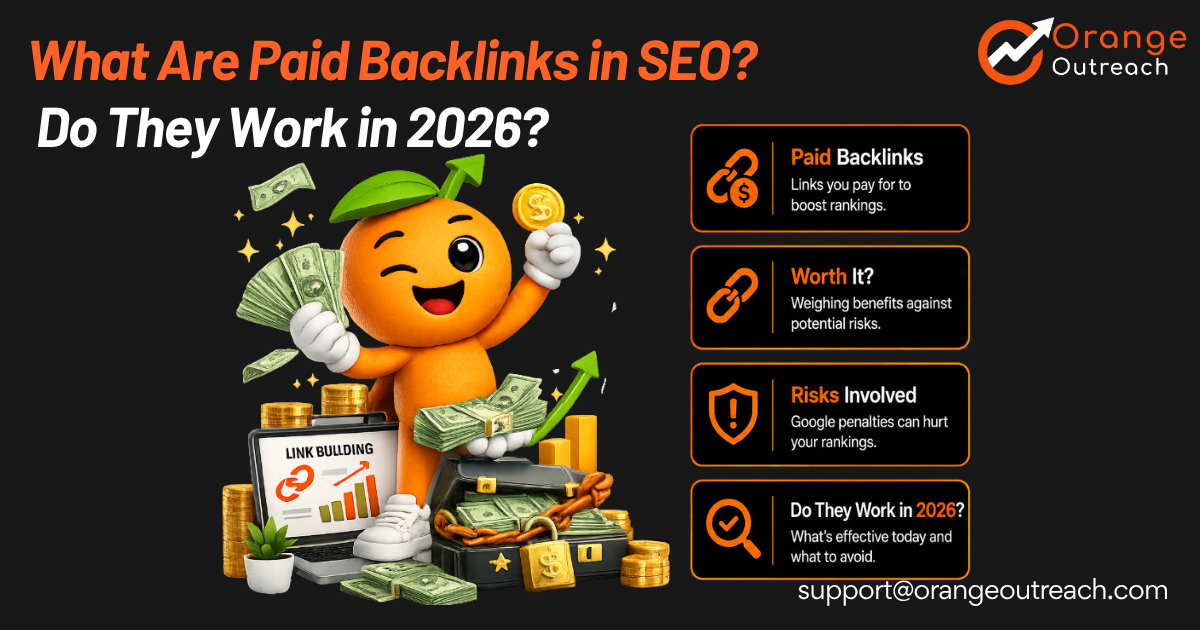
Paid backlinks in SEO are links acquired by paying a website owner to link back to your site. While they can boost rankings temporarily, they violate Google guidelines. In 2026, paid backlinks still carry risk, as search algorithms prioritize natural, high-quality links. Sustainable SEO success depends on authority-driven outreach and organic link-building strategies.
Key Takeaways
- Backlinks are still an important factor in search engine ranking.
- Are you wondering if paid backlinks are safe? Well, paid backlinks are not automatically bad; the way you carry them on makes them bad.
- Poor-quality paid backlinks in SEO are the real risk; they are much more likely to do harm than good.
- Outreach-based paid backlinks are the best and the safest option; you have to be very careful when choosing your backlinks partner. There are many spammers out there.
- Always go for agencies that practice white-label link building to scale ethically. Orange Outreach is one of the best options to consider.
Introduction
→ Backlinks are important. A lot. There’s really no second opinion here.
You can have the best-designed website, the right content, perfect keyword placement, basically, a strong base… But if no one is linking to you (no backlinks), then you have to spill the truth: your visibility becomes a real task.
According to SEMrush’s findings, “Over 50% of sites without a natural backlink NEVER make it to the first page.” And it is also brought into the limelight that 92.3% of top-ranking domains are backed up by strong and solid backlinks.
So yes, backlinks are a core part of SEO. Always has been.
If your goal is to rank higher in the long run, then there is no other way, just the right way:
- Stronger on-page SEO
- With a consistent off-page SEO
- Backed by reliable and high quality backlinks. That’s it!
Now, probably you’ll be wondering,
- “Isn’t link building slow?”
- “Is there a faster way?”
- “What about paid backlinks?”
Well, it is best to always practice Google guidelines. But, speaking of reality, in this high competition, many SEO experts are recommending paid backlinks, but just hold on right there…
→ Paid backlinks are safe. But there are certain expectations and red flags to be really careful about.
This article is going to be really enlightening, covering all the necessary details on paid backlinks. Keep reading…
So, what’s link building?
Link building is the solid SEO and link building strategy practiced for getting other websites to link to your website. Basically, like a trusted voter.
That’s it.
When a relevant website and the right content pages link to you, it signals search engines:
- Your content is useful, credible, and deserves the right visibility.
→ But what most people miss: Not all links carry the same value.
A link from a random or spammy site can only do more harm than some real good.
So link building is solely about quality, relevance, and intent.
Now About Backlinks (And Why Not All of Them Are Equal)
-
White-hat backlinks
These usually come from:
- Real outreach
- Editorial mentions
- Guest posts on relevant websites
- Content that genuinely helps readers
They’re placed naturally, surrounded by meaningful content, and make sense to both readers and search engines.
On the other side is
-
Black-hat backlinks
These often come from:
- Bulk link packages
- Spammy blogs
- Automated tools
- Networks created only to sell links (PMBS)
They might look attractive because they’re cheap and fast, but they rarely end well.
And then there’s the grey area.
So, What About Paid Backlinks?
Paid backlinks are links that are purchased. Not earned.
We know; we’ve experienced multiple clients approaching us with their need for quick, instant results, particularly in link building. All having a common doubt: whether you can go for paid backlinks, and are paid backlinks safe?
Well, the answer to this is purely dependent upon some key factors. And if you are planning to invest in backlinks, keep in mind:
→ Do not fall for marketing tactics.
Because now, many link building agencies have emerged, some in disguise and some evidently highlighting black hat practices. And we have also noticed that many site owners are really interested in going for paid backlinks.
That’s purely because of these disguised agencies’ marketing tactics.
→ Bulk, not relevant paid backlinks in SEO will never help climbing higher search engine rankings.
Stressing this because people misunderstand.
→ Paying for a backlink doesn’t automatically make it bad.
What makes it risky is how and where it’s done.
Most people miss or get backfired by paid backlinks, and Google generally advises not to because they:
- Ignored relevance (which is the key actor for backlinks to work right) gets missed.
Therefore, if you are planning to go for a faster route, your question should not really be “Are paid backlinks bad?”
Your question must be:
Are paid backlinks safe when done the right way?
Well, if you ask us, the honest answer?
Yes!
Going for paid backlinks can be really safe when:
- The linking website is really run by true bloggers or the informative side and active on a daily basis. It naturally creates a right digital presence, and Google notices this.
- The content used for the backlinking has to be written for users for their benefit, their awareness, not for bots, and to fake-train algorithms. (Of course! Google algorithms are sharp enough to catch and spam you if black hat techniques have been utilized.
- The link fits naturally.
- The niche makes sense.
Paid backlinks in SEO become dangerous when: RED FLAGS!
- Sold in bulk. Don’t go for these numbers; they do worse than help.
- Links are from PBNS; basically, they exist as one single source having multiple no-motive sites that just exist only to sell links.
- There’s no editorial control.
You have to keep this in mind: backlinks work to be your trust factor, and this trust has to be genuine, and that’s exactly what search engines expect. So, if you ask, are paid backlinks safe? Yes, they are, and that’s until you give your website to the right link building agency, which only does white label link building and manual outreach, not a forced one.
→ Your safety link doesn’t depend on payment.
It depends on quality, intent, and execution.
Google Guidelines vs. What Actually Happens in the Market
This section is going to be a real reflection on the market now. So, according to Google, buying links, basically paid backlinks in SEO, to particularly manipulate rankings is against guidelines.
Fair enough.
But let’s see a bit of reality here.
Brands pay for:
- Sponsored content
- PR placements
- Editorial mentions
- Guest contributions
Basically, many agencies, particularly those that focus on white label practices, charge for outreach, writing, relationship-building, and placements, all for the shared good. And that’s how the ecosystem works; that’s what a competitive market demands.
Google’s motive has always been for good. To give the searches the right and informative search results. And all these years, even in this AI ecosystem, Google has strived to be the biggest trusted platform. All because of its authenticity, it has websites that carry on healthy SEO practices.
Now, the way search results are working has been updated. Now GEO and AIO are everything! With all these. Google algorithms actively fight against:
- Spam
- Artificial patterns
- Manipulation
- Irrelevant links
That’s why some paid backlinks survive every update—while others disappear overnight.
→ So… Should You Buy Backlinks?
You should if:
- Outreach is manual
- Sites are relevant
- Content is useful
- Links are contextual
→ In short, the safer approach isn’t “buying links.”
It’s investing in structured, ethical link building.
How Paid Backlinks Are Usually Sold (And Where People Go Wrong)
- Low-level sellers
These focus on:
- Cheap pricing
- Huge volumes
- Fast delivery
They rely on spam networks and automated placements. These paid backlinks almost always hurt more than help.
- Mid-level sellers (the dangerous middle)
This includes:
- PBNs
- Splogs
- Artificial blog networks
They look clean at first glance but exist only to sell links. Once flagged, everything connected to them takes a hit.
This is where most site owners lose trust and their rankings.
And then the right one, one who actually follows white hat link-building practices. You’ll see how the whole process works with the right ones below. Keep reading!
The Smarter Way to Work with Paid Backlinks Safely
Paid backlinks don’t work like a button you press and rankings jump overnight. That’s the biggest myth around them. In a real case, paid backlinks work through a process. A gradual process, I would say!
→ Starts with the right websites
Everything starts with choosing where the link will come from.
A proper paid backlink setup looks for websites that:
- Are real and actively maintained
- Belong to a relevant niche
- Have genuine traffic and real readers
- Already link out naturally to useful resources
This step is very important because search engines don’t just see the link. They see the company it keeps. If your link sits on a weak or unrelated site, it adds no value.
→ Then quality content is created (not reused or spun).
Next comes content.
In safe paid backlinks, content is:
- Written specifically for that website
- Aligned with the site’s topic and audience
- Useful even without the link
The link is placed inside the content naturally.
This is important because search engines analyze:
- how the link fits into the topic
- whether it adds context
If the content exists only to carry a backlink, it’s bad.
→ Then comes a careful step: Editorial review or manual approval
This is one of the best reasons that anyone doubting whether paid backlinks are safe has to know. If you are going for quality paid backlinks, the site owner or editor of the concerned website usually:
- reviews the content (guest posts usually)
- approves edits
- decides link placement
This step creates editorial distance, which search engines respect.
If a backlink goes live instantly without review, it usually means:
- The site publishes anything for money.
- There’s no quality control.
That’s not a good sign.
→ Then link placement happens naturally.
Now the link goes live.
A well-placed paid backlink:
- sits inside a relevant paragraph
- supports the topic
- points to a page that actually helps readers
→ After all these right steps, search engines discover and evaluate the link.
Once live, search engines crawl the page and ask:
- Is this site trustworthy?
- Is the content helpful?
If the answer is yes, the backlink:
- passes authority
- strengthens topical relevance
- supports rankings over time
If the answer is no, the link is either ignored or becomes a liability.
→ Note:
Paid backlinks don’t create instant ranking spikes when done properly.
Instead, they:
- Strengthen your overall link profile.
- support existing content
- improve trust signals slowly
Why Choose Orange Outreach to Be Your Link Building Partner?
Orange Outreach is known for their white-label link-building practices; they practice paid link building in SEO the right way with the sole motive of helping clients land in the right space. They don’t sell links; instead, they build them properly.
They work on:
- Manual outreach
- Real websites
- Editorial standards
- Niche relevance
- Long-term trust
Instead of chasing shortcuts, they handle the hard part:
- Outreach
- Relationship-building
- Content placement
Keeping everything aligned with white-hat practices.
For agencies, businesses, and growing brands, working with the right white-label link-building partner like them removes the risk and helps with the right path.
You’re not buying links.
You’re investing in a process that actually works.
Conclusion
Paid backlinks can be safe when executed strategically, transparently, and in alignment with search engine quality standards. Instead of spammy link schemes, high-authority editorial placements and niche-relevant backlinks deliver measurable SEO growth. When done correctly, paid backlinks function as a strategic investment rather than a shortcut. Orange Outreach positions itself as a professional paid backlink agency focused on quality, relevance, and long-term ranking stability—helping brands scale authority safely in 2026 and beyond.
Frequently Asked Questions
- What are paid backlinks in SEO?
In SEO Paid backlinks are links acquired in exchange for money, either directly or through services like sponsored content or outreach.
- Are paid backlinks safe?
Yes, they can be safe if they are relevant, editorial, and built through ethical outreach. Risky methods cause long-term damage.
- Why does Google discourage paid backlinks?
Google discourages manipulative link schemes, not genuine collaborations or editorial placements.
Also Read: Top Digital PR Agencies in the USA