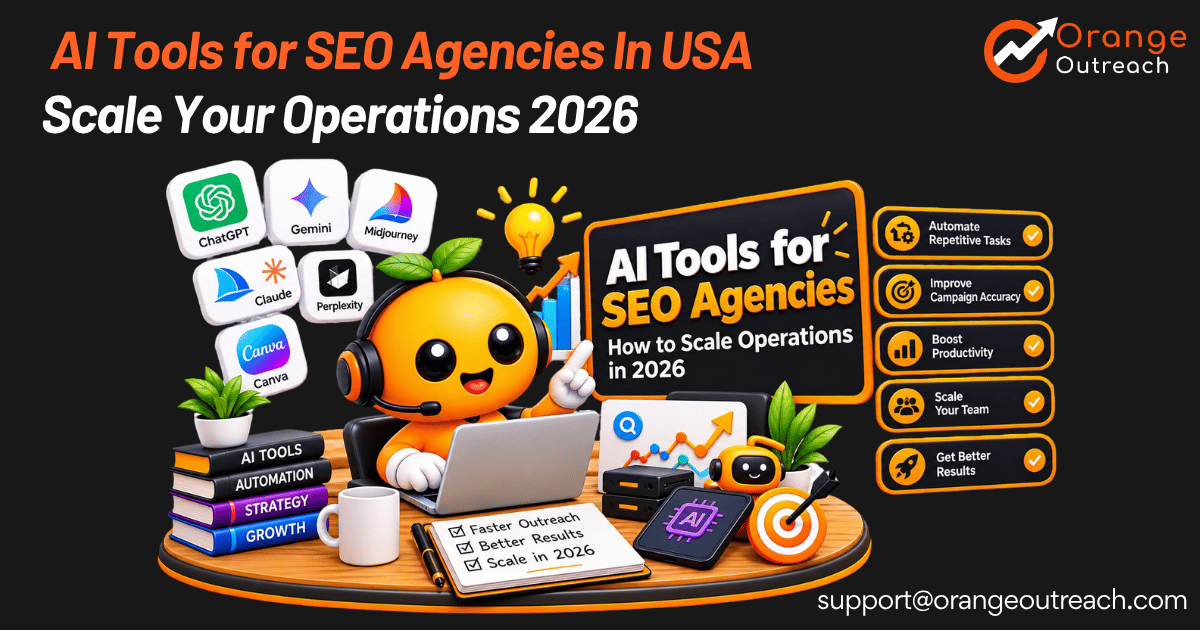
AI tools help SEO agencies scale operations in 2026 by automating repetitive tasks, accelerating keyword research, analyzing competitors, optimizing content, and streamlining link-building outreach. However, automation works best when combined with human expertise, quality control, and data-driven decision-making. SEO agencies can use AI tools to identify relevant backlink opportunities, personalize publisher outreach, monitor website performance, and improve reporting efficiency. For agencies managing multiple clients, partnering with a reliable white-label SEO and link-building provider like Orange Outreach can help expand delivery capacity without increasing internal workloads. Combining AI-powered workflows with relevant backlinks, accurate content, and strategic optimization supports sustainable SEO growth.
Key Takeaways
- You scale an SEO agency with AI by letting tools do the repeat work while your team handles strategy and final edits.
- Start with tasks that are easy to check.
- Always test AI keyword groups against real search results.
- Assign every draft one reviewer and a checklist.
- Track hours saved and client retention, not just articles published.
- Google doesn’t ban AI-assisted content, but it rewards helpful pages that show real experience, so add yours before you publish.
- Introduction
- What Does Scaling an SEO Agency With AI Mean?
- Tasks You Should Automate First
- Speeding Up Keyword Research With AI
- Producing Content Faster Without Losing Quality
- What Does a Good Review Process Look Like?
- How Do You Automate Client Reporting?
- Choosing and Pricing Your Tools
- Mistakes That Slow Agencies Down
- Where Should You Start This Quarter?
- Need More Link Building Capacity as You Scale?
- Frequently Asked Questions
Introduction
You scale an SEO agency with AI by automating the repeatable work, such as keyword clustering, content briefs, reporting and technical audits, and your people keep strategy, client calls and final editing. Agencies that follow this split take on more clients without hiring at the same pace.
Gartner predicted in February 2024 that traditional search engine volume would fall 25 percent by 2026 as people turn to AI chatbots (Gartner press release). That was a forecast, not a measured result, but the pressure on agencies is real: clients now expect faster output and content that shows up in AI summaries too. The right AI tools for SEO agencies make that pace possible.
Still, speed without a system creates sloppy work. In this article, we’ll show you which tasks to hand off, how to build a review process, and how to measure whether it’s paying off. It’s written for US agency owners and operations leads who want more capacity without lowering quality.
“At Orange Outreach we deliver white-label link building for US SEO agencies, so we see where agency workflows break first.”
What Does Scaling an SEO Agency With AI Mean?
Scaling means handling more clients and more deliverables without your costs rising at the same rate. AI tools for SEO agencies help by shrinking the time spent on first drafts, data pulls, and routine checks. It doesn’t replace the person who knows why a dental clinic in Phoenix needs different content than a SaaS startup in Austin.
Here’s a plain definition for you. AI tools for SEO are software products that speed up research, analysis, writing, and reporting tasks that used to be done by hand.
We’ve seen agencies get this wrong in a predictable way. They buy a handful of subscriptions, tell the team to “use AI,” and then wonder why quality drops and nobody saves time. The tools weren’t the problem. Nobody decided which jobs they were meant to take over. The best results come when you treat AI like a junior analyst. Give them clear instructions, and have a senior person check the output.
Tasks You Should Automate First
Start with work that’s repetitive, rule-based, and easy to check. If a task has a clear right answer and a person can verify it in two minutes, it’s a good candidate.
Most agencies get the fastest return from these three jobs.
- Keyword clustering, where you group thousands of search queries by shared intent
- First-draft content briefs built from the top-ranking pages
- Monthly report commentary that explains what changed and why
Leave anything that needs client context or judgment with your team. Link-building outreach, positioning for a new client, and decisions about what to cut from a site all belong there. AI can draft options, but it can’t know that your client’s founder dislikes a certain competitor. If your team doesn’t have the hours for outreach, a white-label link building partner can take that work off your plate without adding headcount
AI vs. Human: A Quick Task Split
| Task | Let AI Do the First Pass | Keep a Human on |
|---|---|---|
| Keyword Research | Clustering queries by search intent | Checking clusters against live search results |
| Content | Outlines, question research, and section drafts | Introductions, examples, statistics, and final editing |
| Technical SEO | Crawl flags and title and meta description drafts at scale | Prioritizing fixes based on business impact |
| Reporting | Commentary drafts based on monthly data | Adding context about migrations, stock issues, and competitor launches |
| Link Building | Prospect lists and initial research | Outreach, relationship building, and publisher vetting |
| Client Strategy | Options, recommendations, and possible scenarios | Positioning, priorities, and client discussions |
Speeding Up Keyword Research With AI
Keyword research is where most agencies feel the quickest gain from AI tools for SEO. Export queries from Google Search Console, Ahrefs, or Semrush, then paste them into ChatGPT, Gemini, or Claude with a short instruction to group them by what the searcher wants. Informational, commercial, and local queries get sorted in minutes instead of an afternoon.
A prompt to start with (adjust it for your niche):
Group the queries below by search intent (informational, commercial, transactional, local). Return a table with: cluster name, intent, a primary keyword, and whether the cluster needs its own page.
Flag any query where the intent is unclear instead of guessing.
Here’s the non-obvious part. Clusters from a language model look tidy and are often wrong at the edges. “Cost of knee replacement” and “knee replacement recovery time” may land in one group when they need two separate pages. Search a few queries yourself and see whether Google shows the same type of result for each. If the results differ, the queries need separate pages.
For bulk jobs, Screaming Frog (a site crawler) lets you connect an AI provider’s API key and run prompts against crawled pages. You can score title tags for relevance, flag thin pages, or draft meta descriptions for several hundred URLs in one crawl.
Used this way, AI tools for SEO give your strategists their afternoons back for the thinking that clients actually pay for.
Producing Content Faster Without Losing Quality
Content is the biggest time sink, and it’s where careless AI use does the most damage. The fix is to split the job into stages and hand AI only some of them.
Let AI tools for SEO handle outlines, question research, and first drafts of sections where the facts are stable. Keep humans on the intro, the examples, the statistics, and the final read. A writer who adds one real client story or one honest observation to a draft changes how the whole piece reads.
Google’s own guidance says appropriate use of AI isn’t against its rules, but mass-producing pages mainly to manipulate rankings is spam. Its advice is to focus on helpful, people-first content that shows experience, expertise, authoritativeness, and trust (Google Search Central guidance).
Answer engines like Google’s AI Overviews, ChatGPT, and Perplexity pull short, clear passages. Structure each page with a direct answer under every question heading, then support it with detail. Short, clear sentences are easier for AI tools to understand and use.
Draft checking is another job for AI, since a prompt can check every draft against a template. Does each H2 (a main subheading) open with a direct answer? Is the target phrase in the first 150 words? Is there a source for every number? It can run those checks on twenty drafts in the time an editor reads one.
One of the easiest ways to make an AI-assisted draft read as expert work: add a short “What we saw” box to each post with a real screenshot, number, or client result.
What Does a Good Review Process Look Like?
A review step is what separates an agency that scales from one that ships errors faster. Build it into the workflow rather than leaving it to whoever has time.
Give each draft one named reviewer and a short checklist covering facts, brand voice, keyword placement, and links. Any statistic needs a source link in the document before it passes, and anything the reviewer can’t verify gets cut.
A Simple 6-Point Review Checklist
- Every statistic has a source link and a date.
- Quotes, case names, and tool names exist and are current.
- Brand voice and US spelling are consistent.
- Target keyword appears in the title, H1, first 150 words, and one H2, without stuffing.
- Two to four internal links are added, and every external link has been opened and checked.
- A human added one original example, number, or screenshot.
Track what reviewers find. If they keep catching the same mistake, like invented quotes or outdated tool names, fix it in the prompt instead of in every draft. After a month, your prompts carry the lessons your editors learned, which is the real efficiency gain.
Hallucination (when a model states something false with total confidence) is the risk to take most seriously. It shows up most often with numbers, case names, legal citations, and medical claims. For clients in law or health (topics Google treats as high-stakes, often called YMYL, or “Your Money or Your Life”), treat every factual claim from an AI tool as unverified until a person confirms it.
How Do You Automate Client Reporting?
Reporting eats hours that clients rarely notice and agencies rarely bill. Of all the tasks agencies hand to AI, reporting automation pays back the fastest.
Connect Search Console, Google Analytics 4, and your rank tracker to Looker Studio, Google’s free dashboard tool, so the numbers update without anyone copying data. Then use AI to write the commentary. Feed it the month’s changes and ask for three sentences covering what moved, a likely reason, and a suggested next step.
Keep the human part. An account manager should read each summary and add context a model can’t see, like a site migration, a stock shortage, or a competitor’s launch. Clients can tell when commentary is generic and reads like filler.
Automation tools like Zapier, Make, or n8n can send the finished report on a set date and log it in your project tracker. A basic setup like this removes most of the monthly scramble.
Use one fixed commentary template (what moved, likely reason, next step) so every client gets the same quality. Account managers edit; they don’t write from scratch.
Choosing and Pricing Your Tools
Don’t buy by feature list. Pick one workflow, test two options on real client work for two weeks, and keep the one your team actually opens.
Most AI tools for SEO fall into three groups.
- General assistants like ChatGPT, Gemini, and Claude for drafting and analysis
- Platform features inside Ahrefs, Semrush, and content scorers like Surfer or Clearscope
- Automation connectors like Zapier, Make, and n8n that move data between everything else
Costs add up fast across a team, so audit usage every quarter and cancel what nobody touches. Price your services by outcome rather than hours. If AI cuts a brief from three hours to forty minutes, your client should still pay for a brief that ranks.
When you compare AI tools for SEO agencies, ask each vendor how it handles client data, since that answer matters more than any feature.
Three Vendor Questions to Ask Before You Paste Client Data
- Is our data used to train your models, and can we opt out?
- Where is our data stored, and how long is it kept?
- Will you sign a data processing agreement (DPA)?
Mistakes That Slow Agencies Down
The first mistake is publishing unedited drafts from AI tools for SEO. Readers spot text that says nothing, and clients notice when traffic stays flat after publishing.
The second is pasting client data into tools without reading the terms. Before you drop a client’s analytics or customer details into any assistant, check how the provider stores that data, and put the answer in your contract. Many agencies skip this until a client asks.
The third is automating a broken process. If your briefs are vague today, AI will produce vague briefs at ten times the speed. Fix the process on paper first, then speed it up.
The fourth is measuring the wrong thing. Articles published per week tell you very little. Track hours saved per deliverable, revision rounds per draft, and client retention. Those numbers show whether AI is lifting your margins or just lifting your volume.
Where Should You Start This Quarter?
Adopt AI tools for SEO agencies one task at a time, starting this week. Keyword clustering and monthly report commentary are the easiest places to begin, since both are quick to verify and low risk. Run them on two clients, time the old way against the new way, and write down what broke.
Then add a simple review checklist before you add a second task.
A 30-Day Starter Plan
- Week 1: Pick keyword clustering and monthly report commentary. Record how long each takes today.
- Week 2: Run both with AI on two clients. Time the old way against the new way.
- Week 3: Add a named reviewer and the 6-point checklist. Log every error you catch.
- Week 4: Compare hours saved and revision rounds. Decide whether to add a third task.
A year from now, the agencies that grew will be the ones that treated AI as part of the process, with owners, checklists, and numbers, and not as a shortcut. Your clients won’t ask which AI tools for SEO you used. They’ll notice whether the work arrived on time and ranked.
Need More Link Building Capacity as You Scale?
AI can speed up research and reporting, but links still come from real outreach and real publishers. Orange Outreach is a white-label link building and guest posting partner for US SEO agencies, built around a large publisher network with a link replacement guarantee. See our white-label link building services, compare white-label link building agencies in the USA [, or talk to our team.
Frequently Asked Questions
What are the best AI tools for SEO agencies?
There’s no single best tool. Most agencies combine a general assistant (ChatGPT, Gemini, or Claude), platform features inside Ahrefs or Semrush, and automation connectors like Zapier, Make, or n8n. Pick one workflow, test two options on real client work for two weeks, and keep the one your team actually uses.
Does Google penalize AI-generated content?
Not automatically. Google says appropriate use of AI isn’t against its guidelines, but mass-producing pages mainly to manipulate rankings is spam. Add real experience, fact-check every claim, and have a named person review each draft.
Which SEO tasks should an agency automate first?
Start with work that is repetitive, rule-based, and quick to verify: keyword clustering, first-draft content briefs, and monthly report commentary. Keep client strategy, positioning, and link-building outreach with your team.
How do I keep client data safe when using AI tools?
Read each provider’s data terms before pasting in client analytics or customer details. Ask whether your data trains their models, how long it’s kept, and whether they’ll sign a data processing agreement. Then write the answer into your client contract.
How should I price SEO services when AI saves time?
Price by outcome, not hours. If AI cuts a brief from three hours to forty minutes, the client is still paying for a brief that ranks. Track hours saved and client retention to see whether your margins are really improving.
Also Read: Best Link Building Packages for SEO Agencies